

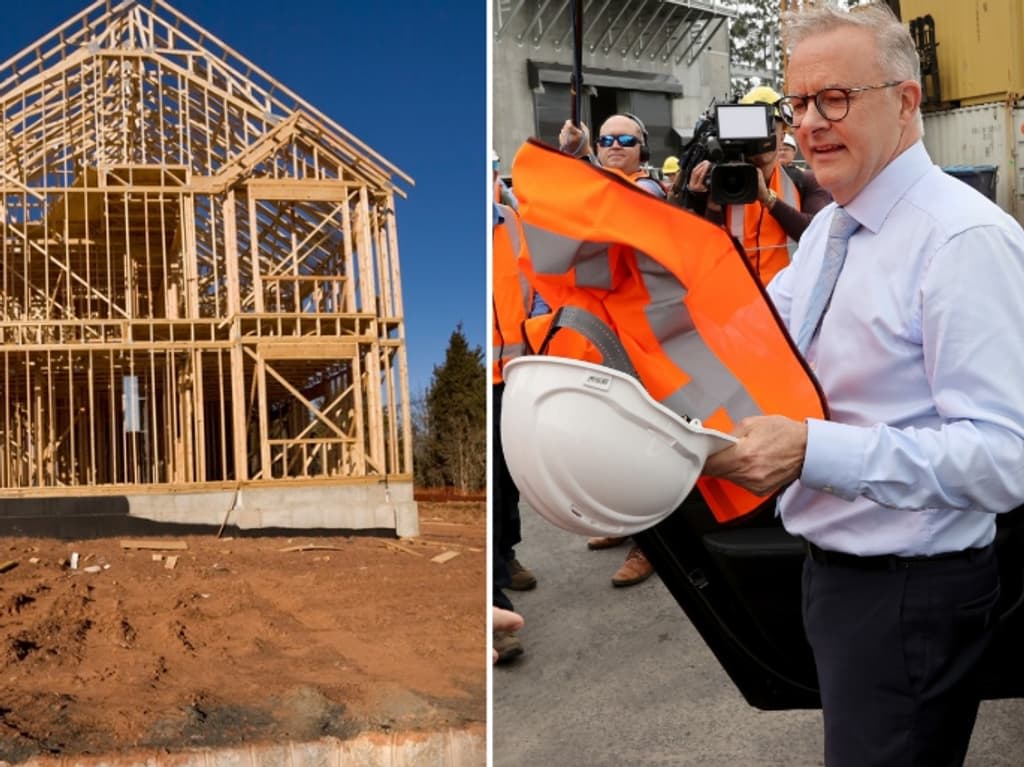
Australian new home completions are more than 80,000 short after two years of Anthony Albanese’s National Housing Accord.
Australia’s housing pain is set to get worse with the nation more than 80,000 new home builds short after two years of a national effort to build its way out of a housing crisis.
Australian Bureau of Statistics data released today show since the commencement of the National Housing Accord, a 1.2 million new home building goal set by the Albanese government to tackle the nation’s housing crisis in 2024, there have been just 355,817 new homes built.
It is barely above the 352,463 completed in the prior two years.
Home approvals drop, apartment plunge threatens Albanese target
Australians spend record $100bn on new homes amid tradie shortage
To hit the 1.2 million homes target, the nation needed to build 480,000 new residences.
While the ABS data shows more of an improvement for new home commencements, which hit 204,502 in the past financial year, up substantially from the 180,518 in the prior 12 months, even that was still short of the national target by almost 95,000 homes.
And it’s the nation’s biggest states that are lagging, with Victoria and NSW both completing thousands fewer new homes in the past in the past two years compared to the prior two in a further sign the Accord is failing to fire.
The difference in completions is being made up by increases in South Australia, Western Australia and Queensland.
Australia needs more than a million new homes to address its housing crisis as population growth continues to strain the nation’s existing supply.
Since the Accord started, Victoria has led the nation having built 112,599 new homes, but built more than 118,000 in the two years ending at June, 2024.
Property Council Victorian executive director Cath Evans said the figures were even worse when considered against separate targets from the Victorian government.
“We continue to fall well short of the Victorian Government’s own target of 80,000 homes a year, or 800,000 homes over the next decade, as set out in the 2023 Housing Statement,” Ms Evans said.
“Victoria’s population is growing, but housing supply is not keeping pace. Without serious reform, the industry cannot deliver the homes Victorians urgently need.”
It was followed by NSW at 91,954 — but their completions were below the 95,303 finished off in the prior two years.
ABS dwelling completions by state over the past few years.
Queenslanders have added 68,694 new homes to the state, Western Australia has built 42,189 and South Australia 26,625.
There have been 7863 homes finished in the ACT, outpacing Tasmania’s 4842 new residences.
The Northern Territory has built just 1240 new homes.
While the numbers are improving, industry groups have warned they have fallen well short of population growth and the homes not built are starting to add up.
HIA senior economist Tom Devitt said neither the completions nor the commencements data had yet to be impacted by interest rate hikes and the impact of the Iran war on building costs, nor the federal government’s changes to investor tax benefits that have sparked warnings of reduced new home building in the future.
Mr Devitt said NSW and Victoria would be “more vulnerable” to housing construction slow downs, given their recoveries have been more tentative prior to headwinds emerging this year.
The nation’s two biggest-building states are facing an uphill battle as their numbers stall out.
“Our latest forecasts do have a softer year next year, so 2027 and 2028 will be where those figures come through,” he said.
Real Estate Institute of Australia president Jacob Caine said the “alarming” data release had confirmed what property industry insiders had already known for the past two years.
“That the government is failing to reach that National Housing Accord target, and failing dramatically,” Mr Caine said.
“The product of this is that housing in Australia continues to be incredibly unaffordable and inaccessible, and those less fortunate in society are being left further and further behind.”
He added a warning that modelling with HIA, Master Builders, his organisation and the Property Council had shown a federal government decision to change investor tax settings at the May budget would lead to further degeneration in home building activity.
Building industry groups are also increasingly worried about impacts on the number of new requirements facing their members impacting their ability to get the job done.
Master Builders Australia chief executive Denita Wawn said it was important to remember that 98 per cent of the construction industry is made up of small <a href="https://industrymovement.com/tracy-brabin-rules-out-business-class-flight-for-india-trip/” title=”Tracy Brabin rules out business class flight for India trip”>businesses and recent policy decisions were impacting their ability to survive.
“Recent policy decisions have been death by a thousand cuts for small building businesses at exactly the time Australia needs them delivering more homes and critical infrastructure,” Ms Wawn said.
“Each new measure, whether it be the Australian Taxation Office’s credit card ban, the upcoming changes to trusts or the changes to property investment, is adding to the growing burden on the small businesses responsible for building Australia.”
MORE: ‘Too little, too late’: Victoria’s land tax revenue falls $1bn short amid exodus
Shock as every Aussie household to lose $120k to downturn
Silent $16.6b worry behind record reno spending
