

Add to Google Preferred Sources
President Lee Jae-myung on the 30th put eradicating real estate speculation at the forefront of his national agenda, announcing sweeping financial and tax reforms alongside a major expansion of housing supply. Pointing to the sharp decline in Seoul metropolitan area permitting and construction starts, he proposed delegating approval authority for developments of 500 units or fewer to district mayors, while emphasizing “surgical support” for young people and genuine end-users. He also cited forecasts of a 3.5% base rate by Q1 next year and rising mortgage delinquency and auction figures as a caution to investors. The government is preparing a system to purchase homes below a certain threshold in bulk for public housing purposes as a safeguard against a sharp price collapse. Experts noted that while rising rates could dampen buyer sentiment, supply shortages in the capital region and rising jeonse and monthly rent prices are supporting the floor on home prices, making a large-scale crash unlikely.
Key Elements
President Lee Jae-myung has placed eradicating real estate speculation at the top of his national agenda, announcing a comprehensive response spanning supply expansion, tax reform, and financial support. On the 30th, via his X (formerly Twitter) account, he declared: “A government of popular sovereignty will, by any means necessary, dismantle the ruinous real estate speculation that has plagued this nation,” adding that “the full capacity of the state will be mobilized not only for financial and tax reforms but also for expanding housing supply volumes and accelerating delivery.”
He stressed that the irrational tax system that has fueled speculation would be corrected in the name of tax justice. “For the hope of the next generation, we must eliminate the ‘hot potato’ game of real estate speculation and the risk of another lost 30 years,” he explained.
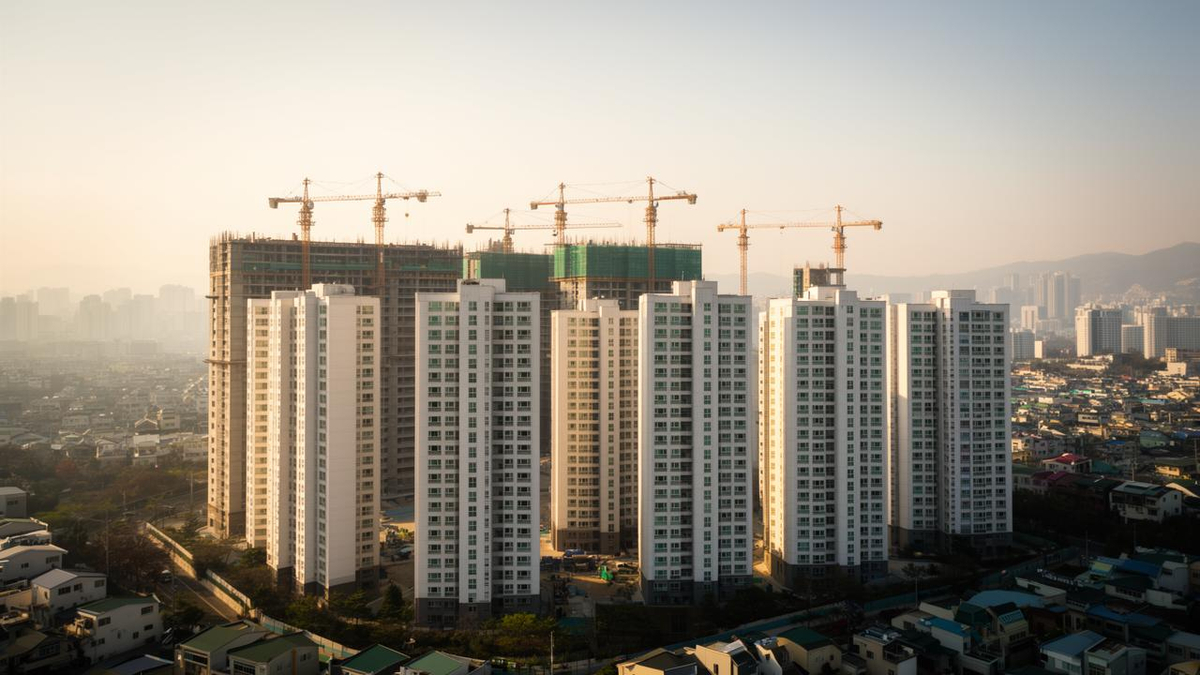
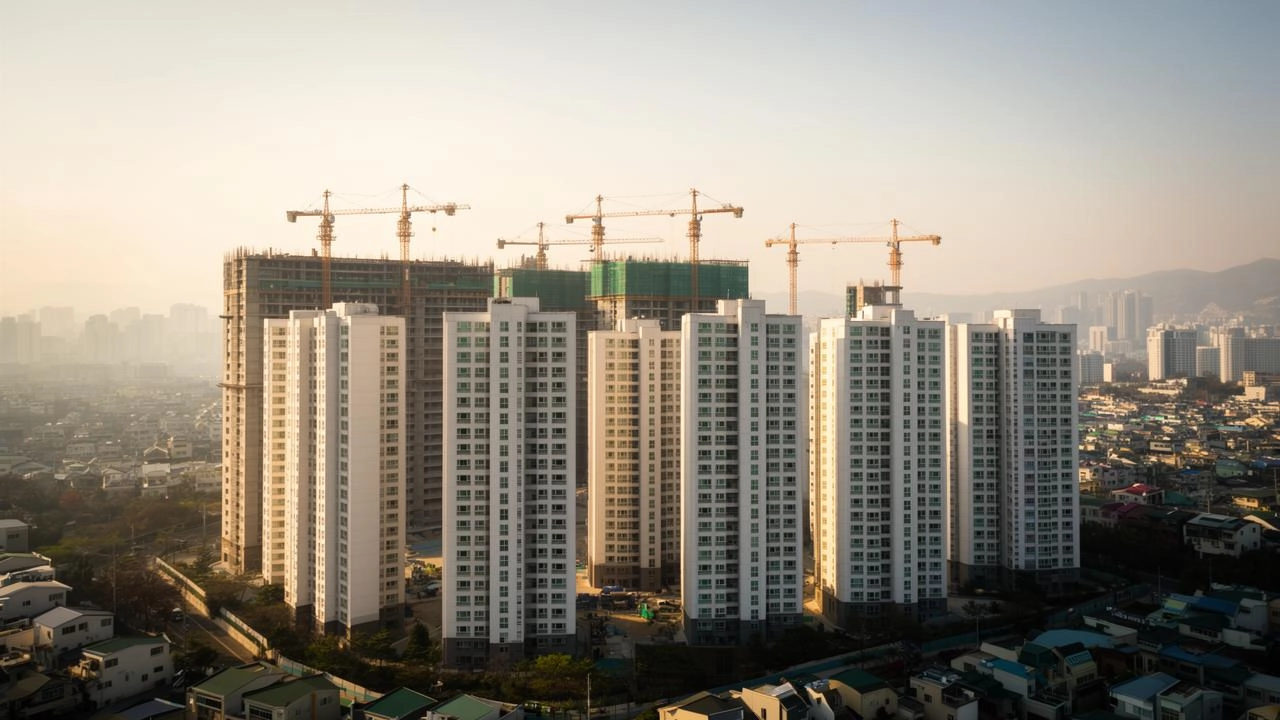
He also outlined specific measures to resolve supply bottlenecks. Noting that permitting and construction starts in Seoul and the capital region have fallen sharply for more than three years since 2022, he plans to delegate approval authority for housing developments of 500 units or fewer to district mayors to accelerate project timelines. Responding to criticism that expanding loan volumes while tightening financial conditions is contradictory, he countered: “Expanding finance to increase housing supply, or increasing lending for young people and other genuine end-users, is precisely the kind of surgical policy that must be pursued.”
This supply contraction is clearly visible in the data. According to housing statistics released by the Ministry of Land, Infrastructure and Transport on January 30, nationwide housing permits plunged from 506,000 units in 2022 to 426,000 units in 2023, rebounded slightly to 435,000 units in 2024, but fell again to 379,800 units in 2025, a year-over-year decline.
| Year | Permits Issued | YoY Change |
|---|---|---|
| 2022 | 506,000 units | — |
| 2023 | 426,000 units | -15.8% |
| 2024 | 435,000 units | +2.1% |
| 2025 | 379,800 units | -12.7% |
uary 30, 2026; e-Narajipyo housing construction permit data)
The countermeasures unveiled by President Lee span three pillars — supply, taxation, and finance — plus a safety net against a market crash.
Rate and Delinquency Warning Signals
He also delivered a message cautioning against market overheating. Citing an article on global investment banks raising their growth forecasts for the South Korean economy, President Lee emphasized that particular attention should be paid to the projection of “a 3.5% Bank of Korea rate by Q1 next year.” The Bank of Korea raised its benchmark rate by 0.25 percentage points to 3% per annum on the 27th. This marks the second consecutive monthly hike following July.
The unusual nature of this hike becomes clear when examining the trajectory of the Bank of Korea’s benchmark rate.
| Period | Benchmark Rate | Change | Notes |
|---|---|---|---|
| 2023.01–2024.09 | 3.50% | Held | 13 consecutive holds, longest on record |
| 2024.10–mid-2025 | 3.50%→2.50% | Cut | Rate-cut cycle in response to low growth |
| 2026.02.26 | 2.50% | Held | — |
| 2026.07.16 | 2.75% | +0.25%p | First hike in 3 years and 6 months |
| 2026.08.27 | 3.00% | +0.25%p | Second consecutive hike; first back-to-back since the 7 straight hikes from Apr 2022–Jan 2023, 3 years and 7 months ago |
While stating that “the government does not and cannot intervene in interest rates,” he cited the rapid recovery from low growth as the backdrop for potential additional hikes. He also added that attention should be paid to rising mortgage delinquency rates, increasing auction listings, and auction success rate trends.
The government is also preparing a safety net against a potential sharp decline in home prices. He announced that he has directed the establishment of a system to purchase homes below a certain threshold in bulk for public housing purposes, should prices collapse due to expanded supply, curbed speculative demand, and rising delinquencies and auctions driven by high interest rates.
Experts: “Crash Unlikely”
Experts, however, assessed that while rising rates could dampen buyer sentiment and slow the pace of price appreciation, the likelihood of a mass sell-off and sharp price decline is limited. The reason: supply shortages in the capital region and rising jeonse and monthly rent prices are underpinning home prices.
Ham Young-jin, head of Woori Bank’s Real Estate Research Lab, analyzed: “The lull in transactions caused by high home prices, rising mortgage rates, and household loan caps is expected to persist through year-end. Demand for mid-to-low-priced homes with high loan dependency and buying activity among those in their 30s could be affected.” For a borrower with a 500 million won (approximately $360,000) mortgage, a 0.25 percentage point rate increase adds roughly 1.25 million won (approximately $910) in annual interest costs by simple calculation.
Lee Eun-hyung, research fellow at the Korea Construction Policy Institute, said a rate hike is unlikely to immediately trigger an increase in listings. “Single-home owners largely have genuine residential demand, making it difficult for them to suddenly sell just because rates rose — and there isn’t an oversupply of alternative jeonse properties available,” he explained. The fact that household borrowing has already been constrained by the stress debt service ratio (DSR) and lending regulations was also cited as a factor reducing the likelihood of a crash.
If high rates persist, there is a possibility that delinquencies and auctions could increase, concentrated among vulnerable borrowers with high loan exposure. However, Lee added: “While it is true that rate changes burden variable-rate borrowers, it is difficult to expect this alone to produce a meaningful increase in market listings.”
President Lee emphasized a “quiet reform” approach that minimizes resistance from vested interests during the reform process. “Making bold claims is the role of those challenging for power; the role of those who have already seized power is execution and results,” he said. “There is no need to shout loudly and thereby strengthen the anxiety and resistance of vested interests.”
Once added, BigGo Finance appears first in Google Search Top Stories, so you get the broadest, most up-to-the-minute, and most comprehensive global financial news first.
