

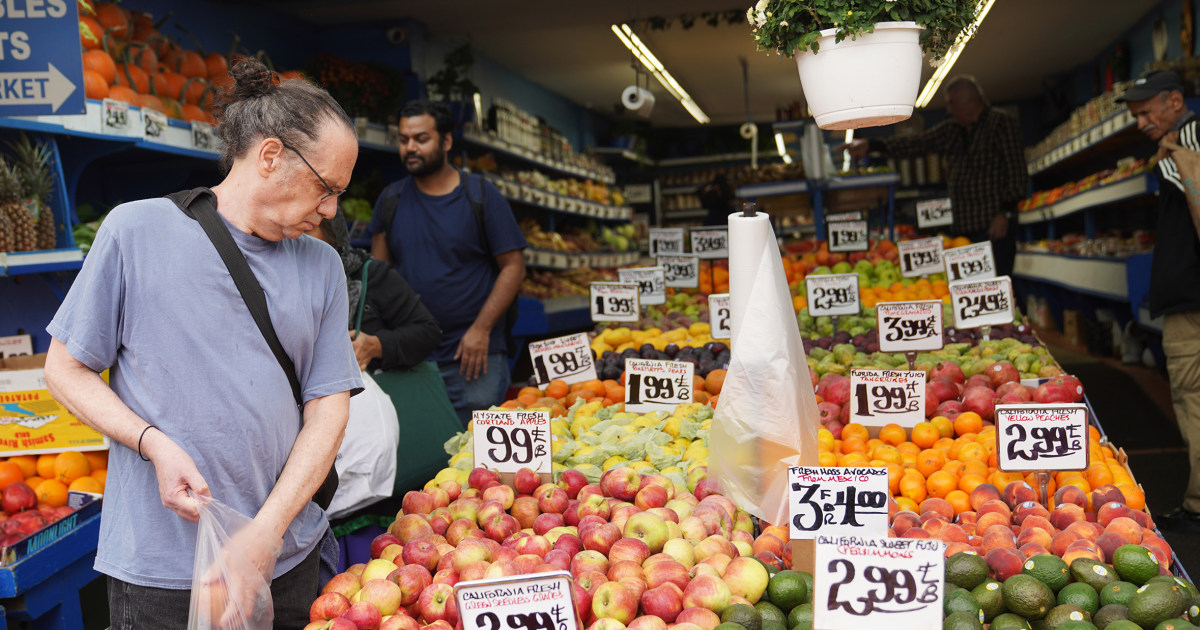

Report shows inflation rose 0.4% in October
03:01
Get more newson
Nov. 10, 2026, 8:32 AM EST / Updated Nov. 10, 2026, 11:28 AM EST
Prices rose 0.4% in October after the rising cost of gas eased throughout the month, bringing slight relief to consumers who have been hammered by high prices for most of the year.
In September, prices had jumped by 0.6% from August, meaning the pace of inflation cooled last month, but it nonetheless remains too elevated for comfort.
Core inflation, which excludes food and energy prices, rose 0.3% from September for the third straight month. Both readings from the Bureau of Labor Statistics were higher than economists had widely expected, underscoring the affordability pressures Americans faced as they voted out incumbent Republicans in last week’s midterm elections.
A higher-than-expected core inflation reading indicates soaring energy prices could be spilling over into the broader economy.
Price growth also continues to outpace wage increases, adding to strain on consumers. Diane Swonk, chief economist at KPMG, described the situation as “the worst bout of inflation relative to wage gains since the 1970s.”
Tuesday’s report includes no year-ago figures because of the government shutdown in October 2025, which forced the BLS to cancel that month’s inflation report.
Diesel prices spill over
The pace of inflation slowed slightly was largely the result of easing gas prices last month, which, according to motor club AAA’s average, fell from $4.41 per gallon Oct. 1 to $4.18 by the end of the month, a more than 5% drop.
But the BLS’ report showed that the overall gas price index still rose a solid 1%, even as the average nationwide price for a gallon of unleaded fell. Home heating oil also rose 2% from September, and electricity prices rose 0.9%.
Top White House officials acknowledged that inflation was troubling and had been worse than expected.
“It’s not a good number,” said Chris Phelan, chairman of the White House Council of Economic Advisers.
“I think that’s what we’re seeing is higher gas and diesel prices, due to high oil prices, filtering through the economy,” Phelan told Bloomberg TV.
He also described the inflation situation as a “cloud” over the economy. “I don’t want to say that this is a good number; it’s not.”
Kevin Hassett, director of the National Economic Council, called it “a disappointing report.”
“Right now, the trickle-down from the higher energy prices is definitely very palpable in the data,” he told Fox Business Network.
Earlier Tuesday, AAA data showed that average nationwide gas prices had fallen below $4 per gallonfor the first time since July. In early trading, oil prices continued their recent sharp descent. Brent crude oil briefly tumbled below $90 after having been as high as $118 on Oct. 30.
But diesel fuel prices are 70% higher than at the start of the year, a far larger increase than regular gas experienced. Diesel is a major input cost for the transportation industry that delivers goods, such as groceries, to store shelves around the world.
Baby formula and groceries hit hard
Several other major consumer categories also put up strong rises over the month. Hospital services, vehicle insurance, dairy, and fruits and vegetables all showed large month-over-month price increases.
The price of baby food and infant formula posted its largest increase ever in October, rising 5.1%.
The price of smartphones also rose a record 1.4%, with prices most likely pushed higher by the AI boom. A demand for memory for data centers has caused dozens of consumer electronics companies, such as Apple, to hike prices.
The “food away from home” category, which essentially measures restaurant and takeout food prices, rose 0.5%.
Meanwhile, the “food at home” category, which follows grocery prices, rose the most since April.
Economists have repeatedly warned since the U.S. and Israel launched the Iran war in February that the unprecedented surge in diesel fuel prices could easily translate into higher food costs, given that diesel powers the trucks that transport those goods around the world.
“Beyond AI, strong prints in categories like household furnishings, which saw the fastest rise since mid-2025, raises questions about whether tariff passthrough is actually complete and/or second round effects from higher energy costs are beginning to show up,” economists at Deutsche Bank said.
Physicians’ services also jumped a similar amount, as did airfares. The price of new vehicles rose in October, although used car and truck prices fell by a sharp 1.2%.
Just weeks before the holiday season kicks off in earnest, the BLS reported that toy prices rose 1.8% in October.
The interest rate debate
There is a lot riding on this month’s inflation data. Economists had expected overall inflation to rise 0.3% and core inflation to rise 0.2%.
But even before Tuesday’s report, Federal Reserve governor Christopher Waller was significantly raising the stakes for what October’s inflation would mean.
“While I am hoping for an improvement over September, even if this occurs, I would still support a 25 basis-point increase” at the Fed’s Dec. 8-9 interest rate meeting, Waller said in a speech at a central banking conference in London earlier Tuesday.
“Let’s just say it. September’s inflation data were bad. There was no silver lining,” he continued. In September, inflation was on the upswing again and hit 3.7% on a year-over-year basis.
He surprised investors by going a step further, however.
“If inflation comes in substantially higher than I expect, more robust action by the [Fed] may be called for,” he said.
Specifically, if core inflation were to rise by 0.3% or higher, “I believe a 50 basis-point hike in the policy rate should be considered at the December meeting.”
Holiday hiring forecast: Where to look for short-term gigs
03:39
The Fed has not hiked interest rates by a half-percent in one sitting since 2022.
The central bank traditionally favors multiple hikes of 0.25% in succession, so members can watch how each rate increase plays out.
“Hiking only 25 basis points would put our credibility at risk, a risk I am not eager to take,” Waller concluded.
Shortly after Waller spoke, the BLS announced that core inflation had, indeed, risen by 0.3% last month.
Hours later, Dallas Fed President Lorie Logan supported Waller’s idea, saying the Fed “needs to implement at least two more 25 basis-point rate increases.” She added, “It may be possible to move more rapidly.”
Stocks fell in response to the data, led by the interest-rate- sensitive tech sector, followed closely by materials and industrial stocks. Those sectors are highly exposed to rate increases, as they raise hundreds of billions of dollars to build and fill up sprawling data centers.
U.S. Treasury yields moved sharply higher on the data, which could make mortgage loans more expensive if it holds up. And a Fed rate hike, of any magnitude, could make matters worse.
The 10-year Treasury yield again neared 5% Tuesday for the first time since the end of October.
Stocks fell in early trading Tuesday before they steadied midmorning to trade flat across the major indexes.
