

In the era of agentic AI, the constraint is no longer producing analysis. Instead, it is defining the task as well as deciding exact outputs, whom to send, what to believe and what to ignore. In other words, the binding constraint is leadership.
Mike is inventive but often makes suggestions that can be impractical. Jane is precise like a Swiss engineer but can lose sight of the big picture.
Good managers know their team members’ strengths and help direct them accordingly.
“Mike, find an unconventional way to solve this problem.”
“Jane, audit our assumptions and every piece of code.”
On the surface, this scenario is no different than those managers have always faced. In this case, however, something is new. Neither Mike nor Jane are human. They are AI agents and sub-agents working together.
AI Agents Create a New Management Constraint: The Manager
Directing AI agents is not unlike managing a talented but imperfect team. Just like with human teams, the crucial role of the manager is to assign work based on their skills and the individual constraints of each member. Managers anticipate key challenges, intervene when the team is stuck and decide when the final product is ready.
But there is one crucial difference: Agentic tools such as Codex, Claude Code and Grok Bot can tailor your team for every task. Add more skeptics if you want more assurance nothing is wrong, replace a generalist with a specialist, have more creative geniuses go for a long shot or reserve a more capable (i.e., expensive) model for the highest-stakes decision while more cost-efficient subagents churn through the data. As the cost of AI usage for firms explodes, prudent matching of model capabilities to tasks is a key task for managers.
When Intelligence Becomes Abundant
In times immemorial (that is, about five years ago), the scarce input was analytical intelligence. Generating serious analysis required scarce expert time and armies of relatively inexperienced apprentice-level analysts to churn it out. The ability to transform capital and electricity into “thinking” has fundamentally altered that calculus, just as the ability to transform coal into physical movement upended manual labor during the Industrial Revolution.
Now, at lightning speed, AI agents can produce first-pass analyses on complex tasks, summarize and verify information and draft high-quality reports of their findings. While AI can still produce the famous hallucinations when not managed well, it is making analytical reasoning abundant and cheap.
A leader can now request 10 forecasts instead of one and ask multiple agents with different profiles to criticize every recommendation. Yet, the human capacity to read, evaluate and act has not increased at the same rate, with even agentic AI power users reporting anecdotally that they are only able to manage less than five parallel agentic workflows.
Effectively, agentic AI is reversing the traditional managerial bottleneck.
What does this change mean for business school? The good news is that agentic AI demands the exact core competency the MBA tries to foster. Some of the most important skills developed through an MBA and needed for the AI age include:
1. Judgment under uncertainty
Agentic AI can produce an excess of information. Consider a chief executive evaluating an acquisition. Agents can produce valuation models, estimate synergies, identify integration risks and summarize precedents under near unlimited scenarios. AI can make compelling arguments both for and against the transaction.
As a result, the manager’s task becomes, in some ways, harder. Information overload is a real threat and the choice which analysis to take seriously becomes crucial.
2. Learning quickly on both the micro and macro level
Over the coming years, AI agents will fundamentally reshape all white-collar business processes. While most organizations will ultimately fall into a new steady state of tried-and-true agentic workflows for routine activity on the micro level, the leaders who grasp the potential of the new technology can set new internal standards for these processes, if they are able to stay on the edge of innovation—the macro level.
3. Leading teams
Understanding the strength and weaknesses of your team, efficiently allocating tasks with big picture guidance, generalizable rules and specific behaviors, giving feedback on work, and distilling outputs down to their core has a name: leadership.
Direction becomes more important as execution becomes cheaper. A poorly chosen objective can now be pursued faster, more consistently and across more decisions. AI multiplies not just good judgment but also bad judgment. Leading AI agents does not consist of asking the machine for an answer. Defining the right problem and outlining the workflow, monitoring progress closely all while controlling cost becomes the core contribution of the human in the loop.
Business education becomes both more important and more demanding in light of these developments.
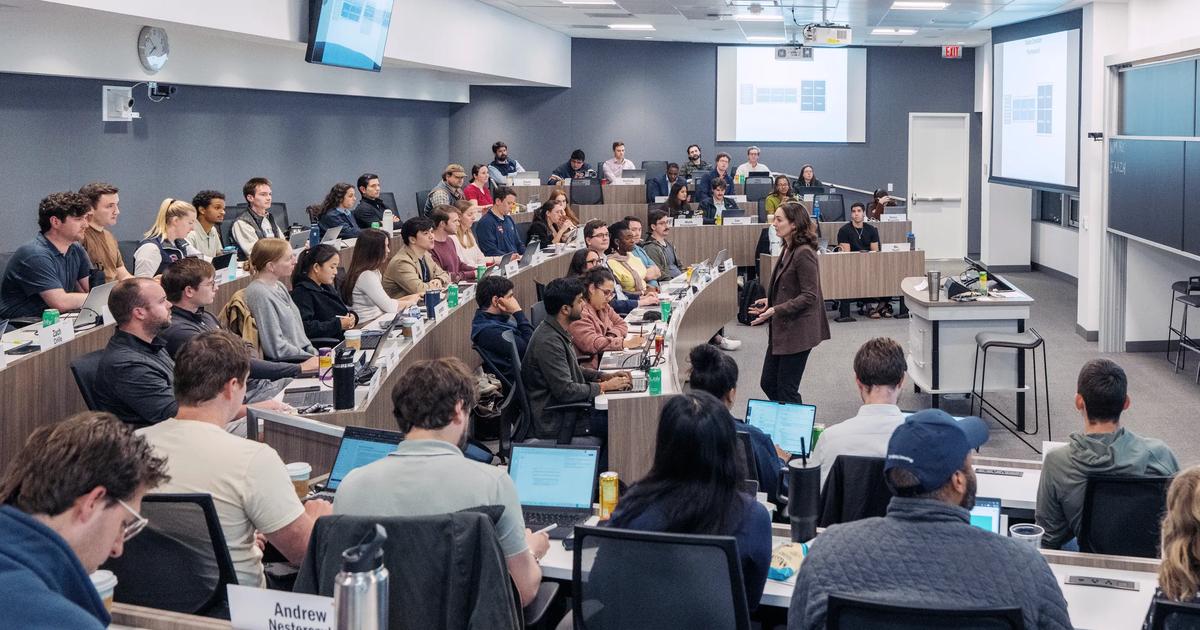
The case method, which is used extensively at the University of Virginia Darden School of Business where I teach, trains students how to absorb and process vast quantities of data and background, while prioritizing the core question at hand.
The Socratic method and teamwork modeled in and out of the classroom create a dynamic environment that prepares students to critically question arguments that sound plausible at first, then hone in on what matters through iteration and discourse.
That resembles the work of an AI-era leader more closely than a classroom organized around lectures that, ultimately, reproduce one correct answer.
The managerial advantage of the future will not belong to the person who can produce the most analysis. Machines will produce more analysis than any leader can absorb. Advantage will belong to the person who knows what to ask, how to delegate tasks, which answers to trust, and when to stop analyzing and decide.
Topics
Artificial Intelligence,School News
Story Type
Article
About UVA Darden School of Business
The University of Virginia Darden School of Business prepares responsible global leaders through unparalleled transformational learning experiences.
Darden’s graduate degree programs and Executive Education & Lifelong Learning programs offered by the Darden School Foundation set the stage for a lifetime of career advancement and impact.

Senor Director of Communications
