

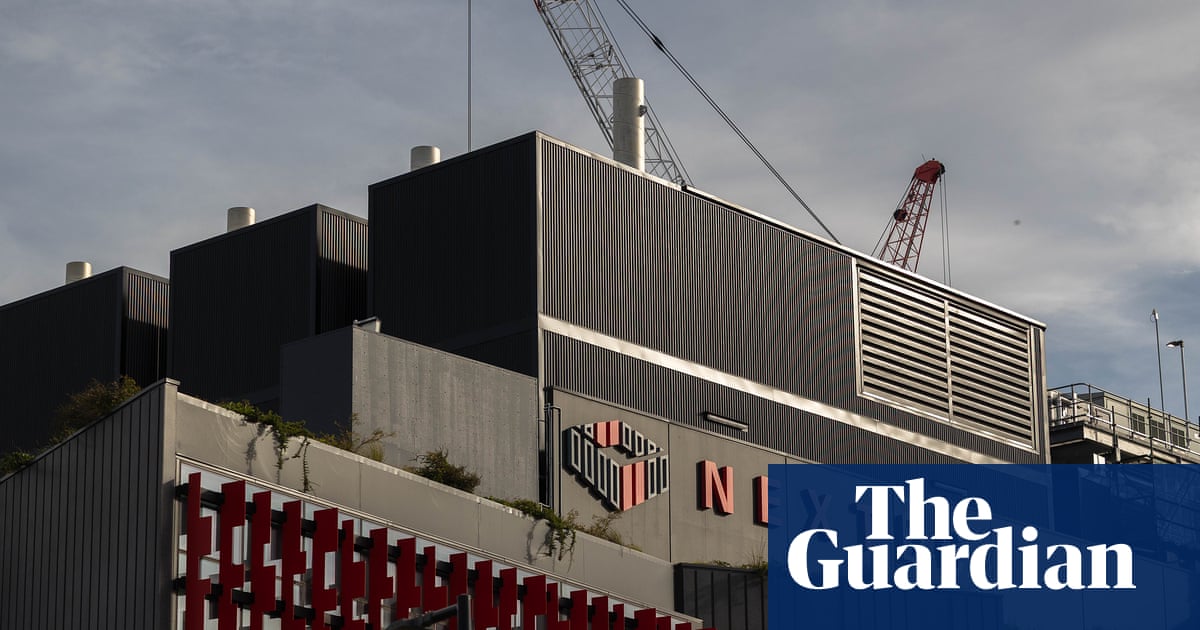
Victoria was ‘ruthless’ in its quest to become the datacentre capital of Australia. Why has it hit the brakes?
With community concerns about datacentres becoming impossible to ignore, the state Labor government has changed course
Follow our Australia news live blog for latest updates
Get our breaking news email, free app or daily news podcast
In the private dining room of Government House, Jacinta Allan was assiduously taking notes as waiters served a three-course meal made with local ingredients and accompanied by Victorian wines.
Sitting around the table at the meeting in March were leaders of artificial intelligence companies and datacentres, hand picked by the governor’s office for a discussion about the future of the industry.
The peak body for datacentres spoke about the investment opportunities presented by its members. Academic researchers and AI executives spoke about Victoria capitalising on the booming industry.
As discussion wrapped up, for economic growth and jobs, Danny Pearson. His message, according to those in the room, was simple: how can we help you?
The conversation continued as the group, including a department secretary and senior government advisers, moved to the historic billiard room for coffee.
“We were very encouraged and we hoped it would be followed up with a formal working group and more engagements, but there’s been nothing since,” says oneak freely
This formal dinner wasn’t the first time Victorian ministers had supped with AI leaders and datacentre executives.
In late January, Pearson dined with the world’s biggest datacentre companies and thetrillion-dollar chip maker Nvidia in the corporate suites of Rod Laver arena. The small group then watched Novak Djokovic win his Australian Open quarter-final match against the Italian, Lorenzo Musetti.
Ministerial diaries show Pearson and other ministers held more than a dozen meetings with AI and datacentre executives in the first three months of this year, reflecting the government’s determination to make Victoria the “datacentre capital of Australia”.
“We’re going to be ruthless about it,” the then-premier told an economic forum in November, flagging up to $25bn in capital expenditure in the state.
But in the middle of the year, something changed within Labor.
Community concern about datacentres in Victoria and elsewhere was becoming impossible to ignore. A change of premier in July, forced in part by dire opinion polls, led to a rethink of several government policies.
Cabinet ministers emboldened by community opposition felt at liberty todirectly rebuke some of the industry’s leading figures. Constituents upset about datacentres started receiving replies from ministers, rather than from public servants.
And a plan for stricter rules for datacentres – which had been delayed for several months – was finally approved by cabinet and announced earlier this week.
Some datacentre executives and government insiders admit they were surprised by the strength of community opposition and are recalibrating ahead of an election.
‘The government’s view has evolved’
Labor’s sensitivity to community concerns about datacentres was made clear in the days before its sustainable datacentre action plan was announced on Tuesday.
The jobs minister, Melissa Horne, accused the chief executive of ASX-listed datacentre giant NextDC, Craig Scroggie, of using artificial intelligence to lobby for hersupport of a controversial AI factory in Melbourne.
“I do not believe that it would be appropriate for me to lend my support to the application and nor do I wish to,” wrote Horne, a factional ally of the now premier Ben Carroll.
Horne’s unusually terse letter to Scroggie was published on social media by the Labor MP for Footscray, Katie Hall, who had been campaigning against the expansion of NextDC’s datacentre in her electorate.
The datacentre, known as M3, is in an industrial area but some residential homes are within 15 metres of its boundary. The company’s application for fast-tracked approval to build over 10 hectares has generated heavy media coverage.
Hall is under pressure from the Greens, who are eying the marginal seat. The minor party recorded a 13.9% swing from Labor at the last election and is confident it can secure the remaining 4.3% of votes to clinch victory.
Hall, along with Horne, is among the Labor MPs urging the government to slow its embrace of datacentres. She says she’s made sure colleagues visiting her electorate see how close M3 is to homes.
“The government’s view has evolved because of advocacy from members of the Labor caucus on behalf of their communities,” Hall says.
“Labor MPs who know and understand their communities and talk to their constituents all the time have been doing their job, as they should, raising these issues in caucus and advocating for change.”
‘Legitimate concerns’
Sean Brown says he’s watched the government’s attitude to datacentres change over the past few months. His group, Citizens of Tottenham, is a vocal opponent of the M3 expansion.
Brown says when he first discussed the issue with Hall in her office in March, she mostly listened and took notes. But at a subsequent meeting that month, he says his local MP was more forthright in her opposition. She was also accompanied by an adviser to the planning minister, Sonya Kilkenny.
When Brown started writing to ministers about datacentres earlier this year, it was public servants who replied to him, politely thanking him for raising his concerns. A former public servant himself, he believed this meant ministers “didn’t want to deal with it”.
“It felt like they didn’t care,” says Brown. “It seemed that all they cared about was investment from the datacentre industry.”
But Brown says that changed around July, when ministerial staff started replying. In early August, Brown received a two-page letter signed by the minister for growth and jobs, Steve Dimopoulos.
Dimopoulos, who was moved to another ministry not long after writing to Brown, told him datacentres were an important part of the economy and the government was committed to ensuring they continued to invest in the state.
But he acknowledged also the pace of investment had caused genuine concerns that needed to be dealt with.
“I recognise that the scale and pace of recent investment can raise legitimate concerns for nearby communities, particularly where industrial activity is located close to residential areas,” said Dimopoulos.
Industry ‘catastrophising’
The Victorian government says its new rules on datacentres are the strongest and clearest in the country. They create a buffer zone of 150m between datacentres and homes and mandate “fair community consultation”.
“Labor is going in a new direction,” says a government spokesperson. “In Victoria, we set the rules. Datacentres must power themselves, protect homes and pay their way.”
But the peak body for datacentres has made no secret of its disappointment. It warns the new rules, which also force datacentres to use renewable energy, could cause investment to flow to other states.
“Other states have seen the opportunity, and they are lining up for it,” says Belinda Dennett, the chief executive of Data Centres Australia.
The government disagrees, pointing to statements from numerous datacentre companies welcoming clarity about the regulations.
The minister for artificial intelligence, Anthony Carbines, told the ABC’s Raf Epstein that Dennett was “catastrophising”.
“There is no evidence from Data Centres Australia that any investment is leaving our state,” Carabines told the ABC.
Dennett declined to respond to those comments. But evidence of a flow of money out of the state may soon appear.
Earlier this month, Queensland premier, David Crisafulli,flew to the US to secure a $31.9bn deal with the AI giant Anthropic for what could be Australia’s largest datacentre. This week, he told an energy forum that more deals were coming.
“Why would I give advice to other states when we are the beneficiary of decisions they are making?”
Explore more on these topicsReuse this content
