

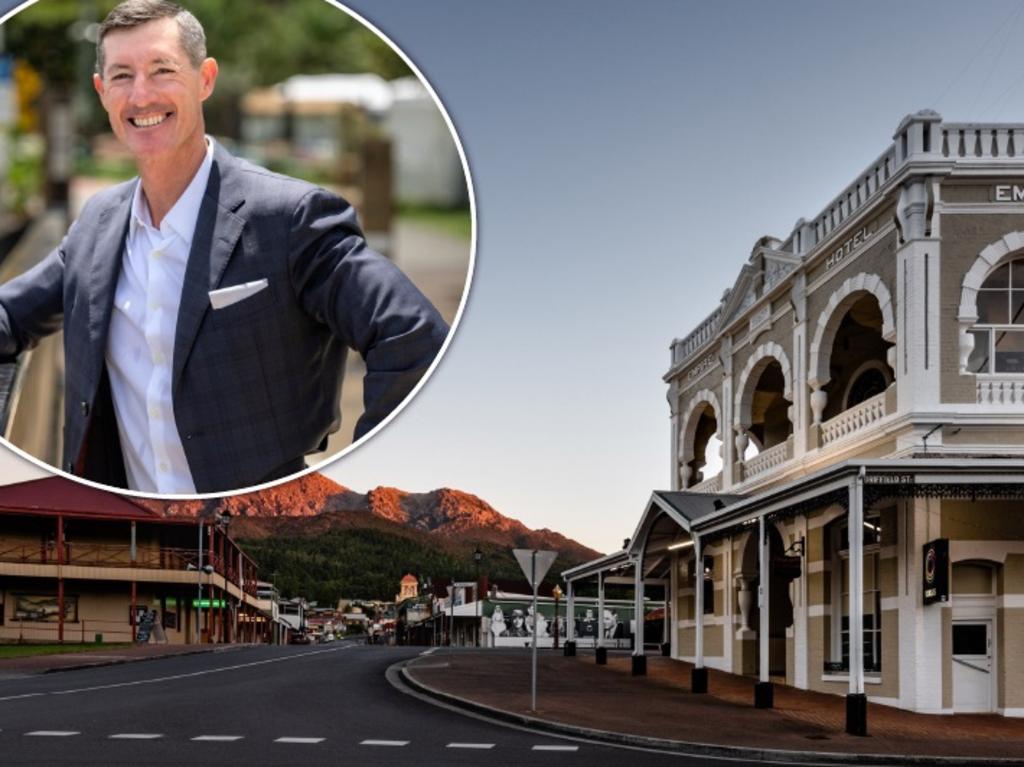
Research by property expert Simon Pressley shows Tasmania’s West Coast is where you should have invested 10 years ago. Picture: Supplied
A spotlight has been shone squarely on a region that is home to some of Tasmania’s most affordable real estate.
New research by Propertyologyfound that over the past 10 years, nowhere produced a higher capital growth rate than the West Coast.
With population growth of just 0.5 per cent, Propertyology’s figures showed an eye-watering 193 per cent uptick in the region’s house prices.
The next best result was houses in Playford, South Australia, at 179 per cent.
Break O’Day and George Town houses also made the Top 15 list with 161 per cent and 145 per cent growth.
Propertyology head of research Simon Pressley noted the Apple Isle’s strong performance.
“Tasmania was the strongest state overall, with Devonport, Burnie and Launceston all producing 130 per cent capital growth,” he said.
Hobart’s growth was 120 per cent, the same as Adelaide. While Brisbane topped the cities at 125 per cent, Sydney recorded 70 per cent growth and Melbourne only 25 per cent.
MORE: Waterfront landmark sold amid stadium-driven investor confidence
$100k in a year: Inside Risdon Vale’s remarkable price surge
Propertyology head of research Simon Pressley. Picture: Supplied
West Coast local Rodney Triffett has previously spoken with the Mercury about the extraordinary trajectory of real estate in his area.
Mr Triffett cited growing tourism and the arts community — everything from mountain bike trails to The Uncomformity festival — as drivers.
“There are a lot of positives that bring people to the area, including new mines that create jobs. The future looks bright; it’s great to see,” he said.
According to Mr Triffett, people relocating to Tasmania’s West Coast are typically seeking an escape from the heat and hustle of city life, drawn instead to a region well suited to those with a passion for the outdoors.
“Around the time the biking trails were announced and then construction started, that is when property prices here noticeably increased,” he said.
No.4 Dixon St, Queenstown is priced at $398,000. Picture: realestate.com.au
No.26 Batchelor St, Queenstown is on the market for $390,000. Picture: realestate.com.au
Real Estate Institute of Tasmania figures tell a complimentary tale compared with Propertyology’s research.
In 2016, across many West Coast hubs, houses were remarkably cheap.
The median house price, per REIT statistics, was $65,000 in Queenstown, $71,250 in Rosebery, $207,000 in Strahan, and $70,000 in Zeehan.
So far this year, Queenstown is up to $220,000, Rosebery $197,500, Strahan $342,500, and Zeehan $234,000.
REA Group figures show Hobart’s median home price is $727,000, $619,000 in the South East, and $613,000 in Launceston and the North East, while the West and North West sit lower at $556,000.
Harcourts West Coast business owner Rodney Triffett.
Mr Pressley said his research showed that from year to year, there is a direct link between the quality of each state’s economy and localised employment strength within each city and town.
“Local economic conditions have a big influence on the household confidence of a critical mass of each jurisdiction,” he said.
“For much of the last decade, household confidence — and thereby buyer activity — was stronger throughout Tasmania, South Australia, Queensland and regional NSW than it was in Sydney, Melbourne, Alice Springs, Canberra, Darwin and Mount Isa.
“In each town and city across Australia, detached houses typically produced significantly higher capital growth rates than apartments.
“Regardless of how affordable they might be, very few owner occupiers will use their hard-earned money to buy a real estate asset which does not have sufficient living space, storage and connection to natural lifestyle elements such as yards and neighbourhood green space.
“Throughout Australia, jurisdictions with the highest density of population have embarrassingly low homeownership rates and well below-par capital growth rates.”

1 Comment
Pingback: Brad Pitt's Cliff Booth sequel gets title 'The Further Mis - Industry Movement