
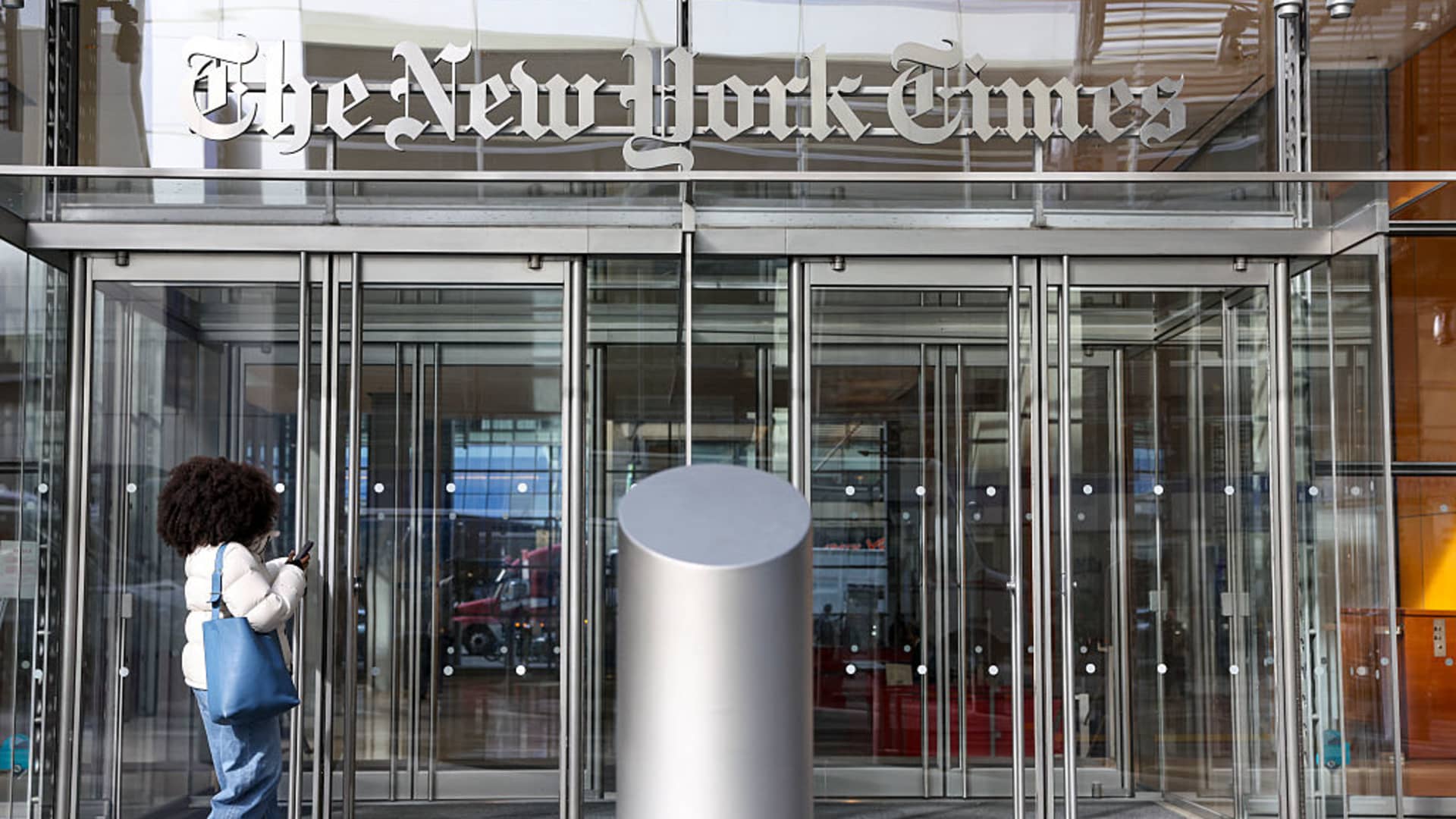
A person enters The New York Times building in New York City on Jan. 22, 2026.
Angela Weiss | AFP | Getty Images
The Department of Justice withdrew subpoenas it had obtained seeking grand jury testimony from and phone records of New York Times reporters involved in an article about security issues involving President Donald Trump‘s new Air Force One jet, prosecutors told a federal judge in New York on Thursday.
The move came at a hearing in U.S. District Court in Manhattan, where Judge Arun Subramanian had warned a prosecutor, Sean Buckley, that he would quash the subpoenas at the request of The Times if the DOJ did not withdraw them, according to MS NOW.
“Why isn’t that the right outcome?” Subramanian asked Buckley, who argued at length that the subpoenas were lawfully issued.
The judge later issued an order noting that the DOJ had voluntarily withdrawn its subpoenas, which the department says were issued as part of a national security investigation into the leak of sensitive information to The Times.
“As stated by the Government at the hearing, to the extent that a decision is made to renew the subpoenas, the Government will come to the Court in advance of issuance,” Subramanian said in his order.
The DOJ on July 10 issued subpoenas seeking to compel Times reporters to testify before a federal grand jury, the newspaper has reported. Federal agents delivered several of the subpoenas to reporters’ homes.
On Monday, The Times reported that the DOJ told the newspaper late last week that it also “had issued subpoenas to third-party phone service providers seeking several journalists’ phone and text messaging records.” The phone records of one reporter’s mother were targeted by a subpoena, according to the newspaper.
The subpoenas were issued by Manhattan U.S. Attorney Jay Clayton, whom Trump has nominated as director of national intelligence. Clayton was asked about the subpoenas at his Senate confirmation hearing on July 15.
Acting Attorney General Todd Blanche, whom Trump has nominated as attorney general, authorized the subpoenas.
David McCraw, deputy general counsel for The Times, in a statement on Thursday after the hearing said, “Today’s proceeding was an important affirmation of our country’s commitment to a free press.”
“We are pleased that the government finally conceded that the subpoenas violated the law, but they should never have been issued in the first place,” McCraw said. “The Times and our journalists will continue to report and seek the truth without fear or favor. We will not be deterred in the face of tactics like these.”
A DOJ spokesperson, in a statement to CNBC, said, “This judge threatened our attorneys with sanctions unless subpoenas were withdrawn, and blocked us from presenting the meticulous process of this investigation.”
“The grand jury has a right to hear testimony from all material witnesses in a federal criminal investigation,” the spokesperson said. “This judge’s conduct overrides clear longstanding principles and common sense — blocking the grand jury from receiving core evidence in a national security investigation.
“Make no mistake, this investigation remains ongoing, and we will pursue justice against those threatening national security by leaking classified information, a serious federal crime,” the spokesperson said.
The probe related to the subpoenas came after the Times reported security concerns about Trump’s new Air Force One, which was donated by Qatar.
The Times had reported on July 8 that Trump flew from Turkey that day “on the old Air Force One instead of his new Qatari-donated Boeing 747-8 as a security precaution related to the resumption of hostilities with Iran.”
The paper, citing people briefed on the new plane’s capabilities, reported that “the new plane does not have all the features of the older plane” in terms of security.
During Thursday’s court hearing, Buckle, the prosecutor, told Subramanian that in a letter on Monday the DOJ had said it was willing to hold the subpoenas in abeyance to pursue other investigative steps, MS NOW reported.
The judge said that was an admission that the DOJ had not taken reasonable steps to obtain the same information from other available sources before issuing the subpoenas, according to MS NOW. Under a controlling federal appeals court precedent that applies to Manhattan federal court, the DOJ must take such steps before subpoenaing journalists.
At one point, Subramanian told Buckley that if the case involved a civil dispute, as opposed to a criminal probe, he would order the DOJ to say why he should not sanction prosecutors for their conduct.
David O’Neill, a lawyer for The Times, told Subramanian that the DOJ’s conduct has been “replete with bad faith and that’s even clearer now,” according to MS NOW.
During his testimony last week to the Senate Select Committee on Intelligence, Clayton said he could not get into the details of the probe about the article on Air Force One.
“Let me say that I am confident that the procedures that we have in place to protect the First Amendment and protect the freedom of the press, and not result in intimidation of journalists,” Clayton said.
