
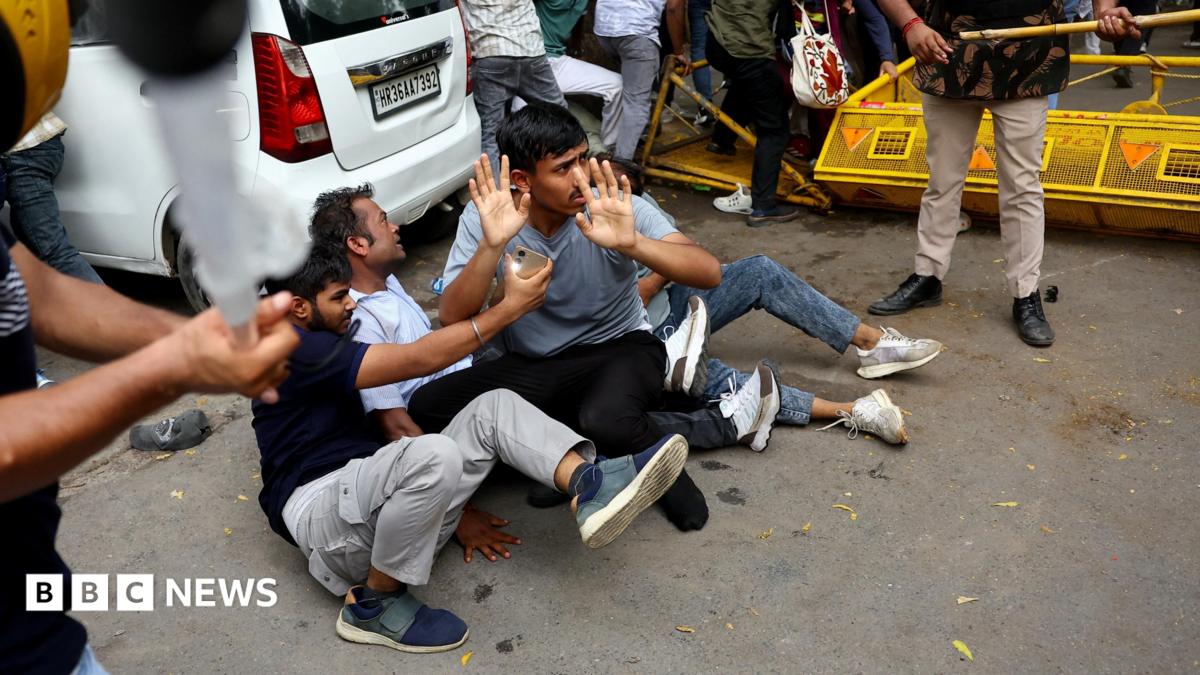
While it is unclear whether the CJP will achieve its aims of having the education minister removed and the education system overhauled, it has had a major impact on India.
Monday’s protest was the largest against Modi’s government that the capital had seen in recent years.
Police tried to disperse the crowd with baton charges and tear gas after protesters tried to push through barricades. Scores of people were injured, including both demonstrators and police personnel.
By the end of the day, officers also dismantled the stage and makeshift tents at Jantar Mantar, the protest’s main base near the 300-year-old observatory. But protesters refused to leave.
People have continued to gather at the site around the clock, braving rain as well as Delhi’s sweltering heat and humidity.
The movement has also drawn support from a number of opposition politicians.
Reacting to images from Monday’s protest, Congress party president Mallikarjun Kharge described police baton-charging protesting students as an “attack on democracy”.
Mahua Moitra, an MP from the All India Trinamool Congress, joined the protesters on Monday morning before attending parliament.
Samajwadi Party chief Akhilesh Yadav has also voiced support for the students and protesters who gathered in Delhi, saying they should be treated with respect.
On Tuesday, opposition leader Rahul Gandhi questioned Modi’s silence over the crackdown and asking him to apologise to students.
