
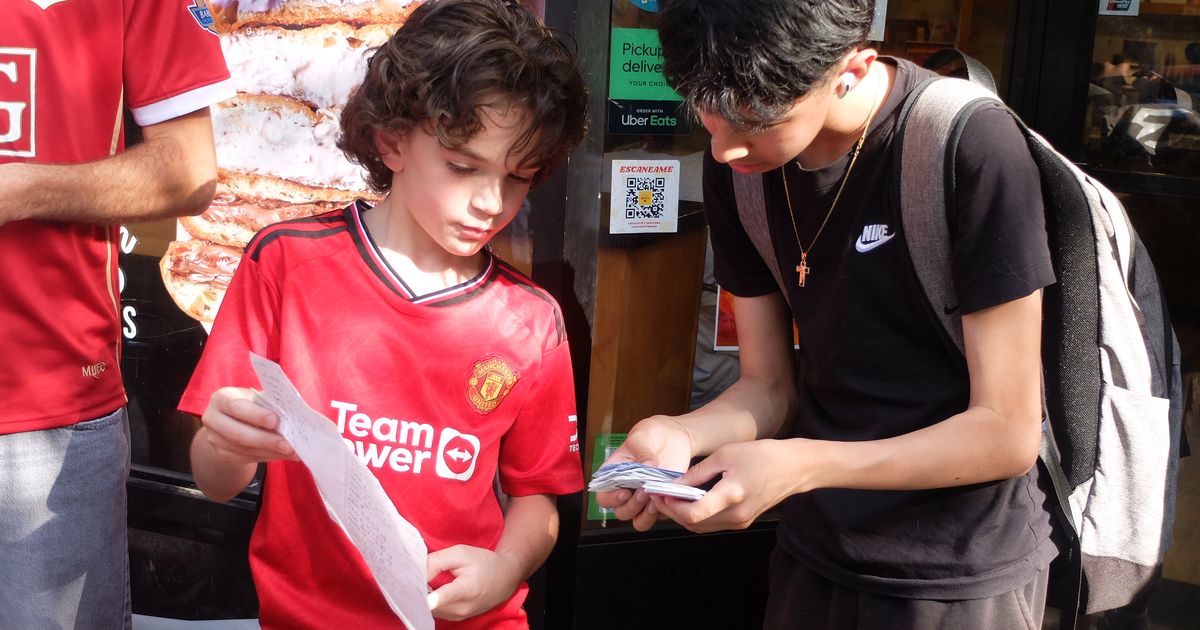

Nine-year-old Mason trades Panini stickers with other children gathered in Jackson Heights during the 2026 World Cup.
Photo: Jo Gutierrez-Chavez/
The sidewalk outside Uruguayan restaurant El Chivito D’Oro is usually like any other corner in Jackson Heights, Queens — busy with people passing by and coming to dine. But during a World Cup summer, this spot in the middle of Little Colombia is where five to six dozen people cluster every day, calling out “Qué te falta?” and “Whatchu got?” It’s the neighborhood’s unofficial hot spot for Panini-sticker trading.
Since 2010, or what soccer fans refer to as “four World Cups ago,” a crowd has gathered here in pursuit of one goal: to complete the FIFA World Cup sticker album sold by the Italian collectibles company Panini. This year there are 980 stickers in all, one for every player and every participating stadium. While the stickers are sold at Target, Walmart, Amazon, Walgreens, and CVS for about $2 a pack, they’re also available in the neighborhood at one of the many ad-hoc stands set up on the avenues. As with blind boxes, it’s inevitable to end up with duplicates. That’s where the trading comes in. It’s a tradition that has taken over school lunchrooms and offices in Latin America and Europe since Panini began selling the stickers in 1970. But it has yet to gain much traction in the U.S., where baseball cards rule the sports-memorabilia world and soccer has less of a mainstream fan base. But you wouldn’t know that from the crowd spilling over on the sidewalk.

Collectors try to complete the album with all 980 stickers.
Photo: Jo Gutierrez-Chavez/
But why this particular corner at 73rd Street and 84th Avenue? Here at least three “professional” traders — devoted enthusiasts who source stickers directly from Panini — have set up shop every day since the tournament began. Some have been coming here since the 2010 World Cup, and their steady presence and exhaustive supplies of duplicates have established this as the place to go. Several of them say the money they earn from sticker sales is minimal, and they do it mainly to show up for the local community. But the professional traders are not the main draw; it’s the crowd itself, of kids, parents, amateurs, and first-timers from all over Queens and as far away as Long Island, clutching lists and sticker albums of their own. For most, collecting Panini stickers is a low-stakes, mildly addictive way to get caught up in World Cup fever and be part of a social scene where fútbol is a point of national pride and identity. It’s also a tradition that many local immigrant parents who grew up in South and Central America can share with their children.

The Panini stickers are available in blind packs and boxes, but duplicates are inevitable. That’s where it helps to trade them; the bigger the meetup, the better.
Photo: Jo Gutierrez-Chavez/


From left: While each collector has their own strategy to keep track of their duplicate stickers, many go analog, carrying around a paper with sticker numbers scribbled over them. Photo: Jo Gutierrez-Chavez/ Photo: Jo Gutierrez-Chavez/
From top: While each collector has their own strategy to keep track of their duplicate stickers, many go analog, carrying around a paper with sticker …
From top: While each collector has their own strategy to keep track of their duplicate stickers, many go analog, carrying around a paper with sticker numbers scribbled over them. Photo: Jo Gutierrez-Chavez/ Photo: Jo Gutierrez-Chavez/
Standing at the edge of one of the trading groups is 23-year-old Spanish teacher Sophia Ballinas, who had come to the corner for the third time this year. She had one goal in mind: to secure a Lionel Messi sticker. She’d begun collecting Panini stickers as a kid after receiving an album from her dad, a Mexican immigrant and soccer fan. Growing up in Forest Hills, she would trade with the kids at her predominantly Latino school, but she never had enough money to complete an album. But now, as an adult, she can. Still, she says, “even now I joke with my dad and ask him to buy me some packs.” Thanks to the meetup at El Chivito D’Oro, she is finally close to completing an album.
Just steps away, 42-year-old Diana Peralta and her 24-year-old son, David Orellana, are joined by Peralta’s 26-year-old cousin, Richard Zhanay. Living in Quito, Peralta first began collecting Panini stickers when her son turned 8, but when they immigrated to Jackson Heights over six years ago, they didn’t know where to trade (2022 was the first World Cup when they couldn’t complete an album). But this year is different, and the roles are reversed; David and his uncle do the swapping while Peralta stands by to place each sticker carefully into the album.
Not everyone got into trading through their family; for some, it was simply the thing to do, growing up in a soccer-loving neighborhood filled with Ecuadorian, Mexican, and Colombian neighbors. Leading one of the larger trading groups of the day was 32-year-old Kevin Julia, who brought his whole family. Julia first started collecting in high school when his Latino friends roped him into it. At the time he was “more of a baseball guy,” he said, but got into sticker trading to fit in at school. But he’s never devoted enough time and resources to complete an album until this year. “I guess with the World Cup being here in the U.S., it’s a little bit more exciting.”
It helps that he convinced his father, who is also more of a baseball guy, to join forces with him. “He loves blind boxes,” Julia explained. His sisters even got into it, coming to Jackson Heights from Woodside to trade on Father’s Day. “I think these are certainly memories that I’m gonna have, opening these packs with my father,” Julia says.
Nearby were 16-year-old Marco Gonzalez and his 9-year-old brother, Mason. In a spot of shade that protected them from the blazing sun, Marco passed Mason a list of the countries and sticker numbers they were still missing. Mason was just 1 when his older brother began trading stickers, but now at 9, he likes taking the lead. Mason took the list and started a conversation with another kid his age whose hands overflowed with stickers. “We’re kind of equal at trading now,” Marco acknowledged, looking over his younger brother’s shoulder. “He’s ready. He knows how to do it.” Their father, Gary, hovered close by, but he was content to stand on the sidelines. “We’ve been collecting for about a month now, and we’re almost finished,” Gary said. “It’s been a great bonding moment for them, actually.”

A crowd of around 50 people gather at any given hour during the weekends, starting as early as 10 a.m. and peaking at 5 p.m.
Photo: Jo Gutierrez-Chavez/

Photo: Jo Gutierrez-Chavez/

Many children roam freely throughout the corner, trading with both people their age or some old enough to be their grandparents.
Photo: Jo Gutierrez-Chavez/
They did get a little help that day. Julian Cruhigger, a veteran trader who began four World Cups ago, was able to find 40 stickers for their album among his duplicates. He talks like a world-weary collector who’s seen it all, but he’s just 20 years old. “This is packed over here. I remember it being maybe two stands in 2014. Now, every block has at least three stands selling stickers,” he said. For him, trading with the kids reminded him of growing up in Queens and doing the same thing. “It definitely did tie me closer to my Colombian roots,” he added. It’s also a bit of a commitment, since he no longer lives in the neighborhood. “Usually I’d be out in Long Island, playing baseball or whatever. But now I like hanging out in Jackson Heights.”
