
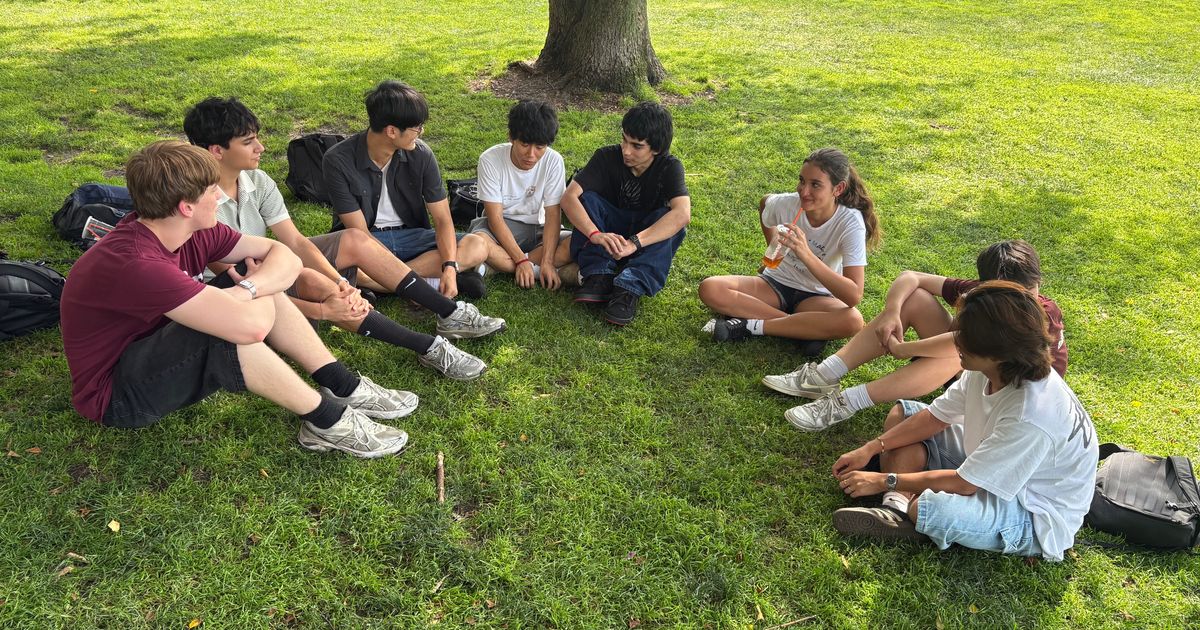

It was a warm Thursday in early June at Rockefeller Park, ideal weather for tanning on the grass or kicking around a soccer ball. But on a shady patch under a sprawling river birch, ten teens who had wandered over from Stuyvesant High School assemble themselves into breakout groups to discuss Zohran Mamdani’s recently released housing proposal. “Okay, so a quick overview,” Millan Bisegna, a junior with a mop of wavy, jet-black hair, tells his classmates before reading the plan’s top-line numbers off his phone: $22 billion invested, 400,000 affordable homes built and preserved. “This is a step in the right direction,” says Eli Smith, also a junior, in a faded Dr Pepper tee and black denim shorts. The other students nod, their faces serious. “It’s broken up over ten years, but 20,000 new houses a year is still a lot,” Qasim Rizvi, another junior, says. “I don’t even know if that’s achievable.”
Stuyvesant is a magnet for hypersmart, hyperdriven, hypercompetitive teens. One of the city’s premier specialized high schools, it has a lower acceptance rate than Harvard — just 3 percent of nearly 26,000 students who sat for the exam received an offer last year. (To say nothing of the parents spending thousands on tutoring and other test prep to give their kids even the slightest edge.) So it was probably inevitable that a contingent of the school’s abundance-loving teens would find each other and start a club to study zoning codes and preach the gospel of YIMBYism: Build, baby, build. Smith and Bisegna formed the club in 2024 and serve as co-presidents. There are currently 30 members — all of them versed in the jargon of ADUs and MIH and RGB. They speak in the language of “net goods.” They’re not immune to the neon glow of the Starbucks Lemonade Refresher, but they argue the pros and cons of land-use ballot proposals between sips. And lest you think this is just another way for overly ambitious teens to pad their résumés and impress college-admissions officers, members insist that Stuyimby lacks the gloss or rigor of, say, debate team or Science Olympiad. “It’s a decent club, but it’s not as prestigious,” says Andrew Chin, a particularly chatty 17-year-old member and the club’s events director. (Though it doesn’t have a ton of events.)
Smith and Bisegna have distinct YIMBY origin stories. Smith, who lives in Ditmas Park and at 16 already sounds like the politician he’ll likely one day become, tells me it was living near Coney Island Avenue and its endless blocks of single-story auto shops and self-storage units that he thought should be apartments. His parents, the journalists Ben Smith and Liena Zagare, probably had some influence, too: Eli says that Zagare cried after learning the City Council had landmarked their Victorian, basically condemning it to remain a two-family forever. “As much as I love my neighborhood, if we wanted to tear down our house and build a six-story apartment building, I think we should be allowed,” he says. “I think that would probably be a net good for the neighborhood.”
Bisegna, who is 17 and more soft-spoken, took a little persuading. The pair first met in their freshman-year biology class and became close after going on a ski trip together. As Smith’s interest in upzoning was taking hold, Bisegna was skeptical — he had come to resent a blocky seven-story condo development called the Rowan that had gone near his home in Astoria a few years earlier. “My dad was like, ‘I don’t like the new buildings … It’s gentrification.’” But over many lunchtime debates, he says, Smith convinced him that more housing would actually preserve what he likes about his neighborhood, not ruin it. Ideally, it would mean he could afford a place of his own one day. “He helped me bridge that gap and really push for YIMBY ideals,” Bisegna says. Others in Stuyimby came through the experience of watching their parents get squeezed by the market. Tenzin Gyaltsok’s family’s rent went up so much during the pandemic that he says they even considered moving to Pennsylvania. (They ultimately stayed in the neighborhood, but they did move apartments.) Ahead of the club’s first gathering, Smith reached out to Open New York, a pro-development organization, for discussion materials and to generally make contact. “It’s really impressive. They’re plugged in,” says Asia Thomas, Open New York’s director of organizing.
The club’s twice-a-month meetings are a labor of love — just one more thing to add on top of studying for Mandarin and psychology exams, prepping for the SAT, and volunteering with local churches and nonprofits. This past year, members say they’ve juggled multiple honors and AP courses, orchestra, mock trial, baseball, cheer, and the robotics team. “I was definitely up later than I would like to have been some nights,” Smith says of the past year.
Meetings, naturally, involve a lot of arguing. Does a new development in Williamsburg deserve an A or an F grade based on how much affordable housing it offers? (What are the grades for? “Mostly for bookkeeping,” Smith says.) And what about increasing NYCHA funding — is that throwing good money after bad? Chin tells me that he’s still personally struggling with the fact that more housing on the Lower East Side could mean a potential depreciation in the value of his family’s apartment. “It’s the devil on your shoulder,” he says with a shrug. The debates aren’t merely hypothetical. Half of the student body at Stuyvesant qualifies as “low income,” and they’re talking about both the housing they currently live in and the housing they’ll likely need as they age into adulthood in the city. “There are plenty of smart people at Trinity, but Trinity costs $90,000, and they’re not struggling,” Chin says.
And they actually do stuff, they tell me. Members canvassed Long Island City in the pouring rain with Open New York in support of the OneLIC rezoning. In February, Smith and another member, Evan Yue, cut school and boarded an Open New York–chartered bus to Albany, where they knocked on lawmakers’ doors and passed out postcards from constituents supporting a bill to help religious organizations build affordable housing on their property. “When I told my parents what I was doing, they were like, ‘Finally, you’re doing something,’” Yue, a junior, says. And they were okay with him missing class? “I might’ve breezed past that part,” he adds.
At Rockefeller Park, the ice in a teen’s Dunkin’ cup has completely melted as the group wraps up the meeting. The consensus about the mayor’s housing plan seems to be a very adult mix of mild enthusiasm and mild disappointment. But there was a lot on the horizon to consider still, like the Rent Guidelines Board hearings that were underway (the mayor’s proposed two-year rent freeze — historic on its own terms — eventually passed) and finals and the state Regents — which were maybe the more immediate concern than the cost of apartments none of them could legally sign a lease for at the moment. Everyone packed up. Smith had to hustle over to cheer practice. Did he know any chants about density around transit hubs? “It’s a little bit of a different crowd,” he says. Not that he hasn’t tried to spread the good word there, too: “Once in a while, I’ll try to sneak it into a conversation.”
