

Photo-Illustration: Curbed; Photo: Getty
When 10-year-old Ollie walks out the doors of his school in Center Slope, the world is his snack oyster. On Mondays, Tuesdays, and Thursdays, he and his friends stop at the deli to pick up Gatorade Zero and BBQ potato chips before heading to their after-school program. On Thursdays, Ollie adds a pack of Hubba Bubba or AirHeads gum to the mix. “It’s sort of like an almost-end-of-the-week prize,” he explains. Sometimes, he skips the deli and gets a treat at the nearby Showroom Bakehouse. At $3.95, a single Belgian waffle eats up nearly half of his $10 weekly allowance, but it’s worth it. “The Belgian waffles are so peak,” he says.
The boys all have money to spend, although not the same amounts. Some get the number of dollars tied to their age (this used to be the case for Ollie and his brother, Owen, until their mom, Rebecca, got tired of them fighting over their disparate payouts) and others much more. Ollie says he’s happy with his $10, but Owen told me he could use a raise. “I’ll just, like, instantly take it to the deli and spend it all,” he says. His snack hauls frequently put him over budget and he has to ask his mom for extra, which she pretty much always provides.
Ask any parenting “expert” or financial coach why kids should receive an allowance, and they’ll opine about learning the value of a dollar, responsibility, and money management. But many of the New York City parents I talked to said they view allowance on different terms: as an essential parenting cost, right alongside summer camp and birthday parties. While a suburban kid may be asking for a ride downtown for a weekly hangout with pink drinks from Starbucks or saving up to buy something on Amazon, New York City tweens and teens come face-to-face with dozens of eye-popping storefronts (not to mention the heavenly scent of pizza sizzling and croissants baking) multiple times a day. With long commutes, friends from far-flung neighborhoods, and small apartments, allowance is a way to fund their entry into much-needed third spaces, says Catie Hogan, a personal-finance expert and the author of the Cents of Humor newsletter. “It isn’t just regular currency,” says Hogan. “It’s social currency.”
How much allowance a kid receives depends not only on their parents but also, in many cases, on the norms in their friend group and on how many stores are on the path between school and home. In Manhattan, chockablock with Duane Reade, CVS, Target, bakeries, and bodegas, the pull to shop can be especially strong. I talked to Upper East Side parents who let their kids buy Butterfield Market sushi every day and heard of deep-pocketed teens who not only splurged on after-school pizza slices and Refreshers but also treated all their friends to the same (which sent one mom into a mild panic that her budget-minded child was considered a freeloader).
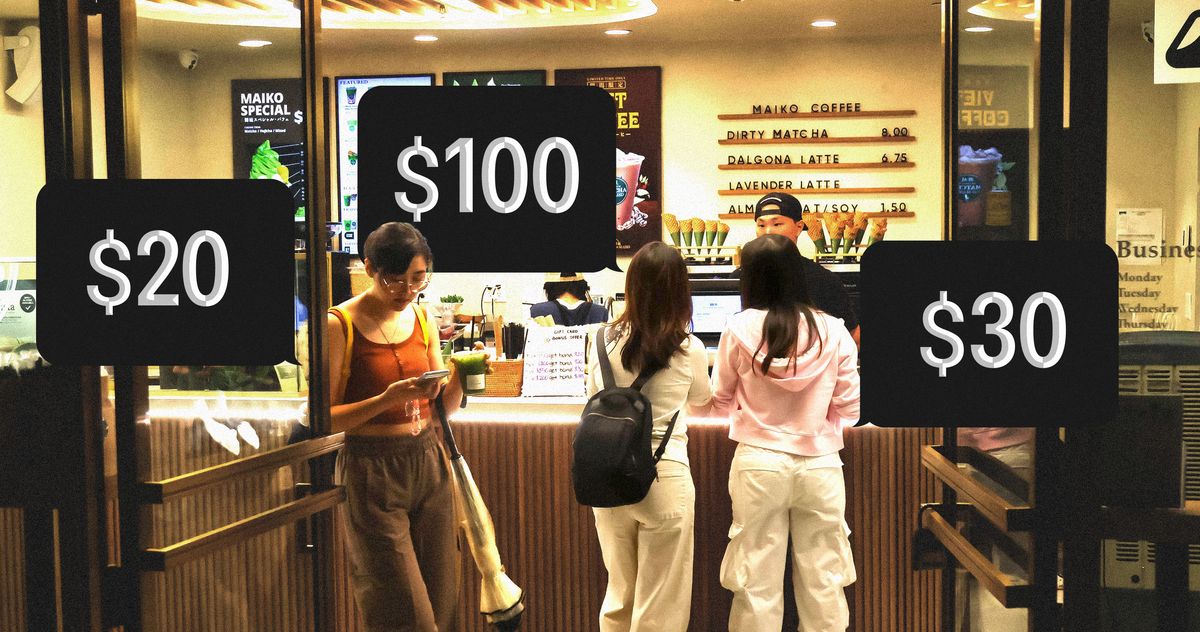
What is “enough” for a New York City tween or teen to not feel left behind? Among users of Greenlight, a family finance app that lets parents automate allowance delivery, the average annual allowance given by NYC parents in 2025 was $831, or roughly $16 a week. (The national average was $347.) But in talking to parents, I heard of kids receiving as little as $5 and as much as $200 per week. I heard about kids becoming overdrawn on their Apple Pay accounts, listing their baseball cards on auction apps to boost their snack funds, and investing their allowances into the stock market (with unknown returns), while others had to complete a list of chores to buy one soda from a vending machine on a Saturday. Christine, a Park Slope mom, uses Apple Cash to give her 11- and 13-year-old daughters $15 and $20, respectively, every Sunday. “I want them to be able to get little things with their friends and not feel left out,” she told me. “I also don’t want to give them so much that they’re like, ‘Oh, I have so much money I can buy whatever I want.’” They get bonuses for completing chores beyond their everyday responsibilities. Recently, Sara, a West Village mom, told me she’s considering increasing her 17-year-old son’s weekly $20 allowance to $40. “It seems excessive, but it will all go to food,” she says. “A lot of kids’ social lives involve eating food after school or going out for lunch. And if your friends don’t want to go to 99-cent pizza, you don’t have much choice.” Even with the increase, she admits that, to her son, it still doesn’t feel like enough.
“The right amount is never a number — it’s a concept,” says Ron Lieber, a personal-finance columnist for the New York Times and the author of The Opposite of Spoiled, himself a Brooklyn dad of two. “We want them to have just enough so that they have what they need and some of what they want — but not so much that they don’t have to make tough choices on the regular.”
Lieber follows a dollar-per-child’s-age guideline for his 10-year-old daughter, with the amount divided into spend, save, and give buckets. “It’s $10 a week — $4 to spend, $3 to save, and $3 to give,” he says. Right now, she spends her money at Sephora or on boba tea (“which we’ll usually pay for if a friend is over for a hangout,” he says). But he anticipates the amount changing “once she’s in middle school and has a digital device of some sort next year.” The goal, he says, is to make allowance an ongoing conversation that evolves along with your kid.
Aurora, Christine’s 11-year-old daughter, is happy with her allowance. “Fifteen dollars is enough for me to get Dunkin’ Donuts every day after school, if I want to. But it’s not so much that I have too much money,” she says. “There’s a kid in my class who said he gets $100 a week, which I think is absolutely insane. Like, who needs $100 a week?”
Bethany, a Battery Park City mom of three, has given her now-17-year-old son $100 a week since tenth grade. She explains where most of it goes: “There’s no cafeteria in his school where he can actually get lunch.” She estimates he spends about $15 a day eating out. “He mixes it up, so it goes from, like, pizza to a Chick-fil-A. Sometimes he’s going to the bodega and getting himself a bacon, egg, and cheese for lunch, or he’s going to one of the food trucks and getting a chicken-and-rice situation.” Anything left over is her son’s to keep (and spend) as he likes.
Still, Bethany says that at times the system has gone awry, particularly because in addition to allowance, her two oldest children also have access to her credit card, ostensibly for emergencies. She told me about a day when her 15-year-old, whose allowance is $30 per week, had a half-day of school and so went out to lunch with her friends, got her nails done, and then got frozen yogurt. She used Bethany’s credit card rather than her own money. “That’s when I was like, ‘Okay, we can’t do all this.’ That was over $100 in a day. That’s insane.” She also recently instituted a rule about Starbucks: It can only be consumed once a week. “It got completely out of control. There was a time when I looked at my credit card statement, and I was like, ‘Oh, my God, you were there three or four times this week.’”
For several parents I interviewed, the question of how much allowance to give had less to do with their kids’ desires than with unpacking baggage from their own childhoods. A few told me that when they were teenagers, they never had enough money to shop with their friends and that they wanted their kids to have a different experience. “I didn’t get an allowance myself growing up in Queens in an immigrant family,” said Jay, a Manhattan dad of a 16-year-old. “There was no such thing.” Jay started giving his son $100 per week when he turned 13; he increased it to $200 per week this past year. The amount helps his son stay in step — sort of — with his private-school classmates, some of whom, Jay says, “have open access to their parents’ credit cards.” The money is enough to fund Starbucks runs and bowling outings and occasional jaunts to the Hamptons with friends.
But it isn’t just about keeping up appearances. For many of the teens, receiving an allowance has provided an opportunity to learn a lesson or two (and sometimes, it’s the exact lesson that getting an allowance is traditionally intended to impart). Owen, the Park Slope 12-year-old, told me that he is steadily learning how to save. “It’s definitely disappointing to, like, go home and count my money and then see that I didn’t gain any and all that week I’ve spent it immediately. That’s kind of upsetting,” he says. “But recently, I’ve been really working on not spending any money at the deli, and I’ve saved $20.22.” And many allowance-wielding teens and tweens are also discovering what it means to be generous. Jonathan Webb, the owner of the Showroom Bakehouse, has noticed something about the kids who stop at his Park Slope shop for Belgian waffles and pastel de nata: They are very good tippers. “For $5.20,” he says, “they’ll leave $6 and tell the person working, ‘You can keep the rest.’”
Leiber says one of the most valuable learning experiences allowance affords is an early money blunder — something Jay says his son is already getting a taste of. Recently, he withdrew $1,000 from his personal brokerage account to buy Pokémon cards. “I was not okay with it,” Jay admits, “but he said, ‘This is the money that you give me as an allowance. I should be allowed to do whatever I feel like.’” The cards are still sitting in Jay’s basement. His son contends they are accruing value; Jay remains fairly certain they were a big mistake.
The names of the parents and children in this story have been changed to protect their privacy.
