
Dockworkers strike in a picket line outside of the Port of Houston Authority on October 01, 2024 in Houston, Texas. The strike, affecting 36 ports, marked a historic event and was the first by the union since 1977. While the International Longshoreman’s Association and the United States Maritime Alliance reached agreement on better wages, automation is still being negotiated. (Photo by Brandon Bell/Getty Images)
Brandon Bell | Getty Images News | Getty Images
The tentative agreement to suspend the International Longshoremen’s Association strike may have consumers and businesses breathing a sigh of relief. Still, the deal is far from done, according to logistics experts.
The union and port ownership reached agreement on a wage increase in a new master contract, but port automation remains a critical issue to hammer out in the tentative deal, and it is not going to be an easy part of negotiations.
In a statement Friday, the ILA said it wants to tighten the language related to the use of automation at ports. “Automation will continue to be an issue that will be worked out and is being worked out in this contract,” the ILA stated. “The ILA negotiated restrictions on automation and semi-automation in the last contract. The ILA just wants to tighten the language that no automation means no automation.”
With a little over three months to work out a final deal, logistics executives remain wary.
“It is good news the strike has ended, but shippers are not out of the woods just yet. It is only a tentative agreement and automation at ports will remain a major stumbling block,” said Peter Sand, chief shipping analyst at supply chain intelligence firm Xeneta. “Now they have just 100 days to reach an agreement, otherwise we could see further strike action.”
At a union meeting in September, Harold Daggett, lead negotiator and ILA president, vowed in a video message to members that wages, health care, royalty payments based on cargo containers moved, and “no automation terminals or semi-automated terminals” were all among the conditions to keep the union from “shutting them down.”
Daggett made good on his initial strike promise and sources with knowledge of the tentative deal tell CNBC the USMX raised its 50% wage increase offer to 61.5% over six years. At one point, the ILA was demanding an increase of as much as 77%.
But automation is an area of negotiation that will be tougher given Daggett’s “no automation” line in the sand.
Dennis Daggett, executive vice president of the ILA and Harold Daggett’s son, called automation a “cancer” in a recent video message to union members shared during the September meeting.
“We do not believe that robotics should take over a human being’s job especially a human being that’s historically performed that job, so we’re going to continue to fight that from from now to the rest of our existence. It doesn’t matter if they pay us $100 an hour, we will not have jobs in the future,” he told union members.
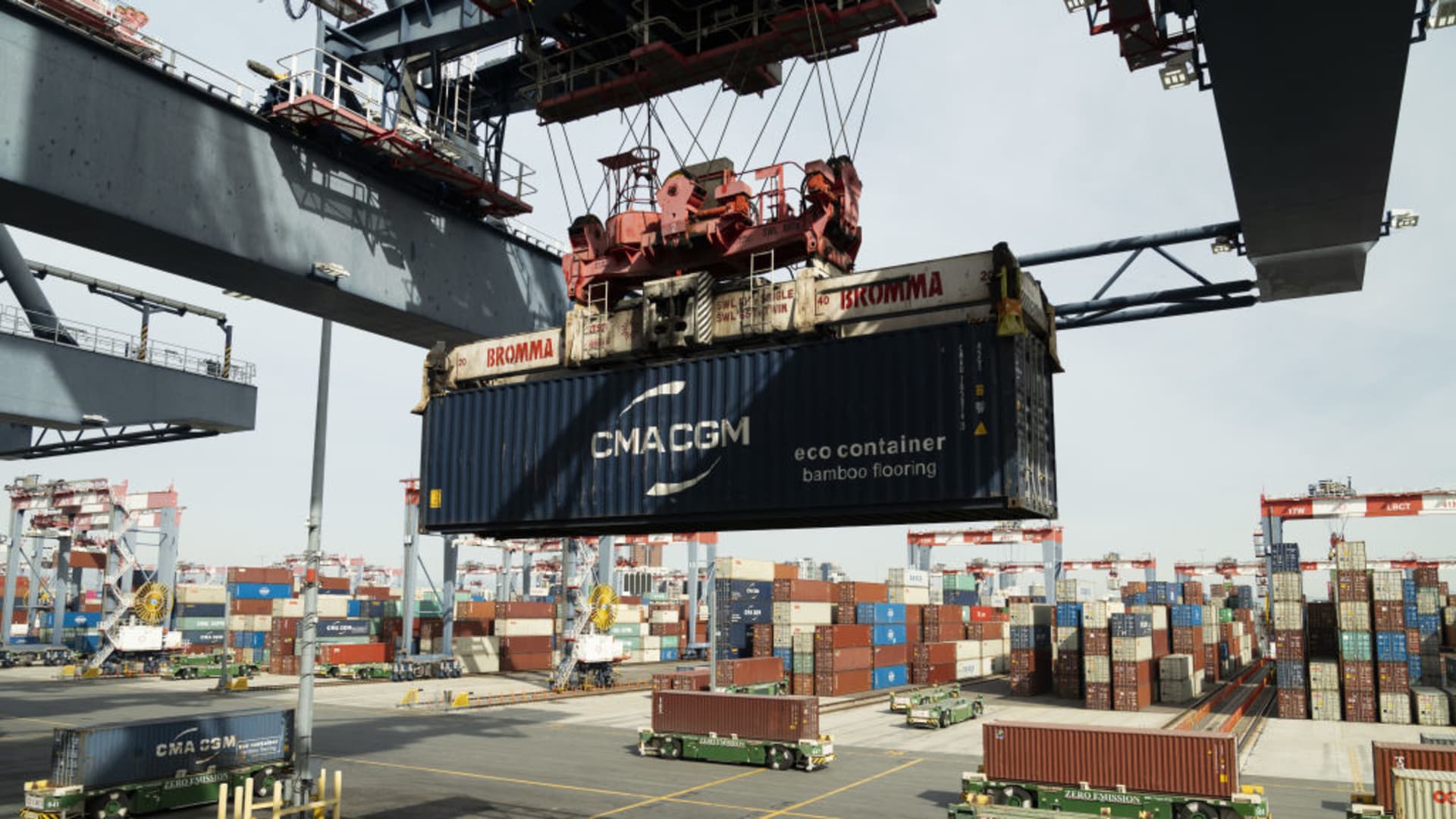
According to the Government Accountability Office, all 10 of the largest U.S. container ports are using some form of automation technology to process and handle cargo. The GAO reported at least one terminal at each port uses it to track and communicate information on container movements.
ILA president Harold Daggett started his career on the docks before containerization — which fundamentally changed the global shipping and ports function — and he has fought hard against automation, semi-automation, and certain technologies. Daggett has voiced his opposition to cameras positioned at the ports and roads monitoring trucks.
“I’m against this big brother,” Daggett said in the September video. “I’m against all that, a man can’t even breathe without a camera looking at him, that’s not right.”
He also called semi-automation a “back-avenue into automation.”
But he did say that when it comes to some technology, “We get more work done with computers and we have doubled the cargo.”
It is for these reasons that Sand told CNBC no one can assume a deal will be done.
A study conducted by Dr. Michael Nacht, Professor of Public Policy at the University of California, Berkeley, and a former Assistant Secretary of Defense, and Larry Henry, Founder of ContainerTrac, concluded that higher output of automation at the two semi-automated terminals at the ports of Long Beach and Los Angeles, California actually increased jobs for the International Longshore and Warehouse Union.
The report was commissioned by the Pacific Maritime Association, which manages West Coast ports and reached a deal on a new contract with the ILWU in 2023, averting a strike. A study commissioned by the ILWU found that automation eliminated job hours and wages.
A gantry crane loads containers onto automated guided vehicles (AGV) at the LBCT container terminal at the Port of Long Beach in Long Beach, California, US, on Thursday, Feb. 16, 2023, part of a 10-year, $2.5 billion redevelopment project.
Bloomberg | Bloomberg | Getty Images
Both TraPac which owns the semi-automated TraPac terminal in Los Angeles, and APM Terminals, an independent division within A.P. Moller–Maersk, are members of the PMA.
Daggett said in his September video message to members that the fully automated terminal at the Port of Los Angeles destroyed 800 longshoremen jobs. He pointed the finger at the maritime companies that come from “overseas” and want to “come into America and build fully automated terminals and get rid of American jobs. Good paying jobs that support families with medical, pensions, and annuities.”
Harold Daggett was re-elected to his fourth four-year term as ILA International President in July 2023. His current term runs until July 2027. As International President, he serves as Chief Negotiator for the ILA-USMX Master Contract Negotiations.
The U.S. ranks below many other countries around the world when it comes to port efficiency. No U.S. ports are in the top 10, according to the World Bank’s Container Port Performance Index 2023. The top-ranked U.S. port is Philadelphia, which has an overall ranking of 50.
In an interview discussing automation with CNBC on Friday morning, acting Secretary of the Labor Department Julie Su — who played a key role in this week’s deal and in the ILWU/PMA deal which also contended with port use of automation — used the same words Harold Daggett had used in his video message when pushing back against a question from CNBC about U.S. port efficiency. “Machines don’t have families,” Su said.
“Other countries have moved much faster than the U.S. to adopt automation at ports,” Su said, but she added, “In many countries, people aren’t as afraid of what’s going to happen with automation because there is so much attention to job security.”
The 2023 deal between the PMA and ILWU did not disclose terms on automation.

The ILA says under its current contract, the union has full automation protections, and protections with semi-automation, but wants to tighten up those protections.
“We have found out the terminal operators are sliding in certain automation which we believe is in violation of the contract,” said Dennis Daggett in the September video.
In fact, allegations of the use of an automated processing gate for trucks at the APM Terminals, in Mobile, Alabama, was among the top reasons for the breakdown in negotiations over the summer between the ILA and USMX, a stalemate that lasted until the union and ports ownership began exchange offers again only the day before the strike commenced on Oct. 1.
“Automation is an issue the two sides have been unable to resolve in over a year of negotiations,” warned Sand. “Now they have just 100 days to reach an agreement otherwise we could see further strike action.”
Why ports automate, and why the U.S. lags
Automation and semi-automation are used to increase the throughput in a terminal and less to reduce the labor force, said Lars Jensen, CEO of Vespucci Maritime. “Automation also leads to a more stable level of productivity. For example, you now have cranes that use a remote control. This makes jobs less physically demanding out in the elements and more safe,” he said.
But Nick Vyas, founding director of USC Marshall’s Randall R. Kendrick Global Supply Chain Institute, said while automation could streamline operations, improve cargo flow, and cut costs, it also threatens to displace the workers who have been striking. “The outcome of these negotiations may set a precedent for the future of port operations in the U.S., determining whether labor-intensive jobs will survive in the face of technological advancement,” said Vyas.
Reasons for automating, or not automating U.S. ports, relative to adoption levels among overseas ports, may come down to a variety of factors not limited to union contract language.
According to GAO report, a terminal would need to surpass a minimum amount of cargo — one stakeholder estimated at least 2.5 to 3 million twenty-foot equivalent units (TEU) — to realize a potential return on what is a high initial cost of investment, and most U.S. container ports handle less than this amount of cargo. Foreign ports also tend to have more transshipments — meaning that containers are moved from one ship to another ship rather than to trucks or rail — compared to U.S. ports, a redundancy that favors automation. Officials from the Port of Singapore, a port with a large percentage of transshipments, told the GAO this was a key consideration in its decision to automate.
At the Port of Norfolk, Virginia, the NIT, which is the port’s largest terminal is in the midst of expanding and will eventually have more than 90 semi-automated stacking cranes which will increase container capacity. Stephen Edwards, CEO of the Virginia Port Authority, has said its semi-automated operations helped the port handle the container surge after the Baltimore bridge collapse.

Beth Rooney, port director for the Port Authority of New York/New Jersey, said at a press conference on Friday that the Port of New York and New Jersey has no automation. She said there is limited semi-automation at the Port Liberty terminal in Bayonne, New Jersey, which was agreed to several years ago between the terminal operator and the ILA. The current master contract is structured to include a committee of six to seven members of the USMX and of the ILA to review any requests that the terminal operators have to implement semi-automation or automation.
“Ports and terminals must have some automation allowing them to improve their efficiency,” Sand said. “I can’t see them give in to the ILA’s demand on no automation or semi-automation.”
The automation portion of the contract is pivotal to Harold Daggett’s goal in establishing an international union comprised of all dockworkers around the world to contest automation.
“I’ve had it up to here,” Daggett said in the September video, gesturing with his hand up to his forehead. “The only way we can fight this is by having this Alliance. … We’re going to show the companies we have the power, not you. … We’re going to fight it with that Alliance. I’ll shut them down.”
The tentative deal and suspended strike can only go so far, says Sand. “Money was shown, but the hurdle of automation may bring around another strike in mid-January.”
