


 Alok Kumar Kanungo
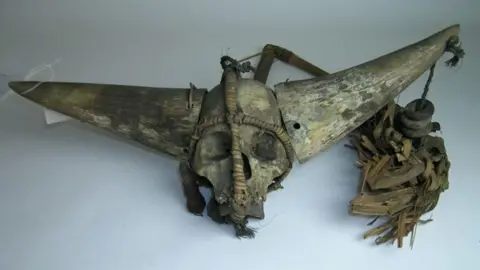
Last month, Ellen Konyak was shocked to discover that a 19th-Century skull from the north-eastern Indian state of Nagaland was up for auction in the UK.
The horned skull of a Naga tribesman was among thousands of items that European colonial administrators had collected from the state.
Konyak, a member of the Naga Forum for Reconciliation (NFR) which is making efforts to bring these human remains back home, says the news of the auction disturbed her.
“To see that people are still auctioning our ancestral human remains in the 21st Century was shocking,” she said. “It was very insensitive and deeply hurtful.”
The Swan at Tetsworth, the UK-based antique centre that put the skull on auction, advertised it as part of their “Curious Collector Sale”, valued between £3,500 ($4,490) and £4,000 ($5,132). Alongside the skull – which is from a Belgian collection – the sale listed shrunken heads from the Jivaro people of South America and skulls from the Ekoi people of West Africa.
Naga scholars and experts protested against the sale. The chief minister of Nagaland, Konyak’s home state, wrote a letter to the Indian foreign ministry describing the act as “dehumanising” and “continued colonial violence upon our people”.
The auction house withdrew the sale following the outcry, but for the Naga people the episode revived memories of their violent past, prompting them to renew calls for the repatriation of their ancestral remains stored or displayed far from their homeland.
Scholars suggest that some of these human remains were bartered items or gifts, but others may have been taken away without the consent of their owners.
 Alok Kumar Kanungo
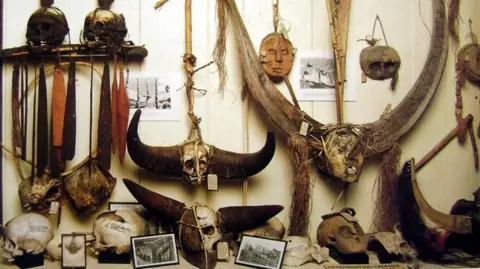
Alok Kumar Kanungo, a scholar of Naga culture, estimates that the UK’s public museums and private collections alone hold around 50,000 Naga objects.
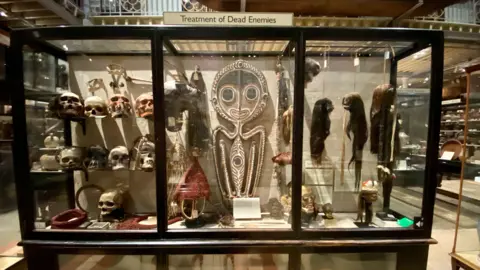
Oxford University’s Pitt Rivers Museum (PRM), which has the largest Naga collection, features approximately 6,550 items taken from the state, including 41 human remains. The museum also has human remains from several other states of British India.
But in recent years, experts say, with growing ethical concerns about collection, sale and display of human remains, many collectors are reconsidering their approach.
Kanungo says human remains have become “white elephants” for museums.
“They are no longer an object that can be disposed of or possessed by its owners; no longer a source of tourists’ money; can no longer be used to present Naga peoples as ‘uncivilised’; and of late have become an emotionally and politically charged issue.”
So, museums have started returning human remains from communities such as the Maori tribes of New Zealand, the Mudan warriors of Taiwan, the Aboriginal people of Australia and the Native Hawaiians.
In 2019, PRM told the BBC that it had returned 22 such objects.
A museum spoksperson told the BBC that the figure has now gone up to 35. “So far these [objects] have all been returned to Australia, New Zealand, US and Canada.”
 Arkotong Longkumer & Meren Imchen
As part of an ethical review, the museum removed Naga skulls from public display in 2020 and placed them in storage. This is when FNR demanded their repatriation for the first time.
The museum said it was yet to receive a formal claim from Naga descendants and the processes to return human remains “can take between 18 months and several years, depending on the complexity of the case”.
Repatriating human remains is more complicated than returning artefacts. It requires extensive research to determine whether the items were collected ethically, to identify descendants and to navigate complex international regulations on movement of human remains.
The Naga forum has formed a group called Recover, Restore and Decolonise under anthropologists Dolly Kikon and Arkotong Longkumer to facilitate returns.
“It is a bit like detective work,” Longkumer said. “We have to sift through different layers of information and try to read between the lines to actually find out about the exact nature of the collections and where they are from.”
But for the Naga people, this process is not merely logistical. “We are dealing with human remains,” said Konyak. “It’s an international and legal process, but it’s also a spiritual one for us.”
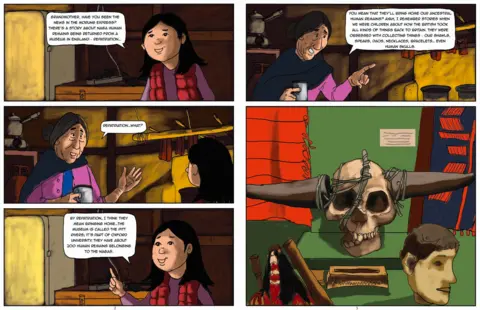
The group has been travelling to villages, meeting Naga elders, organising lectures and distributing educational materials such as comic books and videos to spread awareness.
They are also trying to build consensus around subjects such as the last rites of repatriated remains. Most Nagas now follow Christianity, but their ancestors were animists who followed different birth and death rituals.
 Pitt Rivers Museum
The group found that even Naga elders were unaware that their ancestral remains were in foreign land. Anthropologist and archaeologist Tiatoshi Jamir said one elder told him that this could make “the soul of their ancestors restless”.
Jamir said even he was not aware about the skulls on display in foreign museums until he read about them in a local paper in the early 2000s.
The British took over the Naga areas in 1832 and, in 1873, introduced a special permission for travellers – called the Inner Line Permit – to strictly control access to the region.
Historians say the colonial administrators put down any rebellions and often burnt Naga villages to subdue them, in the process erasing much of their important cultural markers such as paintings, engravings and artefacts.
Konyak says she has discovered that one of the human remains in PRM’s list is of a person from her village and tribe.
“I am like, ‘Oh my goodness! It belongs to one of my ancestors’,” she told the BBC.
She is still undecided about how the last rites would be performed once the remains are returned.
“But we want them back as a mark of respect to our elders,” she said. “To reclaim our history. To claim our narrative.”
Follow BBC News India on Instagram, YouTube, Twitter and Facebook
