
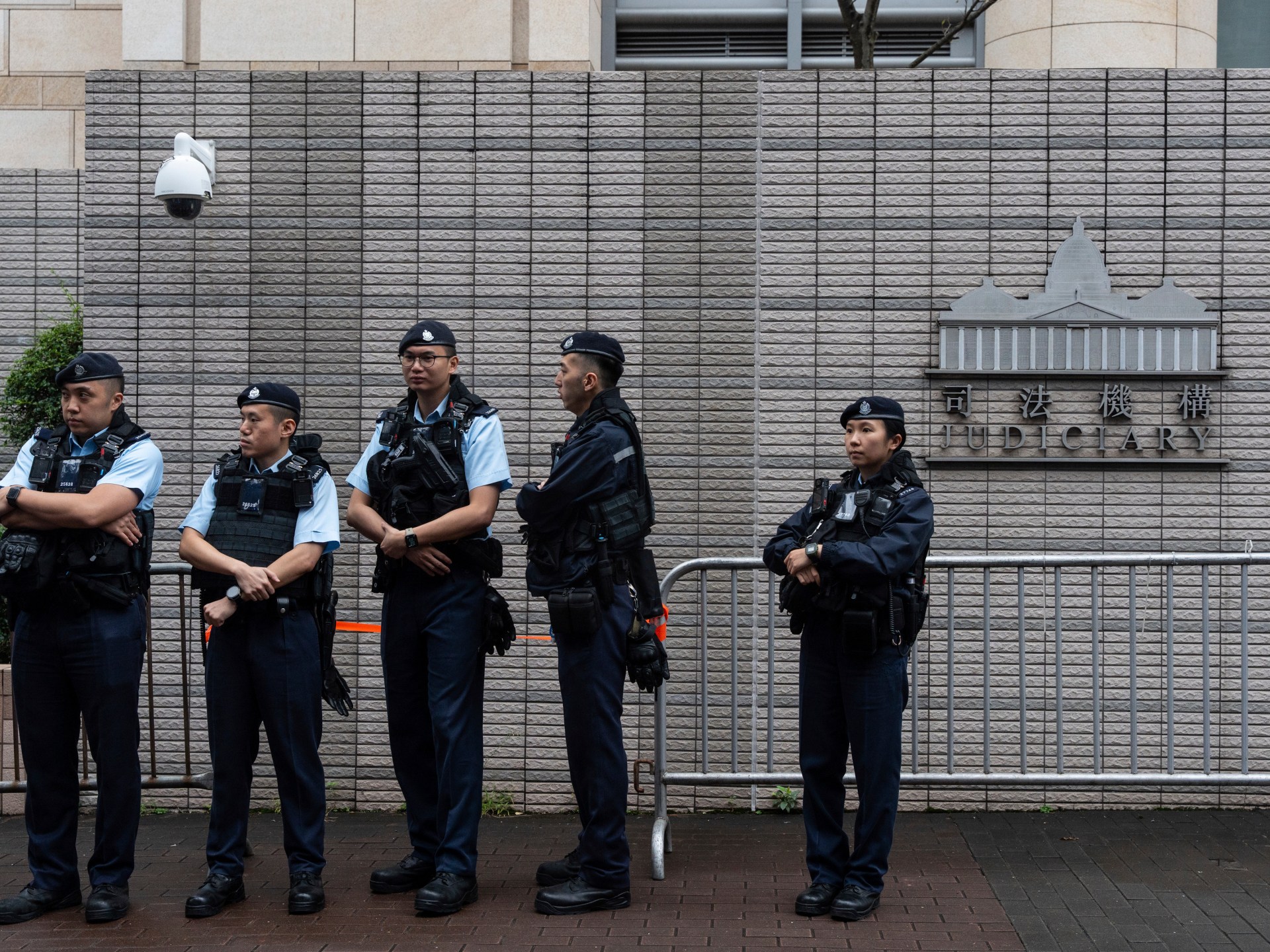
A Hong Kong Court sentenced 45 pro-democracy activists to jail terms of up to 10 years on Tuesday, in the first-ever mass sentencing since Beijing imposed a controversial national security law on the semi-autonomous Chinese city.
The activists were among 47 people arrested in 2021 for organising unofficial primary elections to choose pro-democracy legislative candidates. Authorities alleged the action violated the sweeping Beijing security law first introduced in 2020.
In what’s being called the largest national security case in Hong Kong, prosecutors accused the defendants of plotting to “overthrow” the government by forcing the city’s leader to resign. Two people were earlier acquitted during the lengthy trial.
Foreign governments and rights groups swiftly condemned the Hong Kong and Chinese authorities for the verdict amid concerns of democratic backslide and human rights violations in the city of seven million.
Here’s what we know about the sentencing and the case that led to it:

What led to the trial of the Hong Kong 47?
Following a huge wave of protests in 2019 against a new law, which could have allowed extraditions to mainland China, pro-democracy advocates and politicians organised a primary election set for July 2020 to help shortlist candidates who would run in the legislative elections.
The 2019 law was scrapped after millions of people thronged the streets for months, crippling the financial hub. These were the biggest protests since the 2014 Umbrella Movement, which was sparked by Chinese proposals to pre-approve candidates for Hong Kong’s legislative elections.
The pro-democracy camp, with the unofficial 2020 elections, was seeking to hold a majority in the 70-seat legislature and press for greater police accountability and democratic elections to choose the city’s leaders, all key demands of the protesters.
Presently, an Election Committee, mostly handpicked by Beijing, selects a large proportion of Hong Kong’s lawmakers and all the executives, including the chief executive. Hong Kongers can only directly vote for about 20 percent of the legislature.
Government officials, ahead of the unofficial election in 2020, warned that the vote might violate Beijing’s 2020 national security laws imposed in response to the 2019 protests. The law is criticised by rights groups for broadly criminalising “subversion” – or undermining authority – as well as secession, “terrorism”, and collusion (with foreign forces).
However, the vote went ahead on July 11 and 12, 2020. More than 600,000 of the city’s seven million residents voted in the elections – over 13 percent of the registered electorate.
Beijing immediately criticised the elections and called them a challenge to the national security law. Hong Kong previously enjoyed a range of legal and human rights protection after its sovereignty was transferred to China in 1997 under the principle of “one country, two systems”.
On January 6, 2021, 55 candidates and participants in the vote were arrested.
Eventually, 47 people were charged with conspiracy to commit subversion or undermine the appointed government.
The official legislative elections were later postponed to December 2021, with authorities citing the COVID-19 pandemic.

Who was arrested and how did they plead?
Some of those arrested include legal scholar Benny Tai (60), who was prominent in the 2019 protests and who was cast by prosecutors as the “organiser” of the conspiracy to overthrow the government.
Former student leaders Joshua Wong (27) and Lester Shum (31), as well as former lawmakers Claudia Mo (67) and Alvin Young (48), were also arrested.
The trial began with a marathon pre-trial hearing at the West Kowloon Magistrates’ Court between March 1 and 4, 2021. It continued in June 2022. Many of the defendants were denied bail and were remanded in prison up until Tuesday.
Three judges hand-picked by the government heard the arguments.
Prosecutors argued that the group aimed to win a legislative majority block, and indiscriminately block the passing of government budgets in an attempt to paralyse the government.
However, the defendants’ lawyers pushed back, saying the election was simply an exercise of democracy, and that no eventual coup “scheme” would have materialised from it.
Tai, and 30 others, had earlier pleaded guilty during the trial, seeking lighter sentences.
In May, the court found 14 of the remaining activists guilty of subversion, while two others – former district councilors Lawrence Lau and Lee Yue-shun, were acquitted.

What did the court rule on Tuesday?
Benny Tai received the heaviest sentence of 10 years. Prosecutors had earlier accused the scholar of being the “organiser” of the conspiracy.
In the judgement posted online, the court called Tai the “mastermind” and said he had “advocated for a revolution” through a series of previously published articles that traced his thinking.
According to the Associated Press news agency, the judges had referenced a statement Tai made in March 2020: He said obtaining a controlling majority in the legislature – typically dominated by the pro-Beijing camp, could be “a constitutional weapon with great destructive power”. The judges also accused Tai of writing articles suggesting that repeatedly blocking government budgets could grind governmental functions to a halt.
Tai, in an earlier letter seeking a shorter sentence, had pleaded that thoughts outlined in said articles were “never intended to be used as a blueprint for any political action”.
Young activist Owen Chow (27) received the second lengthiest sentence – seven years and nine months – for running as a candidate in the election.
Former journalist Gwyneth Ho, 34, who prominently live-streamed the 2019 protests, also received seven years for running in the election.
Meanwhile, Joshua Wong (28), a former student leader and internationally known activist, as well as lawmaker Claudia Mo (67) received four years and eight months, and four years and two months, respectively. Both had also earlier pleaded guilty.
Full overview of all 45 sentences in the trial of 47 #HongKong pro-democracy leaders for “conspiracy to subvert state power” under the national security law. pic.twitter.com/nnC7cUhCBa
— Hong Kong Democracy Council (@hkdc_us) November 19, 2024
The judges said the camp’s plan to effect change would have undermined the government and constituted a constitutional crisis. The sentences had been reduced for defendants who said they were unaware the plan was unlawful, according to the judges.
However, Tai and former lawmaker Alvin Yeung (43) – who received five years and one month – were not considered for lighter sentences. The court said it was because they were lawyers who knew the law but were “absolutely adamant in pushing for the implementation of the scheme.”

What are the implications of the ruling?
Analysts say the ruling is a litmus test for democracy in Hong Kong and illustrates just how much authorities have suppressed dissent since the 2019 anti-government protests and the resulting 2020 security law.
The international financial hub was once viewed as largely autonomous and free of Beijing’s control. However, the drastic changes imposed by the national security law reflect how Beijing’s promise to retain the former British colony’s civil liberties is increasingly threatened, experts say.
Many Hong Kongers feel the same. Hundreds protested outside the courts throughout the trials.
On Tuesday, the defendants’ families filled the courtroom and waved encouragingly as the court sentences were read out, while others broke down in tears. Outside the court, dozens of pro-democracy supporters stood in solidarity, as well as diplomatic representatives from several consulates in Hong Kong.
Kevin Yam, a former Hong Kong lawyer based in Australia and wanted by city authorities for alleged national security offences, told Al Jazeera he knew many of the defendants.
“I’ve known [Tai] for over 20 years, and the thought of him going in for 10 years is heavy,” Yam said. “I mean, what has he done? He’s organised an informal vote on something. Basically, all 45 of the people convicted are being punished for seeking to work within the constitutional process.”
Chan Po-ying, wife of politician Leung “Long Hair” Kwok-hung (68), who received six years and nine months, told reporters the advocates had been trying to use some of the rights granted by the city’s mini-constitution to pressure those who are in power to address the will of the people.
“This is an unjust imprisonment. They shouldn’t be kept in jail for one day,” said Chan, the chair of the League of Social Democrats – one of the city’s remaining pro-democracy parties.

How are foreign governments reacting to the sentencing?
Rights groups and foreign governments swiftly criticised the sentencing.
In a statement, the United States Consulate in Hong Kong condemned the sentences and alleged that the defendants had been aggressively prosecuted for taking part in normal political activity.
“We call on [Beijing] and Hong Kong authorities to cease politically motivated prosecutions of Hong Kong citizens and to immediately release all political prisoners and individuals jailed for their peaceful advocacy for rights and freedoms,” the statement read.
Australian Foreign Minister Penny Wong also said her government was “gravely concerned” by the rulings for Australia-Hong Kong dual citizen Gordon Ng, sentenced to more than seven years, and the others. Wong added that Australia expresses “strong objections to the Chinese and Hong Kong authorities” over the continuing broad application of national security legislation.
Meanwhile, Taiwan’s presidential office spokesperson Karen Kuo said the Chinese government had used “unjust procedures” to suppress participation and freedom of speech. The sentencing, she said, “further proves that ‘one country, two systems’ is unfeasible,” Kuo said, adding that Hong Kong’s touted autonomy was broken.
The European Union, for its part, called the sentencing an “unprecedented blow against fundamental freedoms, democratic participation and pluralism in Hong Kong”.
Maya Wang, China director at Human Rights Watch, said the harsh sentences reflect how fast Hong Kong’s civil liberties and judicial independence have nosedived in the past four years since the national security law was introduced.
“Running in an election and trying to win it is now a crime that can lead to a decade in prison in Hong Kong,” Wang said.
