
Close Menu

    Subscribe to Updates

    Get the latest creative news from FooBar about art, design and business.

    What's Hot

    What Real Estate Agents Need To Know About Cognitive Impairment

    December 10, 2024

    Will 2025 finally be a ‘normal’ housing market?

    December 10, 2024

    The Customer Is Always Right, But What If They’ve Been Misinformed?

    December 10, 2024
    Facebook X (Twitter) Instagram
    Trending
    • What Real Estate Agents Need To Know About Cognitive Impairment
    • Will 2025 finally be a ‘normal’ housing market?
    • The Customer Is Always Right, But What If They’ve Been Misinformed?
    • eXp, Weichert say Gibson plaintiffs’ motion is all about attorneys’ fees
    • Americans More Optimistic Home Prices and Mortgage Rates Have Peaked
    • EasyKnock abruptly shuts down its sale-leaseback platform
    • Under-The-Radar NAR Nonprofit May Have Hidden GOP Agenda
    • NAR’s nonprofit funds conservative groups
    Facebook X (Twitter) Instagram
    Industry Movement
    • Home
    • Entertainment
    • Business
    • News
    • Real Estate
    Industry Movement
    Home»News»Why dyeing clothes has a big environmental impact
    News

    Why dyeing clothes has a big environmental impact

    adminBy adminNovember 5, 2024No Comments0 Views
    Facebook Twitter Pinterest LinkedIn WhatsApp Reddit Tumblr Email
    Share
    Facebook Twitter LinkedIn Pinterest Email


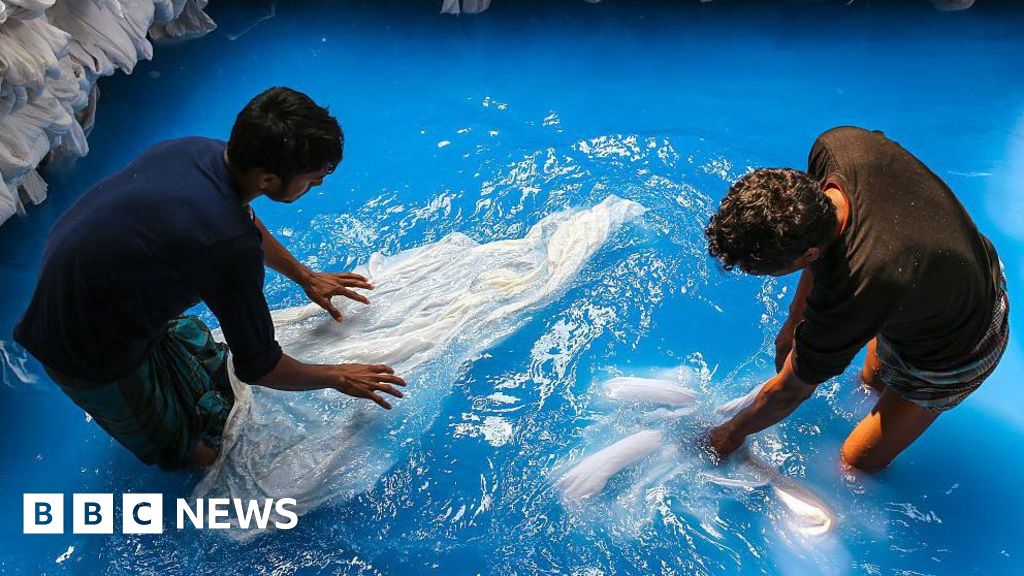
    Getty Images Workers at a dyeing factory in Bangladesh stand knee-deep in blue dye.Getty Images

    Some textile dyeing is still done by hand

    In a small corner of rural Taiwan, set amongst other dye houses and small factories, the start-up Alchemie Technology is in the final phase of rolling out a project it claims will upend the global apparel industry and slash its carbon footprint.

    The UK-based start-up has targeted one of the dirtiest parts of the apparel industry – dyeing fabric – with the world’s first digital dyeing process.

    “Traditionally in dyeing fabric, you’re steeping the fabric in water at 135 degrees celsius for up to four hours or so – gallons and tons of water. For example, to dye one ton of polyester, you’re generating 30 tons of toxic wastewater,” Alchemie founder Dr Alan Hudd tells me.

    “That is the same process that was developed 175 years ago in the northwest of England, in the Lancashire cotton mills and the Yorkshire cotton mills, and we exported it,” he points out, first to the US and then onto the factories in Asia.
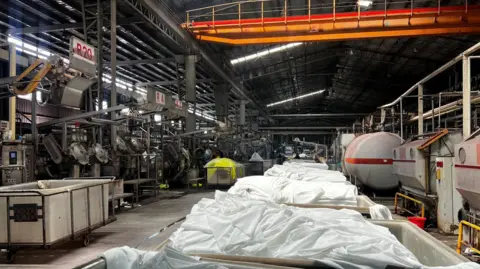
    Crates of white textiles sit in a large dyeing factory

    Dye houses use a lot of heat and water

    The apparel industry uses an estimated five trillion litres of water each year to simply dye fabric, according to the World Resources Institute, a US-based non-profit research centre.

    The industry is, in turn, responsible for 20% of the world’s industrial water pollution, while also using up vital resources like groundwater in some countries. It also releases a massive carbon footprint from start to finish – or around 10% of annual global emissions, according to the United Nations Environment Programme.

    Alchemie says its technology can help solve that problem.

    Called Endeavour, its machine can compress fabric dyeing, drying, and fixing into a dramatically shorter and water-saving process.

    Endeavour uses the same principle as inkjet printing to rapidly and precisely fire dye onto and through the fabric, according to the company. The machine’s 2,800 dispensers fire roughly 1.2 billion droplets per linear meter of fabric.

    “What we’re effectively doing is registering and placing a drop, a very small drop precisely and accurately onto the fabric. And we can switch these drops on and off, just like a light switch,” says Dr Hudd.

    Alchemie claims big savings through the process: reducing water consumption by 95%, energy consumption up to 85%, and working three to five times faster than traditional processes.

    Developed initially in Cambridge, the company is now in Taiwan to see how Endeavour works in a real-world environment.

    “The UK, they’re really strong in R&D projects, they’re really strong in inventing new things, but certainly if you want to move to commercialisation you need to go to the real factories,” says Ryan Chen, the new chief of operations at Alchemie, who has a background in textile manufacturing in Taiwan.
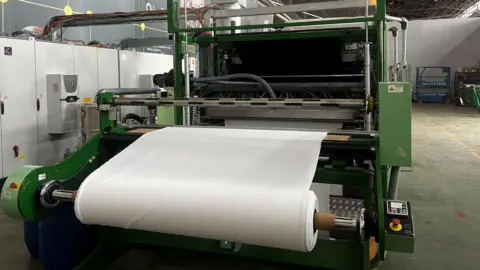
    A roll of white cloth sits on Alchemie's new dyeing machine

    Alchemie has developed a machine uses a printing process to fix colours

    Alchemie is not the only company attempting a nearly waterless dye process.

    There’s the China-based textile company NTX, which has developed a heatless dye process that can cut down water use by 90% and dye by 40%, according to their website, and the Swedish start-up Imogo, which also uses a “digital spray application” with similar environmental benefits.

    NTX and Imogo did not reply to the BBC’s interview request.

    Kirsi Niinimäki, a professor in design who researches the future of textiles at Finland’s Aalto University, says the solutions offered by these companies look “quite promising” – although she adds that she would like to see more specific information about issues like the fixing process and long-term studies on fabric durability.

    But even though it’s early days, Ms Niinimäki says companies like Alchemie could bring real changes to the industry.

    “All these kinds of new technologies, I think that they are improvements. If you’re able to use less water, for example, that of course means less energy, and perhaps even less chemicals – so that of course is a huge improvement.”
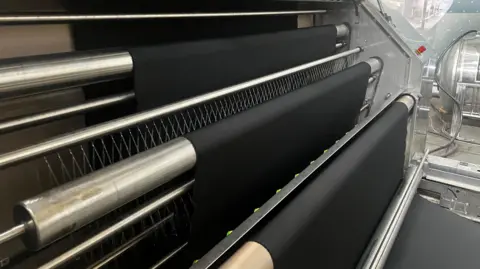
    Black textiles on the Alchemie dyeing machine

    Alchemie is in the process of scaling up its operations

    Back in Taiwan, there are still some kinks to be ironed out – like how to run the Endeavour machine in a hotter and more humid climate than the UK.

    Alchemie service manager, Matthew Avis, who helped rebuild Endeavour in its new factory location, discovered that the machine needs to operate in an air-conditioned environment – an important lesson given how much apparel manufacturing happens in southern Asia.

    The company also has some big goals for 2025. After its test run with polyester in Taiwan, Alchemie is heading next to South Asia and Portugal to test their machines and also try it out on cotton.

    They will also have to figure out how to scale up Endeavour.

    Big fashion companies like Inditex, the owner of Zara, work with thousands of factories. Its suppliers would need hundreds of Endeavours working together to meet its demand for fabric dyeing.

    And that’s just one company – there will be many, many more in need.

    More Technology of Business


    Source link

    Share. Facebook Twitter Pinterest LinkedIn Tumblr Telegram Email
    admin

    Related Posts

    US state of Alabama carries out third execution by nitrogen gas | Crime News

    November 22, 2024

    Old is gold: Why Bollywood is turning to re-releases amid string of flops | Cinema News

    November 22, 2024

    The rise and fall of Matt Gaetz in eight wild days

    November 22, 2024
    Leave A Reply Cancel Reply

    Recent Posts
    • What Real Estate Agents Need To Know About Cognitive Impairment
    • Will 2025 finally be a ‘normal’ housing market?
    • The Customer Is Always Right, But What If They’ve Been Misinformed?
    • eXp, Weichert say Gibson plaintiffs’ motion is all about attorneys’ fees
    • Americans More Optimistic Home Prices and Mortgage Rates Have Peaked
    Recent Comments
      Archives
      • December 2024
      • November 2024
      • October 2024
      • September 2024
      • August 2024
      Categories
      • Business
      • Entertainment
      • News
      • Real Estate
      Meta
      • Log in
      • Entries feed
      • Comments feed
      • WordPress.org
      Demo
      Top Posts

      How To Avoid These 12 Costly Business Traps

      November 30, 202430

      Gen Zer Won NYC Housing Lottery, Pays $1.6K Rent for Queens Apartment

      October 1, 202427

      SEC Chair Gary Gensler will step down Jan. 20, making way for Trump replacement

      November 21, 202424

      Better Pay, More Time Off: What Real Estate Agents Want This Labor Day

      August 31, 202424
      Don't Miss
      Real Estate

      What Real Estate Agents Need To Know About Cognitive Impairment

      By adminDecember 10, 20245

      Senior real estate specialist Nikki Buckelew writes that understanding cognitive impairment among seniors is about…

      Will 2025 finally be a ‘normal’ housing market?

      December 10, 2024

      The Customer Is Always Right, But What If They’ve Been Misinformed?

      December 10, 2024

      eXp, Weichert say Gibson plaintiffs’ motion is all about attorneys’ fees

      December 10, 2024
      Stay In Touch
      • Facebook
      • Twitter
      • Pinterest
      • Instagram
      • YouTube
      • Vimeo

      Subscribe to Updates

      Get the latest creative news from SmartMag about art & design.

      Demo
      Our Picks

      What Real Estate Agents Need To Know About Cognitive Impairment

      December 10, 2024

      Will 2025 finally be a ‘normal’ housing market?

      December 10, 2024

      The Customer Is Always Right, But What If They’ve Been Misinformed?

      December 10, 2024
      Most Popular

      How To Avoid These 12 Costly Business Traps

      November 30, 202430

      Gen Zer Won NYC Housing Lottery, Pays $1.6K Rent for Queens Apartment

      October 1, 202427

      SEC Chair Gary Gensler will step down Jan. 20, making way for Trump replacement

      November 21, 202424
      Legal Pages
      • About Us
      • Disclaimer
      • DMCA Notice
      • Privacy Policy

      Type above and press Enter to search. Press Esc to cancel.