


 BBC
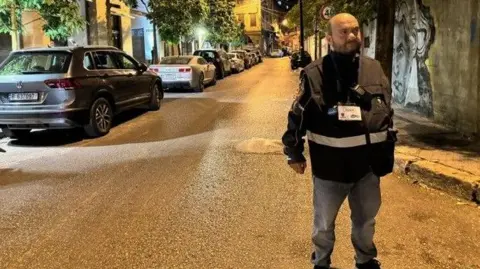
BBCThe sound of war is loud at night in Beirut’s eastern Achrafieh neighbourhood.
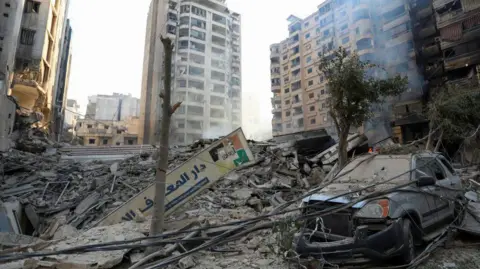
Residents can hear Israeli air strikes hitting the Lebanese capital’s southern suburbs, known as Dahieh. Some can even see the explosions lighting up the sky from their balconies.
However, on the streets it is quiet.
Volunteers in uniform are patrolling the predominantly Christian neighbourhood holding walkie-talkies to co-ordinate their operation.
The neighbourhood watch was formed a few years ago following the financial crisis that hit Lebanon to reassure residents worried about crime. But with recent developments, the mission has changed.
“We have concerns with displaced people who are coming in huge numbers to Beirut, and they have a lot of needs, and it is very complicated,” says Nadim Gemayel, who formed the organisation behind the neighbourhood watch.
Communities across Lebanon rallied to help house and feed the hundreds of thousands of families who were displaced when Israel escalated its air campaign against Hezbollah last month before launching a ground invasion of the south.
However, an influx of people from the predominantly Shia Muslim areas where the Iran-backed group has a strong presence – Dahieh, south Lebanon, and the Bekaa Valley in the east – into places which are majority Sunni Muslim and Christian also risk exacerbating sectarian divisions in a country where memories of the 1975-1990 civil war are still vivid.
Recent Israeli attacks on those areas has only served to heighten tensions between residents and the displaced.
A strike on 14 October in the northern town of Aitou, which killed 23 displaced people, shook the Christian community.
Even though the arrival of wealthy Shia families from the south and Dahieh have caused rental prices to skyrocket and boosted the incomes of landlords, many are now concerned that they could be members of Hezbollah and potential Israeli targets.
Some building management firms have sent out forms to residents asking them for identity details, the number of family members who are staying in flats, and vehicles they are using.
In some areas, leaflets have been distributed asking for members of Hezbollah to leave, while individuals known to be affiliated with the group have been told to go.
“There is a feeling of fear. Some citizens are suspicious about who is coming to their region. A lot of people are very afraid that some Hezbollah members live in a building where they are followed by Israel and probably targeted,” Gemayel says.
“This is why we are trying to follow up what’s happening and trying to control this with the army and security forces to secure the refugees and citizens at the same time.”
Although residents may feel reassured by the neighbourhood watch, some worry that such initiative carries echoes of the civil war, when sectarian militias controlled different areas of Beirut.
The civil war, which lasted 15 years and left almost 150,000 people dead, pitted militias linked to Lebanon’s sects against each other.
It began as a conflict between Christian and Palestinian militias, which were allied with Muslim militias. Later, there were conflicts among Christian and Muslim militias. Foreign powers were also drawn in, with Syrian troops moving in and Israel invading twice.
The main Christian militia, the Lebanese Forces, was led by Nadim Gemayel’s father, Bashir, until he was assassinated in Achrafieh in 1982 after being elected the country’s president.
All militias were supposed to be disarmed after the 1989 Taif Accord that ended the civil war, but Hezbollah was exempt because it was fighting Israeli forces occupying southern Lebanon.
When Israeli forces finally withdrew in 2000, Hezbollah resisted pressure to give up its weapons and continued to carry out cross-border attacks on Israel. They fought a month-long war in 2006, which left much of the south and Beirut’s southern suburbs in ruins.
Gemayel has long called for Hezbollah to give up its weapons. After Israel escalated its air campaign, he said the group was “reaping what it sowed over the past 20 years” – but also warned that the Lebanese people would “pay a heavy price in destruction and devastation”.
 Reuters
In the mixed neighbourhood of Hamra in western Beirut, the scene is completely different.
Unlike in the predominantly Christian side of Beirut, many schools in Hamra have been turned into shelters for displaced families.
Members of the Syrian Socialist National Party, an ally of Hezbollah which has a presence in Hamra, rushed to open empty buildings, including some newly built apartment blocks, to house displaced families.
The move caused tensions between some buildings’ owners and displaced families who broke into them. Landlords expressed fears that the new arrivals would eventually refuse to leave the free accommodation.
In a six-floor 1960s-style building in the heart of Hamra, a designer who wished to remain anonymous has her studio set on the top floor. She says some families broke into the building and were squatting in the empty flats.
“At beginning, we had 20 people. Now, we have 100 living in the building,” she tells me.
“I have great sympathy for them and don’t want women and children to stay in the street. I won’t ask them to leave until the government finds a solution, but this is not sustainable.”
She is also worried about the potential social impact on the area.
The new arrivals are all from the Shia community and follow strict religious rules, with the women wearing the chador, a full-body cloak that covers everything but their faces.
“I don’t have a problem with any religion, but they also should accept my style of living as an atheist,” she says.
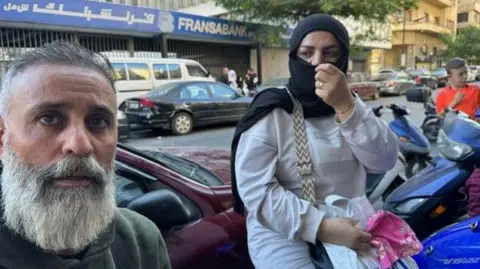
The mood is indeed changing in Hamra, which is home to multiple cultures and faiths.
Thousands of people are believed to have moved there.
It is hard to drive or even walk through the neighbourhood because of the number of cars and motorcycles causing traffic jams.
The night-life has also changed, with the party- and bar-goers replaced by people queueing for fast food and shisha cafes.
Outside shelters, men and women sit on the pavement, smoking shishas and watching news on their mobile phones or even TVs late into the night – something residents have complained about.
But increasing numbers of building owners are emptying people from their properties.
Fatima al-Haj Yousef, who arrived with her husband and three children from the Bekaa Valley, is worried about where to go next. She has stayed in this building for the past three weeks.
“We are happy to sign documents confirming that when the war is over, we will leave, but they sent the police to force us out,” she says. Fatima is mainly worried about her three-and-a-half-year-old daughter who suffers with cancer and needs medication.
“I just need to be somewhere safe and clean for my daughter. The schools are packed full of people, and everyone is smoking indoors.”
Fatima didn’t feel there was any sectarian tension against her as a Shia, but another man who stayed in the building with his five children had a different view.
“If they accept to pay rent, we already can pay rent. But [the landlord] didn’t accept… She wants us to go. It’s not only about the building. It’s something else. I think, and this is my opinion, she wants to kill the [Shia] Muslims here.”
This view was echoed by Daniel, a Hezbollah social worker who was helping finding alternative housing for the families.
“They think that resistance is weakened by the death of Sheikh Hassan Nasrallah, but we are all Nasrallah,” he says, referring to the Hezbollah leader killed by Israel in Dahieh last month.
He believes that this building is being cleared because the inhabitants are displaced families, who are predominantly Shia and are supporters of what he describes as “the resistance movement” – or Hezbollah.
Many here believe that Israel won’t stop until Hezbollah is completely disarmed.
“Either all Lebanon will be destroyed by Israel which will be catastrophic, or they [Hezbollah] surrender and give up their arms, and we build a Lebanese state that will be based on the Taif agreement, and everyone has equal rights and obligations,” says Nadim Gemayel.
