
It is usually said in United States elections that “bread and butter” issues are what drive people to vote and shape their choices, with concerns about economic factors like inflation and the cost of living regularly topping the lists of voters’ priorities.
Further-from-home issues like foreign policy, the wisdom goes, do not decide elections. As one adviser put it in the lead-up to Bill Clinton’s election in 1992, “It’s the economy, stupid”. At the time, then-President George HW Bush had just ousted Iraqi forces from Kuwait, a foreign policy “win” that did not secure Bush victory at the polls. The notion has since become a staple of election cycles — but historians and analysts warn it is only partially true.
Foreign policy does matter in US presidential elections, they warn, especially those tight enough to be decided by extremely narrow margins, as the current one promises to do.
With a protracted war in Ukraine and a widening one in the Middle East, both of which the US has spent heavily on and is growing more embroiled in, as well as foreign policy-related concerns like immigration and climate change that are at the top of many voters’ priorities, it’s clear that the economy won’t be the lone factor determining how Americans vote next month.
While the economy still tops the list, a September poll of voters by the Pew Research Center found that 62 percent of voters listed foreign policy as an issue that’s very important to them. Foreign policy concerns were key for Trump voters in particular — 70 percent of them — but 54 percent of Harris voters also listed foreign policy as a key priority for them, just as many as those who listed Supreme Court appointments as one.
“In very close races such as this year’s match-up between former President Donald Trump and Vice President Kamala Harris, foreign policy issues could tip the balance,” Gregory Aftandilian, a Middle East politics and US foreign policy scholar, wrote in a recent paper. “In particular, voters’ views of how the candidates would handle the Israel-Hamas-Hezbollah and the Russia-Ukraine wars could be decisive in battleground states and thus the election.”
A US election myth
The notion that foreign policy matters little in US presidential elections has only gained ground over the last three decades. Until then, surveys polling Americans before elections found 30 to 60 percent of them listing a foreign policy issue as the most important one facing the country. As the Cold War ended, that number dropped to five percent.
“This is largely a post-Cold War idea”, Jeffrey A Friedman, an associate professor of government at Dartmouth College focused on the politics of foreign policy decision-making, told Al Jazeera.
Even as post-9/11 the US launched years-long wars in Iraq and Afghanistan, which cost Americans some $8 trillion, in addition to thousands of lives, foreign policy played a secondary role in elections, though it did help former President George W Bush win re-election in 2004. While the 2003 invasion of Iraq made him widely unpopular later, at the time Bush won in part because he was able to capitalise on his role as the leader in the aftermath of the 9/11 attacks.
A candidate’s ability to portray themselves as strong and decisive before the rest of the world, more than any specifics about the foreign policy decisions they would make, has mattered in the past, Friedman noted.
He cited former US President Lyndon Johnson, who paved the way for US escalation in Vietnam, during the 1964 presidential campaign. Johnson knew Americans did not want war in Vietnam, but he also knew he had to demonstrate that he would be “tough on communism”, said Friedman.
“Voters are always sceptical of the use of force abroad, but they are also sceptical of leaders who appear as though they will back down in the face of foreign aggression,” he added. “Presidential candidates are trying to convince voters that they’re tough enough to be commander-in-chief. They don’t want to promise that they’ll involve the United States in armed conflicts, but they also need to avoid the perception that they will back down when challenged.”
That’s precisely what both Donald Trump and Kamala Harris are trying to do as Israel has expanded its year-long war in Gaza to Lebanon, and as it promises to drive the whole region, and possibly the US, into further conflict.
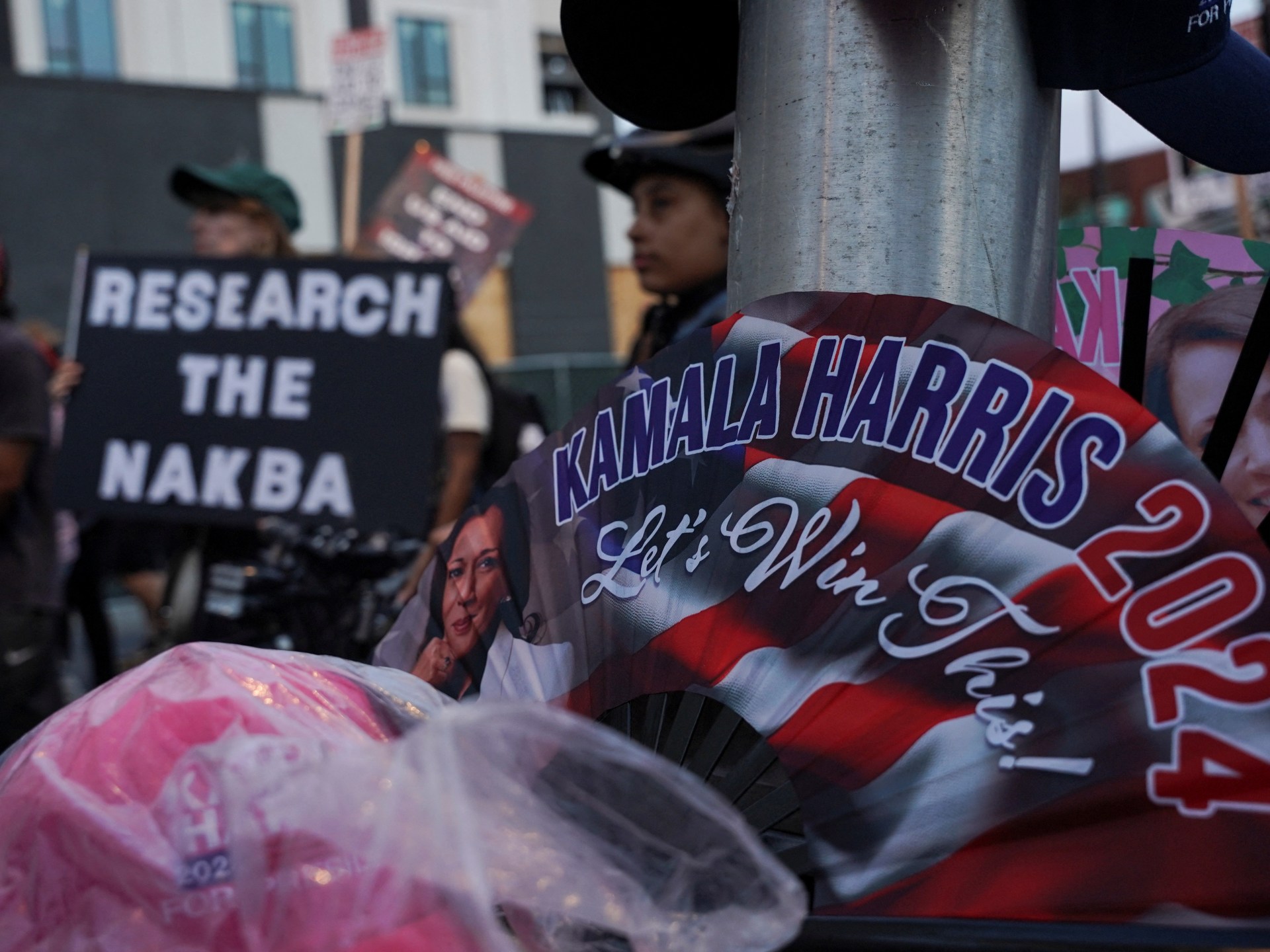
Much like opposition to the Vietnam War, which saw the 1968 Democratic National Convention in Chicago, Illinois become the stage for mass protests that police violently repressed, US support for Israel has proven deeply divisive in the US, leading to nationwide campus sit-ins and presenting a foreign policy issue that candidates are regularly asked to address.
“Harris and Trump are in a very common bind with that,” Friedman added. “And so what they attempt to do is project a vague sense that they will competently handle the conflict without making any promises that would be divisive.”
The Gaza vote
Making vague promises may be a strategy, but in light of the US’s deep embroilment with Israel’s wars in the Middle East, which the US has heavily subsidised and now risks becoming further entangled in, it might not be enough.
With polls an imprecise science, and razor-thin margins in many of the surveys, it’s difficult to predict how much some Americans’ dismay with US support for Israel may impact the vote, and whether pro-Palestine voters will turn to Trump, vote for third parties, stay home, or reluctantly vote for the continuation of President Joe Biden’s policies that Harris has promised.
But the possibility that a protest vote over Gaza might tip the election is not so implausible, some polls suggest.
“If Harris loses and she loses because Muslims didn’t vote for her in swing states, it will be directly because of Gaza,” Dalia Mogahed, a scholar at the Institute for Social Policy and Understanding (ISPU), told Al Jazeera. “The most important issue that Muslims cite for how they will judge a candidate is their handling of the war on Gaza.”
Mogahed cited an ISPU study that found 65 percent of Muslim votes went to Biden in the 2020 election — a number significantly larger than the margin by which he won key battleground states. Before Biden dropped out of the race in July, the number of Muslim voters who said they would support him again had dropped to 12 percent.
Harris has reiterated her unwavering support for Israel, and while she has at times softened her language and spoken of the suffering of Palestinians in more empathetic terms, she has indicated no readiness to shift on policy, and it is unclear she has earned back any of the support Biden lost.
While the ISPU study focused on Muslim American voters, polls of Arab American voters yield similar results, and again see a foreign policy issue — the war in Gaza — as a key factor in the election.
There is a historical precedent for that, Friedman said, citing voting blocks like Cuban Americans in Florida opposed to the normalisation of relations with Cuba or Eastern European communities in the US backing Clinton’s push to expand NATO in the mid-1990s. But if certain groups in the past have backed one candidate over another because of foreign policy preferences, a phenomenon like the Uncommitted National Movement is new, and a signal of deep disillusion with US foreign policy beyond party lines.
“The notion that certain demographic groups have strongly held foreign policy preferences is not particularly new,” Friedman said. “What I’m not sure we’ve seen before is a fairly explicit threat by a community to withhold votes for a candidate whom you’d ordinarily expect them to support.”
But it’s not just Muslim or Arab Americans or others, including many young voters, who may see the war in Gaza as the most pressing issue this election cycle, for whom foreign policy matters.
Across communities, particularly those most lacking in resources, foreign policy is often seen not as a far-removed problem but a “domestic issue”, Rasha Mubarak, a community organiser in Orlando, Florida, told Al Jazeera.
“American voters are able to assess the material conditions of their everyday life and connect it to what’s happening in Gaza,” said Mubarak, citing social needs from healthcare to hurricane relief that people understand would benefit from the public resources the US is investing to support military efforts abroad.
“[It’s] beyond the moral issue of the fact that close to 200,000 Palestinians have been killed due to Israel’s bombardment and genocide,” said Mubarak, referring to what a study estimates is the potential cumulative toll of the war. “American voters understand the interconnectedness.”
