


La Mansana Table and Bench, La Mansana de Chinati, Marfa, Texas, from Donald Judd Furniture (2024).
Photo: Matthew Millman/Mack Books
Thanks in some measure to Kim Kardashian, who recently claimed to own what turned out to be Donald Judd knockoffs, we have been reminded of the perennial appeal of the artist’s furniture. But even before Kim K., and 30 years after his death, it seems we are always talking about Donald Judd and making homages to his deceptively simple designs. You can see plenty of“Judd-style” platform beds on 1stDibs or walk into any number of stylish stores and cafés all over the world to see a variation on his daybed or chairs.
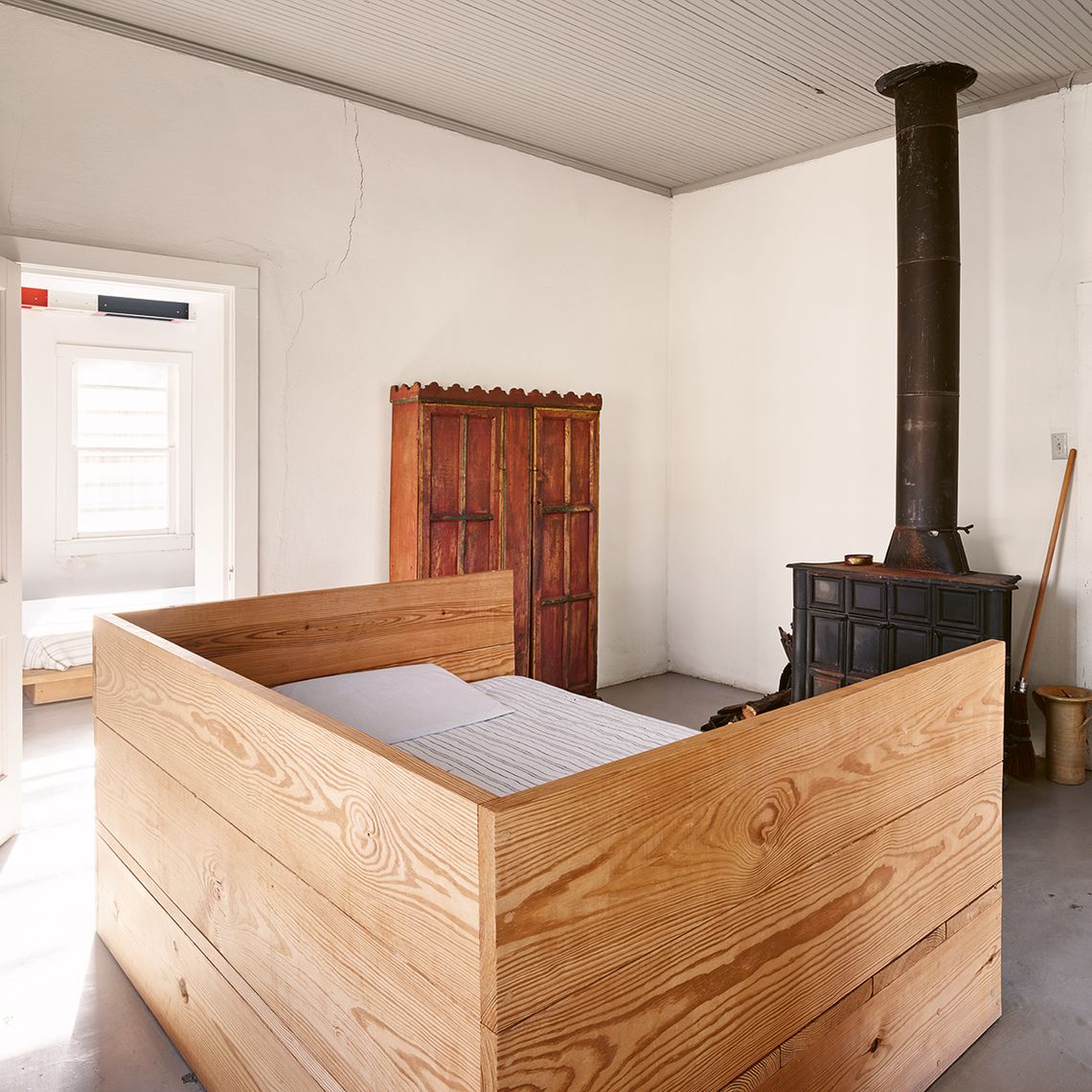
This month, arts publisher MACK published Donald Judd Furniture, a companion volume to its previous book on the buildings and interiors of the prolific artist, designer, and theorist. The book is less a showy coffee-table volume than a manual filled with diagrams that show exactly how the planes of wood and material should fit together. It’s the analog version of what’s already available on the Judd Furniture website by way of the Judd Foundation, but the book is much easier to peruse, with companion photos of the furniture as it took up space in Judd’s own apartments and workshops.

Fourth Floor Low Table, 101 Spring Street, Judd Foundation, New York.
Photo: Matthew Millman/Mack Books
For architects, the conversation with Judd is an ongoing one. As both Furniture and the preceding Spaces book bear out, Judd feels like he belongs to the discipline as much as if not more than to the art world: The dining-room chairs from his 101 Spring Street house (now home to Judd’s eponymous foundation) echo Frank Lloyd Wright’s Usonian chairs; a table at his Marfa compound seems like a long-lost relative of Enzo Mari’s autoprogettazione. As for his influence on contemporary architecture, it’s so pervasive it can almost go unnoticed, which is why we sat down with three New York designers who have borrowed from or worked with Judd designs to talk about their relationship to the artist.

From left: Slip Together Plywood Architecture Table, Architecture Office, Marfa, Texas. Photo: Matthew Millman/Mack BooksTwo-by-Twelves furniture, Casa Perez, Presidio County, Texas, from Donald Judd Furniture (2024). Photo: Matthew Millman/Mack Books
From top: Slip Together Plywood Architecture Table, Architecture Office, Marfa, Texas. Photo: Matthew Millman/Mack BooksTwo-by-Twelves furniture, Casa…
From top: Slip Together Plywood Architecture Table, Architecture Office, Marfa, Texas. Photo: Matthew Millman/Mack BooksTwo-by-Twelves furniture, Casa Perez, Presidio County, Texas, from Donald Judd Furniture (2024). Photo: Matthew Millman/Mack Books
How did you get Judd-ized?
As a sculpture student, I convinced my professors to let me live and work in Marfa at the Chinati Foundation. It was a scrappier institution then: This was pre-Instagram Marfa. I ended up doing everything there, from maintenance to conservation to basic admin, and it was really an interesting opportunity to get in touch not only with the work but with the universe that surrounds it. That experience really caused me to pivot toward architecture.

A room that Onland Architecture designed around Peter Freeman’s Donald Judd desk.
Photo: Mark Wickens
You recently worked on a project that involved some Donald Judd furniture; can you talk about that?
Yeah, part of that project, which was Peter Freeman’s Tribeca apartment, was to design around his black walnut Judd desk. That was a really rewarding way of returning back to my earlier time, when I worked for Peter’s gallery. It was such a delight to be able to organize an entire space around a single piece of Judd’s.
What is it about Judd’s design approach that you think has been most essential for you?
It’s the fluidity of the work: the way it moves between different scales, from the object to the space to the landscape, and the way they all start to dialogue with one another — though it’s often more like a confrontation. The work I do tries to explore those same relationships, although maybe not in quite so confrontational a way.

A house in upstate New York designed by Onland Architecture.
Photo: Mark Wickens

The house that Brown designed had very specific moments for viewing the outside.
Photo: Mark Wickens
Is there a particular project of yours that you tried this approach with?
One of the first projects I did upstate is a small house. I found myself rejecting this idea of the fluid interchange between interior and exterior that so much contemporary architecture is forced to accept. I chose to think about a space that was unabashedly interior-oriented, but then I used a small amount of glass to frame specific perspectives outward, as though the house were an object for viewing. When you think of Judd’s interest in the role of the viewer, setting up a specific frontal or other orientation toward a piece, some memory of that percolated there.
What is your favorite piece of Judd furniture?
The Double Daybed 28. I find the scale and configuration of this piece to be the most direct expression of two nearly architectural volumes held in tension against one another. Yet it’s a nice take on a space that is scaled to the body of an individual. On a personal level, as an intern at the Chinati Foundation in the early 2000s, I had the chance to spend many hours lying around reading on it. I also may have nearly ruined the cushion covers in a washing-machine disaster.
Do you remember your first encounter with Judd?
I first experienced Judd at Dia Beacon — his plywood works there — and I was so drawn to the severity as well as the simplicity of it. The humble materials especially: plywood, yes, but also concrete, aluminum. I was fascinated by that and the way it all seemed to play into how he worked and how he lived. After that, I did a deep dive into the Spring Street house, and I’ve gone to Marfa four times now. I get more curious with each visit.
What is it that drew you to Judd’s furniture and interiors?
It’s the way he was always interested in pairings. You can go to Spring Street and spend the whole time studying the shelves: There’s this nonhierarchical approach to how he placed objects — he’d put a rock next to a sculpture, as though they were the same thing. Or he’ll put a Biedermeier sofa next to some Swedish antiques, and then have a Mies chair. No matter what, he somehow makes sure the space around the object feels just as important as the object itself.

Colin King’s apartment in Tribeca.
Photo: Rich Stapleton

Photo: Rich Stapleton
When have you specifically channeled Judd for a design of your own?
In my own apartment in Tribeca, I took the same approach he did with Spring Street: really just stripping everything back, beginning with the floors, to reveal that warm pine. That in turn influenced the wall color, in order to establish that dialogue between floors and walls. Obviously, Judd didn’t use any window treatments — like, he really let the city be the background to the apartment — so I did something similar with that. And the whole way he created a space expressly for the composition of objects. That was definitely a guiding principle for me.
What is your favorite piece of Judd furniture?
This metal desk. It merges form and function, elevating the work beyond furniture into a sculptural piece: something that defines its space with balance and clarity, and that embodies Judd’s philosophy, his belief that art should seamlessly exist within daily life.
What’s your Judd story?
I grew up in New York, and I think part of what I respond to in his work is that he somehow captures this slice of what it was like in New York in the early ’90s. I feel so at home in his spaces. But what’s funny is that it was always on the periphery of my experience — I’m sure I’d seen his artwork everywhere, but I never went to one of his spaces until I did a project in Marfa in 2016. I just feel like I was always somehow aware of it.
Once you did start to realize you were surrounded by Judd, what is it you noticed?
The commitment to beauty, definitely, and to function. One thing I always think about is that, though “minimalism” gets thrown around a lot with Judd, there’s a kind of maximalism in his interiors and in his art, like he’s throwing around 6,000 tons of steel or whatever. It’s not the philosophy of minimalism as such that’s appealing; it’s the idea that you can make art and design objects in a sort of beautiful but humble way. It’s a refreshing take.

Lee’s, a private dining room, with a table and space designed by Nick Poe.
Photo: Dan McMahon
When have you found yourself “doing” Judd?
Lee’s, a private dining venue, was largely inspired by a space in Albano, Italy, where I attended a dinner when I was living in Rome in 2014. It was a humble space used for communal dinners and had a simple, open kitchen. That space stuck with me and felt like something missing in New York. A couple years later, I stumbled on a dilapidated mah-jongg parlor for rent next door to my old studio, and it seemed like the right fit. I had recently returned from a formative trip to Marfa where I had been for a week or so to work on a project. Experiencing Judd’s incredible work there, especially his living and work spaces, deeply resonated with me, having grown up in and around beloved downtown artist lofts, whose slow extinction I mourn. As I was building Lee’s out of pocket, it also spoke to me that the Judd ethos is about resourcefulness as much as it is about beauty.
I’ve also made lots of couches inspired by his daybeds, albeit with a lower back. They’re in line with his spirit and his philosophy — but you really can’t “do” Judd as well as he did, even with the foundation-certified reproductions. The wood back then was just so much better; today, you can’t get old construction lumber anywhere. The amount of time I’ve spent digging through piles of 2x12s to find the straight ones! All he had to do was go to the nearest hardware store. Now there’s Home Depots everywhere. It’s not really the same ethos.

A kitchen table by Donald Judd in Marfa.
Photo: Nick Poe
What’s your favorite piece of Judd furniture?
It’s archetypical. Could be any farm table, or all of them. His hand and eye is there but nearly removed, not overt; it’s not stylized or self-conscious. The proportions are great, and I love the integrated sink, which makes it subtly special and site-specific. It’s so functional and pure, as are the objects that ornament it. I love the table’s patina, the abandonment of perfection, the overall nonchalance.
