
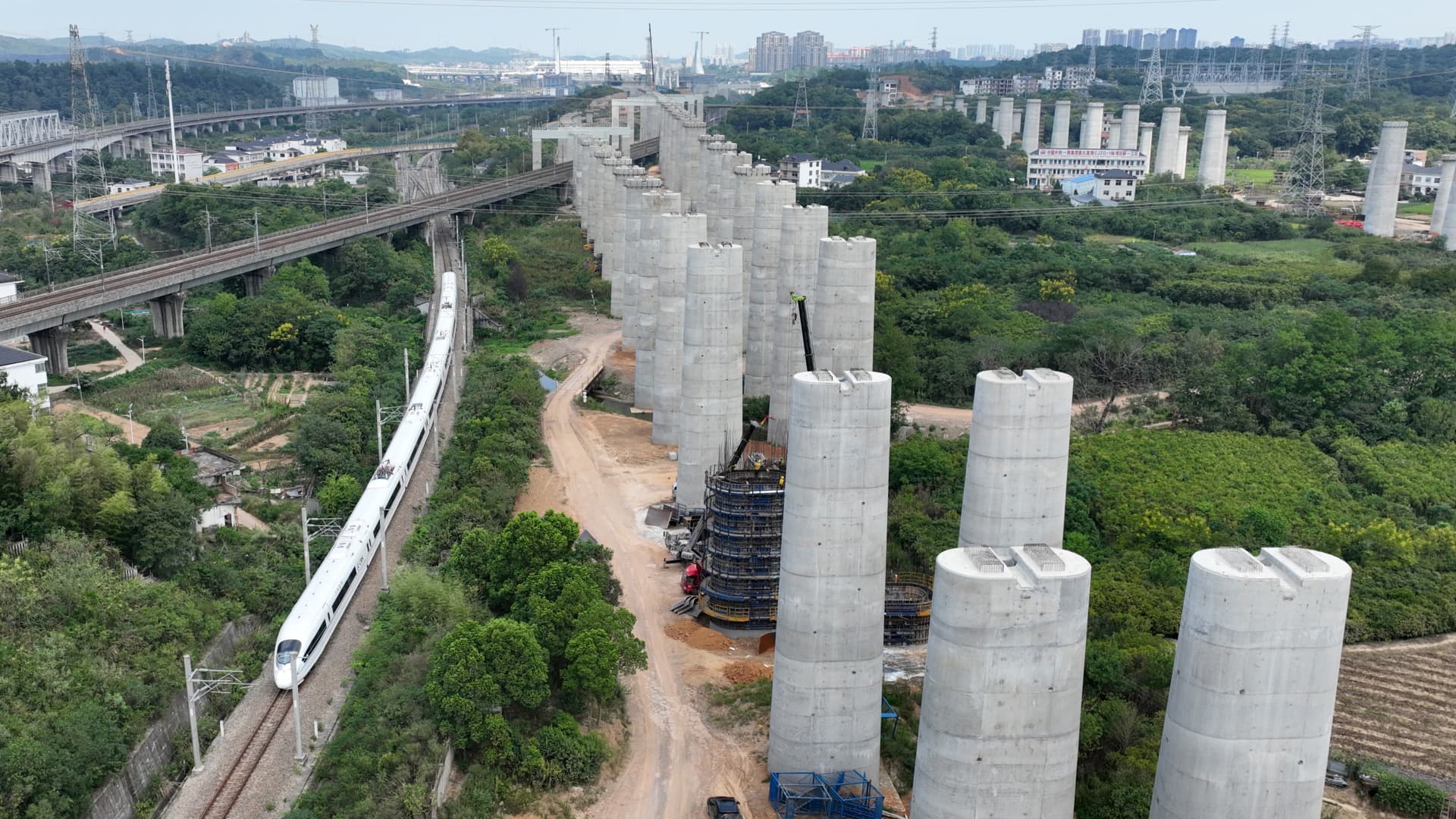
Local governments in China are still building highways, bridges and railways, as pictured here in Jiangxi province on Sept. 6, 2024.
Cfoto | Future Publishing | Getty Images
BEIJING — China’s persistent consumption slowdown traces back to the country’s real estate slump, and its deep ties to local government finances — and debt.
The bulk of Chinese household wealth went into real estate in the last two decades, before Beijing began cracking down on developers’ high reliance on debt in 2020.
Now, the values of those properties are falling, and developers have reduced land purchases. That’s cutting significantly into local government revenue, especially at the district and county level, according to S&P Global Ratings analysts.
They predicted that from June of this year, local government finances will take three to five years to recover to a healthy state.
But “delays in revenue recovery could prolong attempts to stabilize debt, which continues to rise,” Wenyin Huang, director at S&P Global Ratings, said in a statement Friday to CNBC.

“Macroeconomic headwinds continue to hinder the revenue-generating power of China’s local governments, particularly as related to taxes and land sales,” she said.
Huang had previously told CNBC that the financial accounts of local governments have suffered from the drop in land sales revenue for at least two or three years, while tax and fee cuts since 2018 have reduced operating revenue by an average of 10% across the country.
This year, local authorities are trying hard to recoup revenue, giving already strained businesses little reason to hire or increase salaries — and adding to consumers’ uncertainty about future income.
Clawing back tax revenue
As officials dig into historical records for potential missteps by businesses and governments, dozens of companies in China disclosed in stock exchange filings this year that they had received notices from local authorities to pay back taxes tied to operations as far back as 1994.
They stated amounts ranging from 10 million yuan to 500 million yuan ($1.41 million to $70.49 million), covering unpaid consumption taxes, undeclared exported goods, late payment fees and other fees.
Even in the relatively affluent eastern province of Zhejiang, NingBo BoHui Chemical Technology said regional tax authorities in March ordered it to repay 300 million yuan ($42.3 million) in revised consumption taxes, as result of a “recategorization” of the aromatics-derivatives extraction equipment it had produced since July 2023.
Jiangsu, Shandong, Shanghai, and Zhejiang — some of China’s top provinces in tax and non-tax revenue generation — see non-tax revenue growth exceeding 15% year-on-year growth in the first half of 2024, S&P’s Huang said. “This reflects the government’s efforts to diversify its revenue streams, particularly as its other major sources of income face increasing challenges.”
The development has caused an uproar online and damaged already fragile business confidence. Since June 2023, the CKGSB Business Conditions Index, a monthly survey of Chinese businesses, has hovered around the 50 level that indicates contraction or expansion. The index fell to 48.6 in August.
Retail sales have only modestly picked up from their slowest levels since the Covid-19 pandemic.
The pressure to recoup taxes from years ago “really shows how desperate they are to find new sources of revenue,” Camille Boullenois, an associate director at Rhodium Group, told CNBC.
China’s national taxation administration in June acknowledged some local governments had issued such notices but said they were routine measures “in line with law and regulations.”
The administration denied allegations of “nationwide, industrywide, targeted tax inspections,” and said there is no plan to “retrospectively investigate” unpaid taxes. That’s according to CNBC’s translation of Chinese text on the administration’s website.
“Revenue is the key issue that should be improved,” Laura Li, sector lead for S&P Global Ratings’ China infrastructure team, told CNBC earlier this year.
“A lot of government spending is a lot of so-called needed spending,” such as education and civil servant salaries, she said. “They cannot cut down [on it] unlike the expenditure for land development.”
Debate on how to spur growth
A straightforward way to boost revenue is with growth. But as Chinese authorities prioritize efforts to reduce debt levels, it’s been tough to shift policy away from a years-long focus on investment, to growth driven by consumption, analyst reports show.
“What is overlooked is the fact that investment is creating weak nominal GDP growth outcomes —pressuring the corporate sector to reduce its wage bill and leading to a sharp rise in debt ratios,” Morgan Stanley chief Asia economists Chetan Ahya and Robin Xing said in a September report, alongside a team.
“The longer the pivot is delayed, the louder calls will become for easing to prevent a situation where control over inflation and property price expectations is lost,” they said.
The economists pointed out how similar deleveraging efforts from 2012 to 2016 also resulted in a drag on growth, ultimately sending debt-to-GDP ratios higher.
“The same dynamic is playing out in this cycle,” they said. Since 2021, the debt-to-GDP has climbed by almost 30 percentage points to 310% of GDP in the second quarter of 2024 — and is set to climb further to 312% by the end of this year, according to Morgan Stanley.
They added that GDP is expected to rise by 4.5% from a year ago in the third quarter, “moving away” from the official target of around 5% growth.
The ‘grey rhino’ for banks
Major policy changes are tough, especially in China’s rigid state-dominated system.
Underlying the investment-led focus is a complex interconnection of local government-affiliated business entities that have taken on significant levels of debt to fund public infrastructure projects — which often bear limited financial returns.
Known as local government financing vehicles, the sector is a “bigger grey rhino than real estate,” at least for banks, Alicia Garcia-Herrero, chief economist for Asia-Pacific at Natixis, said during a webinar last week. “Grey rhino” is a metaphor for high-likelihood and high-impact risks that are being overlooked.
Natixis’ research showed that Chinese banks are more exposed to local government financial vehicle loans than those of real estate developers and mortgages.
“Nobody knows if there is an effective way that can solve this issue quickly,” S&P’s Li said of the LGFV problems.
“What the government’s trying to do is to buy time to solve the most imminent liquidity challenges so that they can still maintain overall stability of the financial system,” she said. “But at the same time the central and local government[s], they don’t have sufficient resources to solve the problem at once.”
