
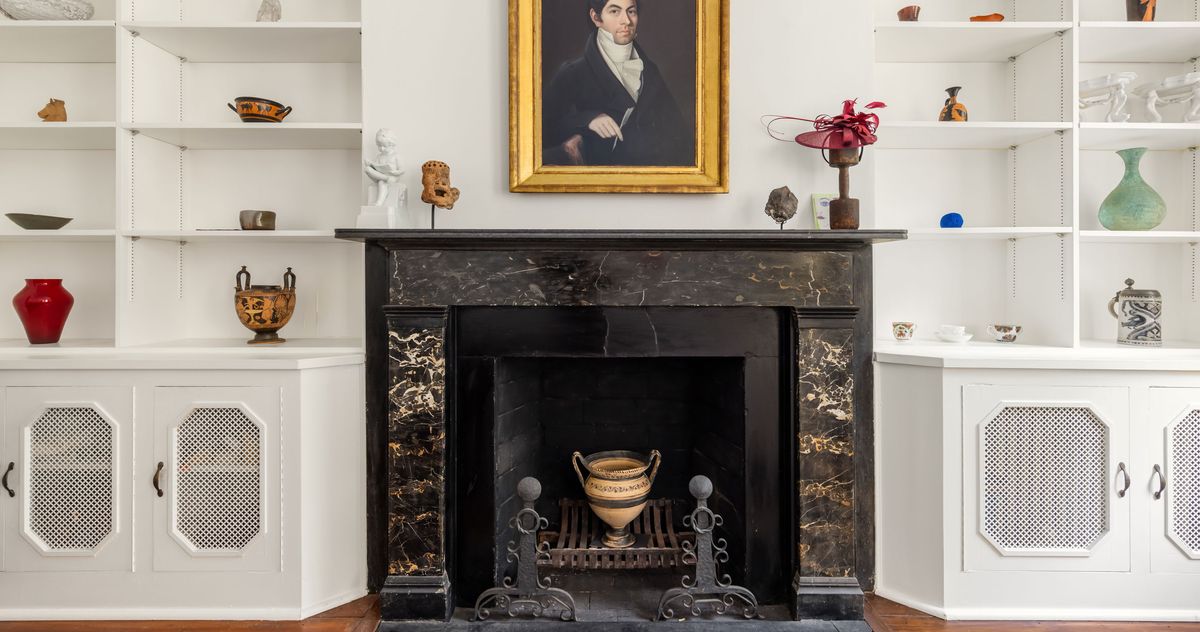

The 1834 home is full of Richard Tuttle’s eccentric collections. A line of rocks, displayed below an early American folk-art portrait, includes a hand ax carved by a Homo erectus (far right). “I kind of see houses differently and appreciate them differently from this house,” said broker Leslie Mason.
Photo: Tim Waltman/Evan Joseph Studio
On the hearth of a fireplace in an 1834 rowhouse on Vandam Street sits an object that is much, much older: a fist-size stone chiseled by a Homo erectus into an ax. “To hold something a million years old and to feel the connection, it supports the heart,” says its owner, Richard Tuttle, an artist almost as well known for his collections of antiques and oddities as he is for the colorful, small-scale works of paper and cardboard that spun postwar art into a tizzy.
For years, he lived with the poet Mei-mei Berssenbrugge and their daughter in a loft in Tribeca. But the neighborhood was loud with construction and busy with celebrities. Friends got more peace and quiet in townhouses. (The couple are close with Kiki Smith, who owns a wide one in the East Village.) Besides, in 2008, Tuttle was undergoing Jupiter’s transit. He’s a Cancer, and astrologers suggested that he ground himself low to the earth. He started thinking about an English basement.
Berssenbrugge and Tuttle have long owned homes outside the city designed by Robert Venturi and Steven Holl. In New York, they looked for one that a lot of people would see as staid and traditional but that they understood to be an architecture of rebellion. “I’m a maniac about the Federal period,” said Tuttle, who has studied how that era’s builders resisted the rococo ornament of British rule. Tuttle knew Vandam Street from visits to Marguerite Stix, the sculptor who had lived at No. 11. Plus, the land itself was once the site of a grand manor owned by Tuttle’s ancestor, Aaron Burr. (A fact he dismisses as uninteresting, given how the Tuttles were also related to Alexander Hamilton. “In those days, there were so few people on earth it was almost like everyone was related to everybody.”) When they bought, in 2008, they didn’t change more than the paint. Berssenbrugge, who had once rented a place in a Federal-style house on Mercer Street, appreciated the proportions — high-ceilinged but humble — and how light came in at all hours, thanks to the trademark arrangement of the staircases in Federal homes, which are placed in the rear, with a window at each landing facing their yard.

No. 29 is on a row of landmarked Federal houses just west of Sixth Avenue in the Charlton–King–Vandam Historic District. Tuttle loved the idea of living in a house built after the American Revolution. “Everyone was thrilled to be independent, and you feel that in the house,” he said.
Photo: Tim Waltman/Evan Joseph Studio
Twenty-nine Vandam dates to 1834, says their broker, Leslie Mason, a trustee of the nonprofit Village Preservation who also sold the home next door, put up by the same builder, Daniel Turner. Mason found that Turner had leased the land from Trinity Church and designed for other New Yorkers like him: business owners and craftsmen, a cabinetmaker and the owner of a paint store. Its rooms were eventually rented to boarders, and by 1919 developer William Sloane Coffin Sr. bought the block, and much of the neighborhood, with an eye toward keeping the bulldozers away. By 1966, the row was landmarked, and its interiors might be the most intact thanks to its last owner, Eugene Rooney, a contractor with an interest in preserving townhouses. He saved fireplaces and moldings, redid floors with pine from a Virginia barn, and brought cabinetry from an 1880 townhouse in Brooklyn.

An Albers print, a Navajo rug, a Federal table, and an artist book by Richard Tuttle are carefully arranged on the second-floor landing.
Photo: Tim Waltman/Evan Joseph Studio
The couple’s focus has been on the objects inside. “The idea of mentioning a stager to them would be so horrifying,” joked Mason, their broker. “The house itself is an object and a piece of art in a way, where you experience and see things differently.” An early Tony Smith painting in blue, black, and gold over a fireplace in the primary bedroom echoes the black-and-gold blocks in an 1880 jacquard textile laid over the bed. The riot of color in a 1959 Alfred Jensen painting is reflected in a rococo mirror. On the second-floor landing, a rug by Navajo artisans rests next to the sharp feet of a Federal table under a Josef Albers print of New Mexico — a kind of diorama about colonialism, made from stuff the family already happened to own. “We’re both visually committed, and our things need to have energy as well as meaning,” said Berssenbrugge. “Like many collectors who are married, we find that the depth of the conversation is a rich part of life.”

Photo: Tim Waltman/Evan Joseph Studio

The parlor hall gets light from the backyard — a design original to Federal houses that is often lost when buyers put on additions, said Mason, the broker. The family turned the space into a gallery. Down the hall are pieces by Gillian Wearing, Pat Steir, and their daughter, the artist Martha Tuttle. A photograph (right) is by their friend Kiki Smith.
Photo: Tim Waltman/Evan Joseph Studio

A door off the hall opens to a parlor with an original fireplace. A painting by Alfred Jensen hangs opposite a mirror in a rococo frame. The bust of Lincoln was carved shortly after the assassination and placed on a table by Joseph Holtzman, an artist and a founder of the magazine Nest. “There’s also something lighthearted and playful about the way in which you experience the house,” said Mason.
Photo: Tim Waltman/Evan Joseph Studio

A piece by Ron Gorchov hangs over a two-tiered table built by Tuttle and covered in a collection of curiosities — including antiques and a gold-plated impression of the tongue of Kiki Smith. “He’ll bring home sometimes a hook made out of a root from an old barn,” said Berssenbrugge. “The things he buys probably have a sculptural intrigue, and for me I like there to be an energy and a harmony.”
Photo: Tim Waltman/Evan Joseph Studio

The angular chair is by Steven Holl, who designed a home for the couple in New Mexico. “It perks the whole place up because of the energy of its design,” Berssenbrugge said.
Photo: Tim Waltman/Evan Joseph Studio

The living area leads to a back parlor or formal dining room. The couple collects textiles, but both are known for spare, conceptual work. “We modernists define ourselves in opposition to our Victorian grandmothers, whose aesthetic was based on clutter,” Tuttle said.
Photo: Tim Waltman/Evan Joseph Studio

In the back of the house, a paper-and-wood sculpture by Tuttle — the orange arc — hangs over a rug designed by Asger Jorn. The rug is “not just a nice rug, it makes art historical sense,” said Tuttle. Jorn’s most famous essay, “Intimate Banalities,” argues that the best art is kitsch by craftsmen who aren’t academics — like the so-called “primitive” or “folk-art” portrait over the fireplace.
Photo: Tim Waltman/Evan Joseph Studio

The primary suite occupies the entire third floor. Berssenbrugge writes at a desk looking over the backyard. The couple prefers to sleep on the floor. Their bed faces an early Tony Smith painting that Smith gave to Tuttle, who had worked as his assistant.
Photo: Tim Waltman/Evan Joseph Studio

Tuttle thrilled at the idea of a home with a garden. “I can go out there and get as much dirt as I want, which is kind of a rarity in Manhattan,” he said. Tuttle landscaped. A weekly visit to the New York Botanical Garden in the Bronx inevitably meant he brought a plant home from the gift shop.
Photo: Tim Waltman/Evan Joseph Studio

The garden becomes wilder as it gets farther from the house. A hellebore marks the spot where the family buried their beloved corn snake, and their daughter was married under the magnolia tree. “Everyone has their own idea of living in Manhattan, but in my humble opinion, a house like this is the top,” Tuttle said.
Photo: Tim Waltman/Evan Joseph Studio
