
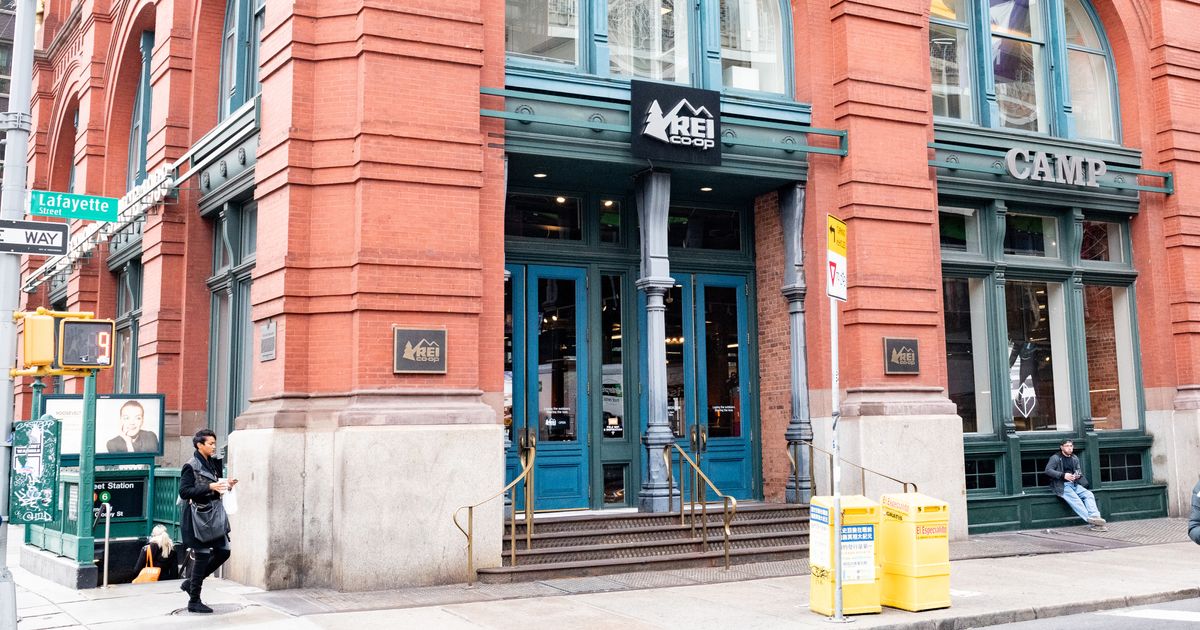

After nearly 15 years, REI will close its Soho flagship on July 23.
Photo: Michael Brochstein/SOPA Images/LightRocket/Getty Images
“I come here almost every day,” says Glen Nison, a retired Sanitation Department worker and passionate snowshoer I find standing near the front of the Soho REI, his arms full of gear. “I might have to get a job to have something to do.” Nison has been a member of the outdoor retail co-op since 1975 and is what you might call a die-hard: He still has Yeti cups from the store’s “Pray for Snow” parties and is on a first-name basis with just about everyone on staff. He even brings them banana bread he bakes at home. Browsing the “ReSupply” section — discounted climbing rope or thermal underwear or a subzero sleeping bag that’s been used and returned to the store — is basically his hobby, and on this particular Tuesday, his haul included a women’s North Face down parka for 80 percent off (“One of my friends should be able to use it”) and a Grayl sling bag and a pouch. But it’s a melancholy kind of shopping. On Thursday, he plans to drop off one more batch of banana bread as a farewell gift before the store closes for good. “Usually I make one, but it’s not enough,” he says. “I made three.”

Many people were beelining for the store’s “ReSupply” section, where you might find discounted climbing rope or a subzero sleeping bag that’s been used and returned to the store.
Photo: Matthew Sedacca

REI loyalists will have to get their Keens online or out in Huntington Station after Thursday.
Photo: Matthew Sedacca

It was slim pickings in the store’s final days.
Photo: Matthew Sedacca
The REI in the Puck Building will close its doors on July 23, ending a nearly 15-year run on the corner of East Houston and Lafayette. This is a closing of note. When the news broke last year, outdoorsy types across the city grieved and wondered where they would buy camping stoves for last-minute trips to the Adirondacks. There are plans for a funerary shrine on Lafayette Street. A reliably clean bathroom has also been lost. (“You learn a lot about a culture from how they treat public bathrooms,” said Juan Pablo Baene, an artist, while checking out a monocular with his kid. “It’s sad.”) Employees mourned too — mostly about being out of a job. I also overheard a few customers lamenting the recent arrival of OpenAI, which now occupies 90,000 square feet upstairs. There goes the neighborhood.
Pick your villain when it comes to the store’s demise. Was it Kushner Companies deciding not to renew the lease, as I heard some in the store speculating in hushed tones. Or a poor financial outlook on dried camping meals and ultralight hiking bags? Union busting? Whatever the reason, the people coming to the store to honor it and pick its bones didn’t seem ready to accept that they might have to rely on Paragon in Union Square for their gear needs. “The lighting in that store is crazy,” Eric Swick, an interior horticulturalist, tells me. “It’s like smoke-shop vibes.”
This kind of fandom was never a given, though. When REI first opened here in November 2011, some saw the move as risky. (“The Seattle-based retailer says it is determined to win over high-rise-living, taxi-riding, restaurant-eating and forever-in-a-hurry New Yorkers,” per the New York Times that year.) But it also made a certain kind of sense: This was an era when brick-and-mortars still held real sway, and didn’t Wall Street executives bound for the Arctic need somewhere to try on ice cleats? Other outdoor-clothing companies had already signed leases downtown, too — Burton had been selling snowboards and boots since 2005 on Spring and Mercer, and Eastern Mountain Sports had recently opened a second location down the block on Broadway. The city was gesturing toward going green as well: The Bloomberg administration was working to make the city more bike friendly by adding more lanes and a bike-share program. (REI responded to the plan by setting up a “quick-fix” bike-repair area, in addition to a full-service shop in the cellar.)

The opening-day line for the REI Soho flagship in November 2011.
Photo: Glen Nison

Some saw the outdoor retailer’s move to open in Manhattan as risky, but it developed quite a fandom.
Photo: Glen Nison
Plus the flagship REI would do more than sell tents — there would be lectures from visiting mountaineers and rock-climbing lessons in public parks. And the store would be as grand as the city itself: 35,000 square feet inside a brick-and-cast-iron building that had once housed a grand printing-press operation. REI worked with the design-and-architecture firm Callison on the restoration, exposing the late-19th-century brick walls and ceilings and, in a nod to its West Coast granola origins, repurposing original wood to create cashier counters and display tables. Chandeliers were restored and hung, and a pair of steam flywheels that had once powered printing presses were put on display. It all kind of felt like a retail theme park. “Even if you didn’t go camping, they organized camping trips, which fed into the fantasy,” says a retired taxi driver named Kenneth who had come in looking for tick spray. “I liked that.” By Tuesday, though, the scene was empty shelves and moving carts, blocked off with cordons and AREA CLOSED signs. Notices were posted warning that the store was sold out of everything from backpacking chairs to tarps and towels; a woman looking for REI-branded pants ahead of a trip to Idaho was out of luck. “We’re heading to Jones Beach for the Dave Matthews Band concert and thought they would have a rain jacket,” one woman tells me. “They don’t have much on sale,” her husband adds.
Which, in addition to mourning, was the other prevailing sentiment in the shop. Where were the closeout deals? “Everything is gonna be sent to the other stores,” says an employee when I ask about the lack of sales. And those locations will not be in Soho. People looking to get rock-climbing harnesses or gently used Keens off the discount table will have to go to Huntington Station or drive out to East Hanover in New Jersey. Or turn to the internet — not that they’d be happy about it. “That’s the last thing I want to do,” says Baene, the monocular shopper, with a shrug.

An REI employee said customers had been coming up to him and asking about the lack of closeout deals.
Photo: Matthew Sedacca

Glen Nison, a retired Sanitation Department worker, has been a constant presence at the Soho flagship.
Photo: Matthew Sedacca
