
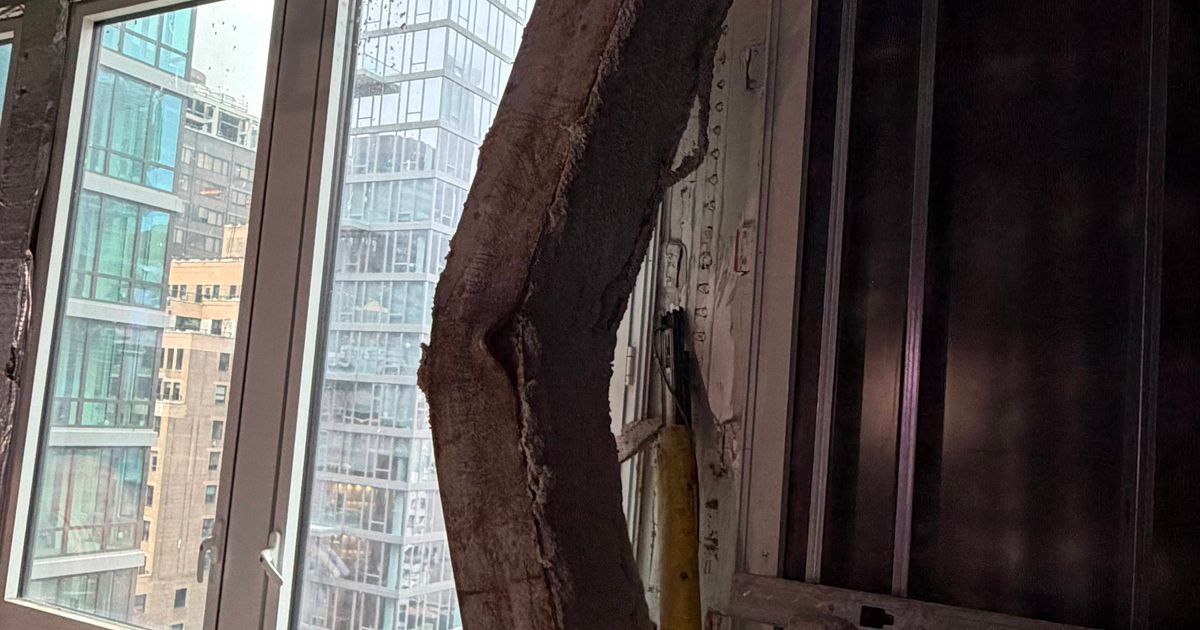

Photo: Courtesy of the owner
From last September until early July, Sean Dow worked at a high-rise construction site on East 42nd Street. It was a complicated project: a pair of obsolete commercial buildings, once the headquarters of the pharmaceutical company Pfizer, were being reconfigured as an apartment complex with about 1,600 units — the largest office-to-residential conversion done to date in the city. Dow, a 25-year-old member of the Steamfitters union, worked on a crew installing a new fire-protection system. On July 7, he reported to work around 6 a.m. and was assigned to go up to the 22nd floor of the taller of the two buildings. MetroLoft, the company handling the renovation, was expanding the floor with a slender addition. “I was checking out what I was going to do for the day,” Dow told me, “taking my notes.” Looking down, he noticed what he described as “hairline fractures” in the concrete-slab floor. He traced the cracks back to an unfinished corner, which appeared to be crumbling and sagging through the ceiling below.
Dow took the stairs one flight down to the 21st floor. There, other contractors were gathered around the obvious source of the problem: two vertical steel columns that were bent and cracked like toothpicks. “Holy shit,” someone said in a video that would soon be posted to TikTok and blasted around the world. Dow took some pictures and videos of his own, to document the scene for his union, then rushed up and down the building alerting workers that it was unstable.
It was around this time that developer Nathan Berman, the chief executive of MetroLoft, received a call from the job site. “Some sort of a problem at the building; it was structural,” he recounted the next day. “The Fire Department has been called, the Buildings Department has been called.” Berman, who lives in Yorkville, jumped in his car and raced toward the scene. But emergency responders, fearing a collapse, had already closed off surrounding streets. “I couldn’t get within five or six or seven blocks,” Berman said. “So I had to turn around and head back uptown so that I could get on the phone to see what the hell was going on.”
What Berman turned out to be facing was a multifaceted disaster — a structural failure that undermined not just one building but potentially the entire concept of recycling empty office buildings for housing and the government policies that have recently incentivized it on a mass scale. Almost two years ago, then-Mayor Eric Adams enacted his “City of Yes” program, which contained a package of zoning changes to ease regulations on conversions and generous tax breaks for those that included affordable rental units. The proposition made intuitive sense: Many office landlords needed a financially feasible way to dispose of buildings emptied by COVID, and New York needs more apartments now. And its passage had an immediate effect, whipping up a frenzy of conversion activity. “That is the game right now,” says architect Michael Zenreich, who served on an adaptive-reuse task force that recommended the policy changes. “It’s like discovering land to build on.”
A report released last year by the city comptroller’s office found that more than 40 office properties have entered the conversion pipeline since 2020, the vast majority of which are becoming rental buildings, which are eligible for tax breaks if they include affordable units. But the city might not continue to say “yes” so quickly if it turned out that the renovations were being done shoddily. When we talked, Berman sounded overwhelmed, ruing the “morbid curiosity” about what had gone wrong. At the edges of the city’s barricaded “frozen zone,” watchful eyes and TV cameras were tilted upward. “People are standing there and watching to see, ‘Is it now falling?’” Berman, who is from Ukraine, said with a slight lilt.
City inspectors were swarming. His lenders were demanding reassurances. The Steamfitters were staging protests outside the Pfizer site, accusing the MetroLoft — which employs a mix of union and nonunion contractors — of building on the cheap and tolerating unsafe work conditions. (Berman called the union’s claim about the quality of his construction “total nonsense” and has used nonunion workers without similar incidents elsewhere.) They put Dow in front of the cameras, hailing him as the “hero of 42nd Street.” Reporters were investigating his business practices and his contractors. “They want to be there for the autopsy,” Berman said. “I think what nobody’s writing about is, what’s the essence of this project?”
I spoke to Berman back in 2023, when I was working on what would become a cover story about New York’s commercial-real-estate crash. The office vacancy rate was at its post-pandemic peak, and some landlords were defaulting on their mortgages. City officials and academics debated whether New York was entering a “doom loop,” in which plunging real-estate values would start to impact its tax base, government services, and quality of life. It was clear that tenants would never return to some buildings, and residential conversion seemed like a logical way to give them new life.
But few conversions were actually taking place. “Most developers really do not have the experience converting, so it is the fear of the unknown,” Berman told me then. “We say that it’s not rocket science, but you need to know what you’re doing logistically in a conversion. It actually intimidates most developers.” He had started his real-estate career in Tribeca in the 1990s before shifting his focus to the Financial District, where office rents — and thus acquisition costs — were cheap, and where the city had put in place temporary incentives designed to encourage the area’s transition to a lived-in neighborhood. At 17 John Street, completed in 1999, Berman purchased an office property dating to the 1920s for just $5.4 million, put in 111 rental units, and later flipped it for $85 million.
Because he didn’t have to worry about the time-consuming process of ground-up construction — one of his MetroLoft executives once told me they were “buying the bricks” — he could work quickly, limiting the crucial period between the moment he took out a high-interest construction loan and the day he started to collect rent. He wasn’t invariably successful. MetroLoft defaulted on its debt on a pre-COVID conversion project at 20 Broad Street, and one of its lenders ultimately assumed ownership of the building. The renovation of a former factory building in Tribeca, a favorite address for celebrities since it was completed in 2017, has been marred by lawsuits over alleged construction defects. But he was positioned to pounce when the crash came.
Within the real-estate industry, there was skepticism that Berman’s approach would work in other parts of the city. Conventional wisdom held that the Financial District’s prewar buildings, with their architectural ornamentation and relatively small footprints, were well suited to residential use, but the more modern stock common in other office districts presented problems. Developers generally needed a zoning variance to convert ones constructed after 1961 in much of Manhattan. (In most of the Financial District, the cutoff was 1977.) Regulations set different floor-area maximums for office and residential uses, and it was sometimes impossible to convert an entire building. Windows were an issue: The housing code requires them for bedrooms, creating a design challenge in modern office buildings, which are characterized by deep floorplates and lots of interior space. They also had to open, but many buildings erected since the 1960s have exterior walls of solid glass.
Berman, who has never constructed a building from the ground up, told me his willingness to work around such constraints was his competitive edge. “It’s really a creative process,” he said in 2023. At that time, I took a tour of a building on Broad Street that his company had just started to renovate. The floor plans were a jigsaw alignment, jutting around to provide access to windows and narrow harbor views. Berman was not deterred by the fact that a few office tenants on other floors were still there on unexpired leases; he told me he specialized in doing such “phased conversions.” At another MetroLoft project, 25 Water Street, Berman and a co-developer had taken a radical approach to breaking up the interior space of a hulking building that once housed offices belonging to JPMorgan Chase. At 1,300 rental units, it was the country’s largest office-to-residential conversion at the time. They were hollowing two courtyards out of its interior and then redistributing that inside square footage to new floors on the roof. “There isn’t a floor plate in New York that we could not convert to resi,” Berman told me. “The issue is simply the efficiency of the layouts and the cost.” And both of those problems were about to become easier to solve with help from the Adams administration.
The City of Yes plan swept aside cumbersome zoning rules and made office buildings completed as recently as 1990 eligible for conversion in most of Manhattan and parts of other boroughs. More quietly, the city’s Buildings Department also relaxed its interpretation of the housing codes, allowing developers to do more with interior space. Some converted buildings now feature windowless “home offices” that can be turned into one-bedrooms. Reviews from renters in finished conversions are decidedly mixed, with some complaints about cramped layouts. But that’s par for the course in New York, and overall the apartments are leasing.
The most important factor driving the market is the program’s package of tax incentives. For rental conversions, developers who make 25 percent of their units affordable to tenants below an income threshold can typically qualify for rebates that cover their entire tax bill during construction and as much as 90 percent of their taxes for decades afterward. The incentives were also available retroactively to projects that were already in the pipeline, like 25 Water, which took advantage. “The abatement was so compelling that the market has been going bananas with these conversions,” said Bob Knakal, a broker who specializes in commercial-building sales.
The lucrative incentives have allowed for the conversion of unwieldy buildings in unlikely districts. Major Manhattan developers like SL Green and the Rudin family are now in the process of transitioning buildings along the drab Third Avenue corridor in midtown. Scott Rechler, a prominent Manhattan office landlord who talked to me in detail about his portfolio’s plight back in 2023, is now converting two of his properties, including a tower that was constructed as part of the redevelopment of Times Square in the ’90s. Berman also pressed his advantage as a first mover, borrowing capital from large financial firms that wanted to get into the market. In May 2025, he and a partner secured a $720 million construction loan for the Pfizer building from a real-estate private-equity firm, a record at the time for a conversion. Last December, Berman outdid himself, landing $867 million in financing from a group of lenders that include Apollo Global and JPMorgan Chase to convert a 1960s-era office building at 111 Wall Street.
Before it ran into trouble, the Pfizer building’s conversion looked like a model of what was possible under the City of Yes. An investor had purchased the 1.1 million-square-foot property from Pfizer in 2018. The price, $357 million, was cheap given its size and location next to Grand Central Terminal and reasonable given that it had no future as an office building. Pfizer had a plan to relocate to Hudson Yards, and when it finally moved out in 2023, Berman swooped in. A design put together by the architectural firm Gensler took advantage of the local zoning to add more than 300,000 square feet of space. (Adding extra stories “isn’t only our strategy,” Berman said. “Every converter that is converting buildings is doing exactly the same.”) The property consisted of two connected buildings. On top of the shorter one, which was originally constructed more than a century ago, MetroLoft erected a 19-story tower. The adjoining high-rise, built in 1960, was expanded with a 16-story addition that horizontally bumped out the existing top dozen floors and put four more stories on the top. The bottom of the addition was cantilevered over an original building setback.
“That’s where we encountered a problem,” Berman said, describing the cantilevered section as a mere appendage. He had told the Times the day before that he planned to resume construction in weeks, claiming the incident was “nothing more than a typical construction mishap.” (The upbeat message landed with a thud seeing as nine blocks of midtown were shut down at the time he said it, and Berman acknowledged to me, “Maybe I inartfully used the word typical.”)
The day of the “mishap,” after it was determined that the building was not about to collapse, a team of six Buildings Department employees went up to the 21st floor and began to assess what went wrong at the point of failure. At the same time, fascinated engineers around the world were examining the same pictures and videos as everyone else. “My initial observation is similar to a layperson’s: wow,” said James LaFave, the director of a structural-engineering laboratory at the University of Illinois Urbana-Champaign. “I’ve never seen a vertical column bent like that other than in a research setting.” A high-rise’s vertical columns are the most important element of its skeleton, carrying its load down to the foundation. LaFave pointed out that the columns in question were originally designed to hold up a roof and were now bearing the weight of the 16-story addition, and he theorized that the bent ones were either inadequately reinforced or else someone miscalculated the “load path,” inadvertently concentrating the weight at a weak point.
Berman told me that LaFave was basically right. “These columns either did not receive sufficient enhancement or they may have been missed by the contractor,” he said. “That’s it.” He complained that the news coverage — a New York Post headline branded the building “Leaning Tower of Midtown” — was sensationalistic. “It was not a problem of the entire building,” but rather the addition, which “settled up to four inches maximum. That’s the actual extent of the issue right now: It settled four inches. Now obviously that’s not a desired effect, but the press is insisting on showing the images of two bent columns like this building is coming down.”
Nonetheless, Berman told me he intended to take down the entire addition rather than trying to fix it in place, which did seem like a drastic and expensive concession to the seriousness of the mistake, especially coming from someone who specialized in reuse. Berman closed our day-after discussion by agreeing to meet for a further conversation at his office in the Trump Building at 40 Wall Street — a skyscraper that is often speculated to be a conversion candidate itself. But after a few more days of tough coverage, Berman hired a crisis-management public-relations firm through which he declined to directly comment further. (“We continue to work closely with the Department of Buildings,” a MetroLoft spokesperson said on July 22, “and our focus is on ensuring the site remains safe as we complete the work necessary to move forward with the successful completion of the project.”)
Berman’s comments after the structural failure indicated that human error was to blame, leaving the city to wonder: Which humans? Weeks of further revelations would complicate the question of responsibility. The New York Times reported that the private firm he had hired to inspect and certify crucial aspects of the project had been cited for safety lapses in the past. Then it reported that the man who founded the inspection firm was a former Buildings Department employee who resigned in the 1980s amid allegations that he threw coke parties in the office and later pleaded guilty to evidence tampering in a separate case involving bribery in the permitting process. The Times further reported that the engineering firm working on the Pfizer building had designed for the columns that buckled to be reinforced with welded metal plates, which did not appear to have been installed as specified. The newspaper’s independent analysis suggested it wasn’t ridiculous to think the entire building could have toppled over.
Mayor Zohran Mamdani has signaled his continuing support for the conversion policies begun by his predecessor. “I think that streamlining and safety are not in tension,” Mamdani told Errol Louis on NY1. But in reality, the City of Yes could now be more like the City of Maybe. “When there is a catastrophe, the Buildings Department will often react — and sometimes overreact — to determine if this is something that happens in other places too,” a former city official told me. The department has reportedly been conducting a sweep of construction sites associated with contractors working on the Pfizer building. According to the news site Gothamist, one early focus of its inquiry appears to be the company that MetroLoft used to install the building’s steel. The department says it is currently conducting a “massive review” of the Pfizer conversion, where MetroLoft’s renovation work remains frozen in place for the time being. The Manhattan district attorney’s office is also reportedly conducting a criminal inquiry.
Construction unions have taken advantage of the publicity surrounding the evacuation to draw attention to the fact that the conversion program does not mandate the same minimum wages that are required in large ground-up residential developments that receive similar subsidies. Labor activists marched with a banner reading “Shame on Metro Loft” outside the site, and at a press conference, an official with the steamfitters local that Sean Dow belongs to suggested that potential renters should beware. “Do your due diligence [about] who built that and how it was built,” the official said, pointing to the building. “Or that could be what you’re living in.”
The real-estate people who stand to profit from conversion projects claim (unsurprisingly) that adding union-friendly requirements would make their math impossible, effectively killing a program that is already bearing fruit. The comptroller’s report last year estimated that the subsidy-eligible projects underway would yield more than 15,000 rental units, and more have entered the pipeline since then. (By contrast, the subsidy program for new construction, with its wage requirements for buildings larger than 100 units, appears to have just yielded a whole lot of 99-unit buildings.) “These buildings that are already in the midst of being converted, they’ve gone through the inspection processes with the city,” says an executive at one large firm that is doing such projects. A single high-profile incident shouldn’t stop them from being completed. But it could make lenders more careful in the way they assess the risks that might be hiding behind the walls of old buildings. “The way that these kinds of guys like Berman make money is they are consistently fundraising around a thesis,” says Hiten Samtani, publisher of the commercial-real-estate industry newsletter The Promote, raking in fees for managing the investment capital and the development process that may even outweigh the profit from the converted buildings themselves. To keep the capital flowing, they need to keep churning through one empty high-rise after another, but if lenders pull back, it could spell the end of the go-go approach. Ironically, as the office-to-residential boom has consumed millions of square feet of space, the office vacancy rate has declined and leasing has picked up, threatening converters’ ability to acquire properties at rock-bottom prices. If outmoded office buildings end up becoming once again viable as office buildings, Berman’s thesis could end up becoming a casualty of its own transformational success.
Before he stopped talking to the press, Berman tried to communicate the message that one mass evacuation should not spoil a good thing for New York City. “The complexities of making conversion efficient, and making a conversion work, have absolutely nothing to do with the issue that we have,” he told me. And he said the benefits were beyond question. “We are giving 400 affordable units to the city that’s starved for them,” Berman said. “We’re adding another 1,200 units of [market-rate] housing into a supply-starved city. We are creating jobs. We are creating growth. By the way, we are helping the commercial-real-estate market by taking out all of this excess supply that’s dragging the market down.”
The fault was not with the bones of the old building, he said, or with the policy that enabled their reuse. It was just a principle of physics exerting downward force. “What happens if you put a brick on a match?” Berman said. “If that match is not supportive, the match will break. Very simple.”
