
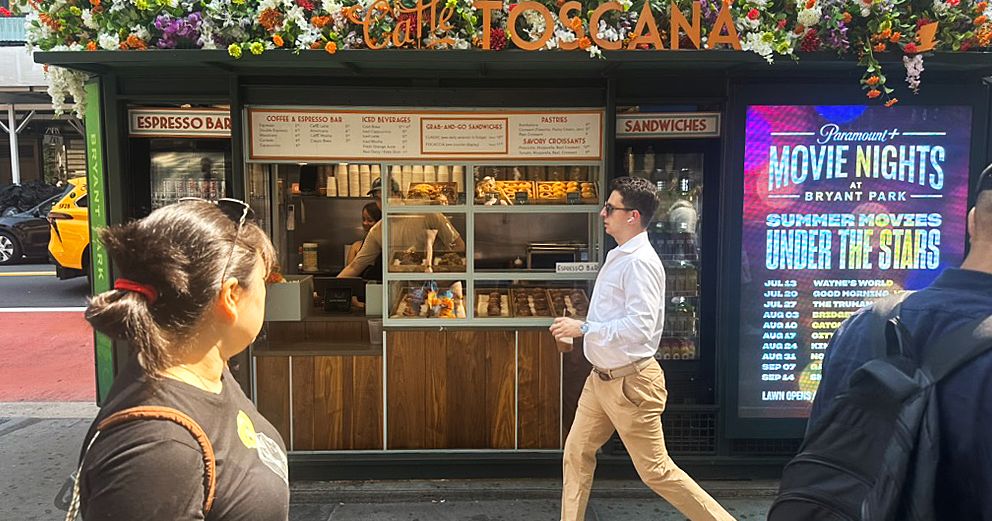

Caffé Toscana on 42nd Street is operating out of a sidewalk newsstand that the operator converted for $150k.
Photo: Anne Kadet
Pedestrians passing the old newsstand near the corner of Fifth Avenue and 42nd Street are doing a double take — it’s now a spiffy Italian café serving espresso, pastries, and sandwiches. “It takes them a minute to understand,” says Luca Meacci, who opened Caffé Toscana a few weeks ago. “But then they try it out.” It’s not your standard street-cart fare; here, a pistachio bombolone or a prosciutto-mozarella croissant might accompany your cortado.
For years, converted newsstands around the world have been selling everything from vinyl to ice cream, tickets, and flowers. But in New York, thanks to tight regulations limiting what can be sold, the trend is only now starting to take off. It’s different underground, where the MTA has invited public proposals and welcomed quirky art installations, like Rex’s Dino Store at Grand Army Plaza and the Data Vandals space at 51st and Lexington, to take over its vacant newsstands. Aboveground, however, Caffé Toscana is a pioneer.
When I met with Meacci on 42nd Street last week, the 43-year-old Tuscan native said he’d been operating a café out of a kiosk in nearby Bryant Park for more than a year and was surprised to discover that serving coffee from a sidewalk newsstand is a very different proposition. “Over here, the attention span is literally no more than ten seconds,” he says. He’s already done a lot of tweaking to accommodate the fast pace: simplifying the menu, replacing the made-to-order sandwiches with premades, and swapping his favorite (but obscure) brand of water for the more familiar Acqua Panna. Last week, he festooned the newsstand with fake floral garlands. “It signals that something is going on here,” he says.

Luca Meacci in his newsstand café.
Photo: Anne Kadet
But the majority of the work took place before the café opened. Meacci says he spent $150,000 on a complete renovation, adding signage, replacing the original counter and newspaper racks with custom-made display cases, and installing two new beverage coolers. He also had to install a sink (with a water hookup provided by Bryant Park), an air conditioner, and an espresso machine.
Thanks to these modifications (along with a stellar location facing a subway entrance and the New York Public Library), daily sales have grown more than fivefold since the launch, says Meacci. He’s got two clerks manning the stand plus a runner to do the restocking. The former restaurant manager sees Caffé Toscana as a model for further newsstand-to-café conversions around the city — he’d like to open in additional high-traffic areas such as Herald Square.
When I told Meacci I’d love to see his stand in my neighborhood, Brooklyn Heights (where the local newsstand operator sells pretty much nothing), he happily said he’d consider it. But when I asked if he would sell newspapers, too (I still love the occasional print edition), he gave me a look. “Oh no,” he said. “No, no, no newspaper!”
“You don’t think you could sell any?”
“Oh no,” said Meacci. “Zero, zero, zero.”
The state of New York’s 300-odd sidewalk newsstands is somewhat sad. They function largely as billboards for JCDecaux, the French outdoor-advertising company that partners with the city to sell ads on street furniture — a 20-year deal worth roughly $1.4 billion. What goes on inside the stands, meanwhile, is largely a testament to legislative red tape. City law still requires newsstands to sell periodicals, but few bother for obvious reasons. (There’s a newsstand on 34th Street that carries actual newspapers, but the owner hides them under the counter for his five regulars so they don’t take up valuable display space.) What most do carry is a predictable assortment of convenience-store items such as candy, soda, chips, lottery tickets, and cigarettes. And because some of the distributors supplying the stands have gone out of business, most newsstands buy from the same set of wholesalers, which explains why they all carry the same stuff, says Max Bookman, counsel to the New York City Newsstand Operators Association: “Twenty years ago there were seven different candy vendors; now there are two.”
Newsstand operators say they want to sell other items, but city regulations, last updated in 2013, prohibit the sale of clothing, jewelry, fashion accessories or anything that costs more than $10. “We need a break,” says Eric, who operates a newsstand at Broadway and 96th offering cheap sunglasses and $5 used books along with the usual candy, soda and generic phone chargers. “$10 is nothing anymore.”

Eric manages a newsstand on Broadway that also sells cheap sunglasses and used books.
Photo: Anne Kadet
There’s an exception to these regulations, however. There are a small number of sidewalk newsstands controlled by the Parks Department, which makes its own rules — this is why Meacci can offer his $11 sandwiches. Last year, the not-for-profit Bryant Park Corporation (which is also famous for its “award winning” public restrooms, another perk of private fundraising) got fed up with its newsstand’s former tenant. “He was becoming more and more candy-and-soda,” says Dan Pisark, the park’s VP of retail services. The park issued a call for proposals seeking a new tenant offering fresher fare, and eight local businesses submitted ideas ranging from a souvlaki stand to a macaron shop. The BPC chose Meacci because he’d already proven himself with his park kiosk. Pisark says that a second newsstand at 42nd and Sixth, at the other corner of the park, will soon reopen as a Little Biggs Sandwich Shop.
Alexander Han, the Parks Department’s chief of concessions, says three more newsstands — one on Verdi Square on the Upper West Side, one near the basketball courts at Sixth Avenue and West 4th Street, and another at the southeast corner of Union Square Park — are also slated for conversion to food-and-beverage stands. Parks is also considering converting the newsstands at Grand Army Plaza and near the Callahan-Kelly playground in East New York. One on Columbus Circle in Central Park, meanwhile, was successfully converted a decade ago to a bike-rental stand, while the newsstand at City Hall Park was torn down and replaced with a rest space and battery-charging kiosk for delivery workers that opened in April. “We’re not really interested in using them to sell cigarettes and things like that,” says Han.
But the city-controlled newsstands can sell only prepackaged snacks and drinks. And while the late-’90s pivot from newsprint to Coke and Snickers worked fine for decades (there was plenty of demand for sugary snacks), that’s changing in the Ozempic and protein-maxxing era. “People are buying less and less of those things now,” says Bookman. “It’s not 2005 anymore.” While a few newsstands have found interesting items to sell for less than $10 — a Midtown newsstand is selling zines and ceramics, for example — others are flouting the law and selling everything from scarves and hats to costume jewelry. Near Times Square, it’s pricey souvenirs. On the Upper West Side, there’s a newsstand devoted entirely to selling electronics accessories. The stand’s employee, Mustafa, says he does a brisk business selling $20 speakers.

A newsstand devoted almost entirely to electronics accessories on the Upper West Side.
Photo: Anne Kadet
Express Essentials on the Upper West Side is likely the city’s first newsstand specializing in Caribbean treats, health aids, and pet supplies. (It also offers a sidewalk bowl with fresh water for pets and miniature topiary decorating both sides of the kiosk.) When I visited the stand at Broadway and 94th Street in April a few weeks after it opened, Zakariya, the employee manning the kiosk, told me its best sellers were water and 25-cent bananas. But it was also doing a brisk business in $4 Jamaican patties (salmon, lentil, chicken, or jerk plantain), ginger shots, tea, currant rolls, sorrel juice, pet treats, dog vitamins, protein mixes, turmeric gummy chews, and horny goatweed powder. He even tried offering the New York Times, said Zakariya, though no one was buying.

Zakariya at the window of Express Essentials, which has a more health-focused inventory.
Photo: Anne Kadet
The owner, Rodney, who is from Jamaica and also owns a storefront café in Harlem, said he wanted his business to have a health focus: “Not so much the candy, chips and soda.” When I returned last week, however, it was looking a bit more like a typical newsstand with lottery tickets and scratch-offs displayed prominently. The fresh-pressed juice, meanwhile, had been replaced by Red Bull and a larger soda selection. But the hot patties? Still a big seller, says Nandini, the new clerk.
A bill recently introduced in the City Council would lift the $10 price cap and allow sales of accessories such as handbags and hair ornaments. But it wouldn’t lift the restriction on selling fresh food. Operators hope that will change. “It’s not a huge imposition on the existing landscape for 300 newsstands to offer coffee and bagels,” says Bookman. Or ginger shots, for that matter.
