
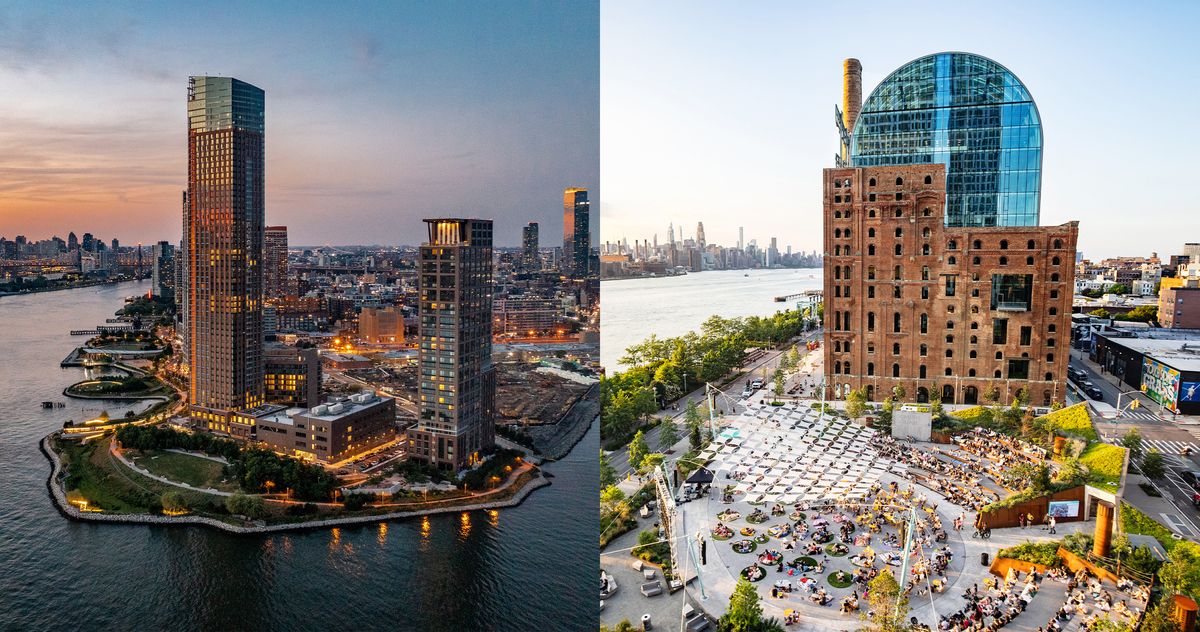
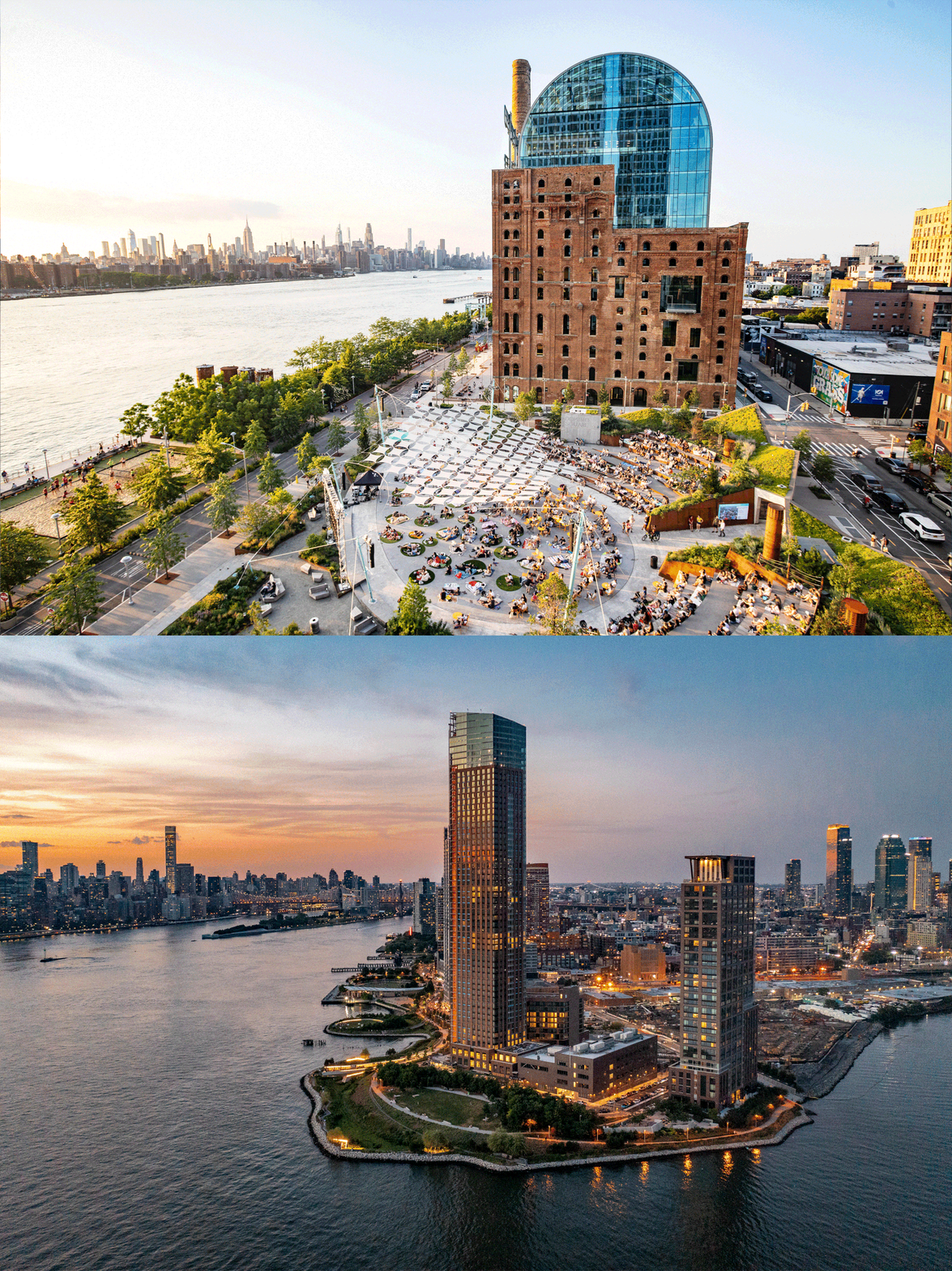
Photo: © SWA Group/David Lloyd (Hunter’s Point South); Radhika Chalasani (Domino)
A quarter-century ago, when the Twin Towers still stood, Rudolph Giuliani was still a largely rational mayor, and ’N Sync sold out the Garden, the media tycoon Michael Bloomberg climbed out of his car on a tumbledown stretch of the Williamsburg waterfront. His Upper East Side neighbor, the urban planner Amanda Burden, wanted to read him into her vision of New York’s future: a new skyline neighborhood with better views than Battery Park City or Sutton Place. Rather than gazing out at New Jersey or Queens, its residents would behold Manhattan itself from a chorus line of towers. Grimy docks would metamorphose into a stretch of inconceivably pristine shoreline, adorned with parks, shops, schools, and dog runs — maybe even a ferry to usher a new generation of Brooklynites to jobs in skyscrapers they could practically reach out and touch.
About a year after that field trip, Bloomberg became mayor and Burden his planning director. It wasn’t long before she aimed the power of her office at that waterfront and kept her gaze traveling northward to Long Island City. Her ambitions, and her boss’s support, proved transformational. A pair of sweeping rezonings — a 175-block section of Greenpoint-Williamsburg in 2005, Hunter’s Point South, the southernmost lip of Long Island City, in the middle of the second term — renegotiated New York’s relationship to the water and drew a new skyline that made the word outer before borough seem suddenly obsolete. But the two areas diverged. In Brooklyn, a single developer, Two Trees, controlled one massive multi-acre lot; in Queens, the city stayed in charge, doling out parcels to builders one by one. All these years later, we can see how these separate approaches played out. It’s almost a controlled experiment in real-estate strategies.

Two residential towers by REX are still under construction to the left of the Refinery at Domino.
Photo: Daniel Levin

Domino Park in Williamsburg has many options for leisure in a narrow strip of public space.
Photo: Daniel Levin
From a distance, Hunter’s Point South and the Domino district in Williamsburg look similar: densely clustered towers set back from a buffer zone of open space. In both places, the physical labor and industrial grime of the old working waterfront have given way to recreational exercise and public lounging. Both are a hike from the subway but offer high-grade sunsets and are laced with bike lanes. Most important, both are lumbering their way to completion, while some of their peers — notably, Atlantic Yards and Sheldon Solow’s Con Ed site along First Avenue — have stalled, fragmented, or both. But look more closely and you can see that they offer different models. Domino is a lively but pricey urban enclave as meticulously curated as a country club, while Hunter’s Point South, on the tongue of land that laps Newtown Creek, is a collection of rent-regulated apartments stacked like magazines atop a landscaped mound.
At Domino, an artful arrangement of designer condos flanks a circular plaza. The rest of the public space, a narrow strip of quasi-park, is kitted out with an assortment of leisure amenities: a cooling mister you can run through on blistering days, squares of artificial turf, wood recliners, an elevated catwalk, a gourmet taco stand with café seating, an industrial-themed playground, and various adorably preserved relics of the long-defunct sugar refinery. (One public necessity is in short supply: shade.) Strolling through the development on a summer afternoon, I feel like an extra in a promotional video, alongside giggling kids, shirtless jogger bros, dog walkers, sunbathers, and an assortment of other dedicated enjoyers. That menu of amenities is open to all, but it also lifts rents in the towers, which are now the highest in Brooklyn. The offices in the refinery building are mostly occupied now, but you’d never know anyone around here had a job. The only visible work that’s getting done is construction: The final piece of the project, a pair of residential towers at 280 Kent Avenue designed by REX, is growing quickly and noisily. It won’t be complete for a couple of years, but already it looms over the strip of esplanade, which feels a bit narrower with each passing year.

A rendering of the view from the towers designed by REX, the last of the Domino district still under construction.
Photo: Luxigon


From left: The retail floors of the Refinery at Domino, the office building in the Domino complex. Photo: Alex StaniloffThe massing of 1 South First designed by Cookfox also has a cutout, a feature built into the master plan by SHoP Architects. Photo: Daniel Levin
From top: The retail floors of the Refinery at Domino, the office building in the Domino complex. Photo: Alex StaniloffThe massing of 1 South First de…
From top: The retail floors of the Refinery at Domino, the office building in the Domino complex. Photo: Alex StaniloffThe massing of 1 South First designed by Cookfox also has a cutout, a feature built into the master plan by SHoP Architects. Photo: Daniel Levin
Domino demonstrates how convincingly a well-resourced local developer can conjure a slice of city — not just a suburban knockoff or a collection of off-the-shelf condos, but a genuine New York neighborhood — from scratch. The developer Two Trees acquired the site in 2012, toward the end of the Bloomberg era. Then the company’s CEO, Jed Walentas, pushed Bill de Blasio’s administration to approve a second rezoning to allow for more density, more useful public space, and more fluid neighborhood connections. Walentas tapped some of the city’s elite architectural boutiques, including Annabelle Selldorf, PAU, and the landscape firm James Corner Field Operations. SHoP, which hadn’t yet become the global force it is today, came up with a master plan decreeing that the individual buildings would leave vertical spaces — a doughnut hole in the firm’s own 325 Kent Avenue, gaps between the double towers of Cookfox’s 1 South First Street, One Domino Square, and 280 Kent — so that the upland neighbors could at least see through the wall to the sky. Yet those gestures don’t change the fact that the development is more tightly packed and taller than the site can comfortably accommodate. It’s crowding in on itself and even manages to hem in the East River.

At Hunter’s Point South, the landscape is expansive, designed to look wild, by Weiss Manfredi and SWA/Balsley.
Photo: Albert Vecerka
Hunter’s Point South, by contrast, flaunts its parkland, a beautifully sculpted series of faux-wild landscapes by SWA/Balsley and Weiss Manfredi, which links up to the older Gantry Plaza State Park and mutates as it moves south from flat expanses to entwined folds of marsh, path, and slope, culminating in a photogenic lookout. On the waterside, the area is spectacular, with the U.N. and the Chrysler Building etched against the sky. But turn away from the river and the area feels insular, severed from the heart of Long Island City by a great moat of rail yards. And even though thousands of residents and students fill the current crop of six towers and two schools, the neighborhood still doesn’t feel fully formed. That’s partly the result of the process. About 60 percent of the apartments have below-market rents, a rate that tends to keep budgets austere and architecture on autopilot. Two parcels remain unbuilt and, south of 51st Avenue, services are thin on the ground. Stepping Stone Coffee on Malt Drive is a lonely outpost of the retail cluster further uptown.

The park at Hunter’s Point South.
Photo: Victor J. Blue/Bloomberg/Getty Images

Photo: Shutterstock
Blocks will gradually fill in and borders will blur. Still, the differences between the two areas aren’t just a matter of timing. The two neighborhoods were born from different givens. The city owned the land at Hunter’s Point South, whereas the Domino deal was private from the get-go, so public officials had less leverage there. Hunter’s Point South was also swept up into Mayor Bloomberg’s (doomed) plan to win the 2012 Olympics; that was where an Olympic Village for 11,000 athletes would rise. When the Games bid failed, the city recast the area as a mixed-income district rich in affordable housing and fortified with streets, schools, infrastructure, and a city-built park — not a privately managed outdoor amenity but a true public landscape. Big real-estate companies like TF Cornerstone and Related, along with the prolific Gotham Organization and the nonprofits Phipps Houses and RiseBoro, won individual parcels through public competitions, which prevented any of them from shaping the whole project.
There’s some political irony in the results. Bloomberg, the technocratic tycoon and free marketeer, produced a Queens neighborhood that might make a democratic socialist proud. His leftie successor, de Blasio, opened the door to a neoliberal Brooklyn dream: one zone, one company, one powerful engine of gentrification. Predictably, Walentas’s empire is expanding. Right next to Domino, Two Trees is planning River Ring, a massive pair of towers designed by BIG, fronted by another patch of corporate parkland, complete with a boating cove and artificial wetlands by James Corner Field Operations. (Hunter’s Point South’s advance has hit the border with Brooklyn, where Greenpoint Landing, Park Tower Group’s massive 22-acre waterfront complex of buildings and landscape, is blossoming across Newtown Creek.)
New York doesn’t have to choose between these two models. Here, public interest and private money are locked in a perpetual tug-of-war, their equilibrium constantly shifting. You gauge the victor not by objective measures but by which compromises you can live with. You might prefer Domino’s top-down design, private security, and robust maintenance budget, even if it means a neighborhood character plotted out in the executive suite. For myself, I would choose the lower rents and ampler park of Hunter’s Point South, even though it means settling for more basic architecture and waiting a little longer for vitality to creep in.
