
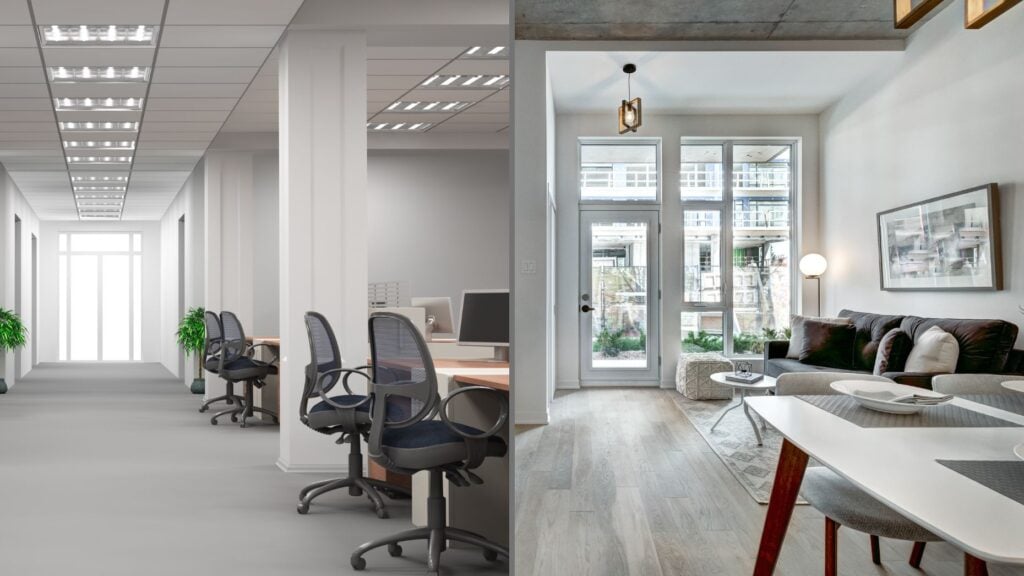

Despite the need for more affordable housing, writes multifamily expert Michael Zaransky, it’s unlikely that office conversions will solve the problem more effectively and cheaply than building new. In some cases, however, it makes sense.
Whether it’s refining your business model, mastering new technologies, or discovering strategies to capitalize on the next market surge, Inman Connect New York will prepare you to take bold steps forward. The Next Chapter is about to begin. Be part of it. Join us and thousands of real estate leaders Jan. 22-24, 2025.
The former United Artists Building in downtown Detroit is a historic, 18-story property that once housed a theater, a bank, and commercial office space. According to the U.S. Department of Housing and Urban Development, the building largely has been vacant since 1983. But an $80.8 million public-private redevelopment has transformed the location.
TAKE THE INMAN INTEL INDEX SURVEY FOR NOVEMBER
The Residences @150 Bagley, scheduled to begin leasing in late 2024, features 148 apartments, 30 of which will be listed as “affordable units” for households earning up to 80 percent of the city’s median family income. They also could represent a model for the future of vacant urban buildings.
“Commercial conversions are by no means a panacea for our housing supply, affordability or emissions-related challenges,” HUD noted in a 2023 guidebook to adaptive reuse of commercial space, “but if only a small percentage of underutilized commercial buildings were converted to housing, it could create thousands of units of much-needed housing while also reducing the carbon footprint of existing buildings.”
It sounds so common sense and simple. The United States has too few houses and too much vacant office space (a record 20.1 percent, according to Moody’s). So why not fix two problems at once?
The idea is earnest and well-meaning but paints broadly over the complicated, impractical and expensive realities of adaptive reuse, which became one of the most popular stories in real estate following the global pandemic. “Can we turn all those empty office buildings into housing?” asks CNN. “Can turning office towers into apartments save downtowns?” wonders The New Yorker.
Let’s take a real-world look at the issue.
The pros and cons of adaptive reuse
CBRE reports that 169 office-to-housing conversions, either in progress or planned, could add 31,000 apartments to the U.S. supply over the next few years, which certainly is useful. But as CBRE also notes, “This additional supply represents less than a half-percent of total U.S. apartment inventory and will do little to alleviate the broader U.S. housing shortage.”
That’s the practical reality of adaptive reuse. As a targeted measure in urban areas with a surfeit of vacant space, it’s a positive. As a long-term strategy for substantially addressing housing demand, it’s a bandage. As for the pros and cons, here’s a sampling:
The pros of adaptive reuse
- It increases access to affordable housing: Cities big and small ache for housing that touches more income classes. Office conversions can bring more affordable units into downtown areas.
- It deploys public power for housing: In some cases, repurposing a building costs less than demolishing it and starting new. That’s true particularly when local, state, and federal grants are available for such projects. Local governments also can expedite the regulatory and zoning processes if it means adding to their housing inventory.
- It revives urban areas: Adaptive reuse that brings people into new downtown apartments could also bring more jobs, commerce, and culture to those areas.
- It promotes sustainability: Office conversions require fewer new materials than new construction and don’t add to overall energy usage, according to one study.
The cons of adaptive reuse
- It’s prohibitively expensive: Conversion costs can range from $250 to $600 per square foot, according to CBRE. Without a public-funding component, developers might be more willing to raze sites and start new.
- It’s often impractical: Office buildings weren’t designed for living. Their access to light, heat, air conditioning, water and waste removal turns conversion into a 3D jigsaw puzzle to solve. Zoning from commercial to residential complicates and delays the process.
- It misses the key point of real estate: Do urban-core conversions — in places that lack schools, shopping, eating and nightlife — really adhere to the idea of, “location, location, location”?
- It might be too early to panic: Are we certain that work-from-home will empty all the office space? Companies are rethinking remote work, which could revive some of these properties. As the Brookings Institution notes, downtowns don’t have too many offices. They have “too little of everything else.”
When office-to-multifamily conversion makes sense
Projects like The Residences @150 Bagley in Detroit, with an affordable-unit component that uses public funding, might be the way to go with adaptive reuse. Of the project’s estimated $80.8 development cost, $42.3 was funded through a HUD mortgage and more than $30 million through federal and state grants.
HUD provides community development block grants to help developers acquire buildings and fund projects. It offers below-market loans and access to State and Local Fiscal Recovery Funds to ease long-term costs. HUD’s 2023 guidebook lists dozens of programs across seven agencies that can assist developers with making commercial conversions.
In some cities, conversions are making an impact. CBRE reports that Cleveland has reduced its office vacancy rate to 17.3 percent by converting 3.5 million square feet of space. Cincinnati (2.8 million square feet) and San Francisco (2.1 million) are following suit.
In Seattle, 14 percent of office buildings could be converted to multifamily housing, according to Moody’s. Sixty-four buildings in New York could be repurposed as part of the city’s Office Conversion Accelerator Program. And California recently approved $400 million to attract developers to consider conversions.
Vacant buildings are assets in search of cash flow, which reduces their long-term and resale value. From that perspective, conversion makes sense. But there are many conversion ideas:
- What about leasing vacant office space to small businesses, day-care facilities, or public services?
- Could we repurpose some of this space for tech storage or even self-storage?
- What if we simply razed some office buildings and started over?
We need more housing, particularly housing that’s affordable. Still, it’s difficult to conceive that office conversions will solve this problem more effectively and cheaply than building new. Nevertheless, with the effective use of federal grants and loans, coupled with cities that lower the logistical hurdles, adaptive reuse could make an impact on the future of urban multifamily housing.
Michael H. Zaransky is the founder and managing principal of MZ Capital Partners in Northbrook, Illinois. Founded in 2005, the company deals in multifamily properties.
