
Berlin, Germany – In some countries, a snap election is held in a matter of weeks.
Germany, by contrast, will enjoy a leisurely three months before it goes to the polls in an election that is likely to be overshadowed by the return of Donald Trump to the White House, an increasingly perilous situation in Ukraine, and a flagging domestic economy.
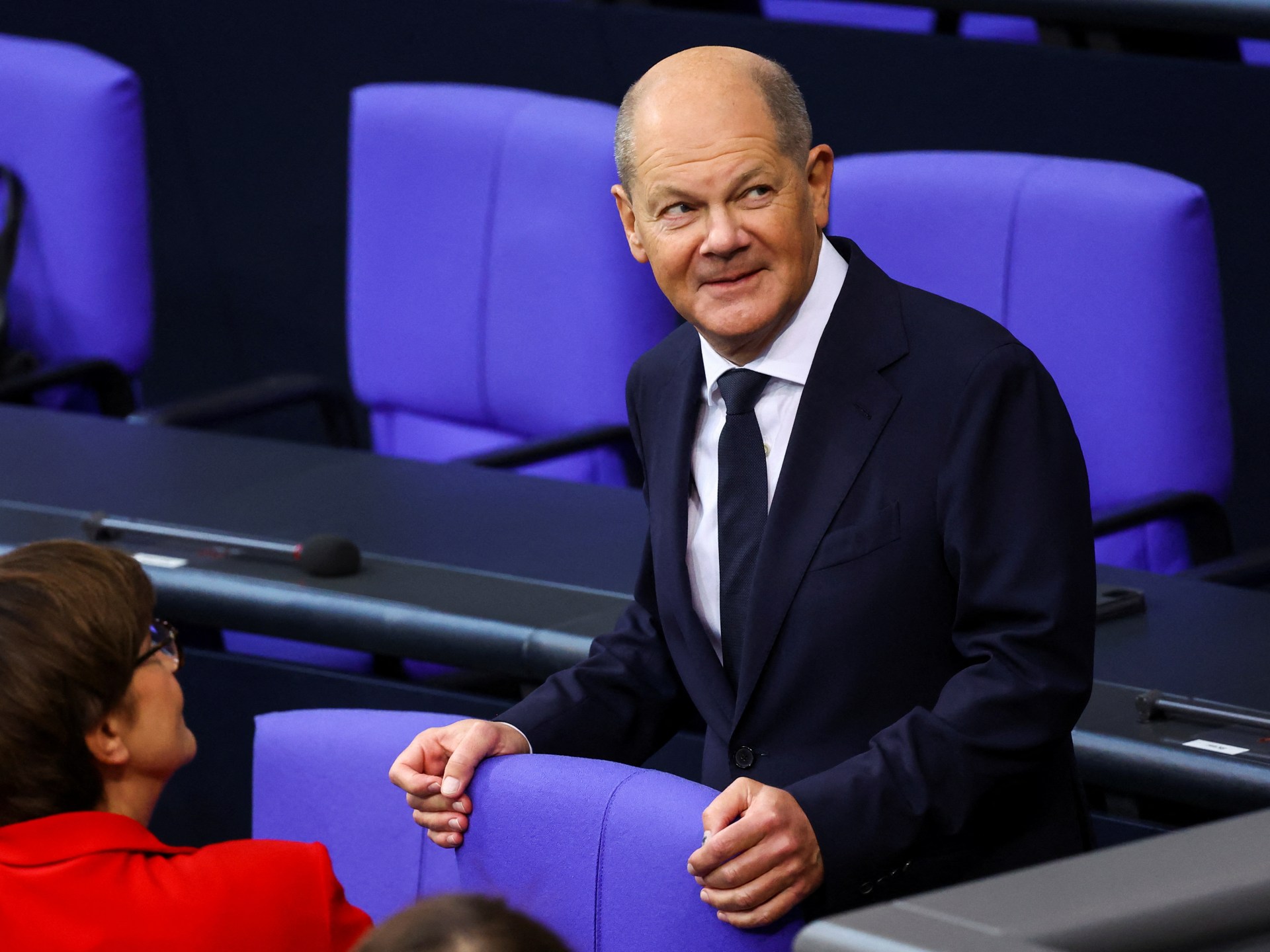
Germany’s ruling “traffic light” coalition, formed by the Social Democratic Party (SPD), Greens and Free Democrats (FDP) collapsed on November 6, after Chancellor Olaf Scholz dismissed his finance minister, FDP leader Christian Lindner.
Scholz has announced a vote of confidence will take place on December 16. The snap poll is expected to take place on February 23.
Why did the coalition collapse?
The three-way alliance formed after the 2021 elections was a rarity for Germany, and the FDP’s fiscal hawkishness always made an uneasy marriage with its centre-left partners, who campaigned in the 2021 elections on increased social and climate spending.
The final break came during preparations for the 2025 budget, with Scholz arguing to pause Germany’s “debt brake”, which tightly limits public borrowing. Lindner insisted on demanding major public spending cuts and rolling back climate targets.
Last week in the Bundestag, Scholz accused the FDP leader of pitting the government’s financial and military support for Ukraine against German pensioners.
The national weekly newspaper Die Zeit reported that the FDP had deliberately provoked Scholz to collapse the coalition and force an early election, which the party has denied.
“It was difficult to reconcile those three very different political ideas and ideologies,” said Markus Ziener, a senior fellow at the German Marshall Fund think tank, who believes infighting has weakened Germany’s position within the European Union at a time when the bloc is sorely in need of leadership.
“The hope could be that the next elections will bring much more stable conditions to form a reliable government.”
Who’s leading opinion polls now?
The Christian Democratic Union (CDU) and its Bavarian sister party are currently polling at 32 percent, according to a recent INSA poll, more than all three of the coalition parties put together.
Friedrich Merz, a former BlackRock board member who has moved the party rightward since becoming leader in 2022, is therefore well-placed to become the next chancellor.
Based on current polling, he could lead a government with the SPD – based on the latest predictions likely to secure 16 percent, as a junior partner, a return to the familiar “grand coalition” that was in place for three of Angela Merkel’s four terms, or with the Greens, which are polling at 12 percent.
Merz has promised to roll back several of the coalition’s reforms, including on climate. He wants to lower taxes, reduce social welfare spending and tighten the country’s borders.
“It is time for a fundamental course correction in migration, security, foreign and economic policy,” Merz told the Bundestag last week.
Scholz, now the least popular chancellor in post-war German history according to polls, has indicated that he will run again as the party’s candidate.
But many senior figures in the SPD want to make a clear break with his tenure, and quickly. If he is to be deposed, Defence Minister Boris Pistorius is likely to replace him.
How popular are far-right and leftist parties?
The far-right Alternative for Germany (AfD) is on course to record a historic result.
Assessments from Germany’s domestic intelligence agency that several of the party’s state branches are right-wing extremist organisations have not prevented the party from polling second, at 20 percent.
Though all other parties refuse to form a coalition with the AfD, a strong performance could increase its influence on powerful parliamentary committees.
Meanwhile, the FDP and the socialist Left party are currently below the 5 percent threshold required to enter parliament. The newly formed, left-wing Sahra Wagenknecht Alliance is at 7 percent.
What are the key foreign policy and domestic economic issues?
Trump’s campaign promise to bring a quick end to the conflict in Ukraine, and threats to pull military assistance to President Volodymr Zelenskyy’s government, come at a time when the war-torn nation is losing ground to Russia in the east and facing major attacks on its energy infrastructure ahead of winter.
If Trump follows through, Germany, Ukraine’s second-largest backer, will be expected to dig deep and massively increase its military spending.
Scholz recently spoke with Russian President Vladimir Putin for the first time in two years. He tends to tread a more careful approach and has refused to deliver long-range Taurus missiles out of fears of escalating the conflict.
By comparison, Merz has been more hawkish on weapons deliveries and indicated he would approve the transfer, in line with the policies of the United Kingdom, France and the United States.
Potentially adding further strain to the budget, Trump’s plans to slap 20 percent tariffs on all imports and 60 percent on Chinese imports would have severe consequences for the economy, as Germany remains heavily reliant on exporting manufactured goods.
Europe’s largest economy is also its slowest growing.
Though it has narrowly skirted recession, Germany’s central bank said on Tuesday that the present stagnation is likely to continue in the face of weak international demand and investment, and the prospect of new US tariffs.
“We’re basically in a squeeze here. On the one hand, we probably have to deal with direct additional customs in the United States,” said Ziener.
“On the other hand, we will probably be very much affected by high duties against Chinese products.”
How do politicians plan to fix the economy?
With no end in sight to the economic woes, more financial institutions and business representatives are calling for a reform of Germany’s debt brake to increase public investment, which has lagged for years.
Merz, long known as a fiscal disciplinarian, has recently suggested an openness to reforming it, a possible sign of a shifting consensus.
The constitutional-anchored measure limits borrowing to 0.35 percent of gross domestic product (GDP), but special investment off-budget funds worth hundreds of billions have been used to circumvent it.
Dezernat Zukunft, a research institute that advocates for reform of the debt brake, estimates that Germany requires public spending of $782bn before 2030, which it says can be achieved without constitutional amendments.
“The deeper question is whether there’s a political majority for debt finance in Germany,” said Max Krahe, director of research at Dezernat Zukunft, a research institute that campaigns for reform of the debt brake.
“To say, yes, we are willing to use debt as a financing instrument to tackle all the problems in front of us, whether it’s defence, decarbonisation, infrastructure, competitiveness, education, healthcare.”
