


 Goktay Koraltan
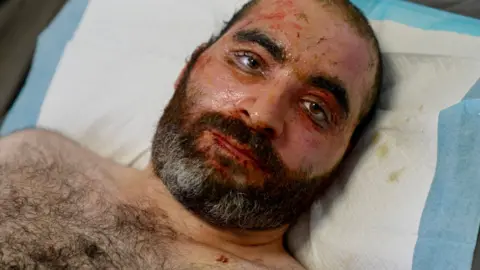
When the air strike hit, Mohammed was handing out hot food to elderly neighbours – something he and his friends had been doing since Israel’s latest invasion of Lebanon on 1 October.
The civil engineer, 29, was standing about 5m (16ft) away from the explosion, which destroyed a house in his village in southern Lebanon.
Layers of skin were scorched from his forehead and his cheeks, leaving his face raw and pink. His hands were charred. His abdomen has third-degree burns. Two weeks on he radiates pain, and trauma, but wants to tell his story.
“It was all black, smoke everywhere,” he says in a low voice. “It took about a minute. Then I started to recognise what is around me. I noticed my two friends were still alive but bleeding a lot. It took about five minutes for the people to get us out.”
Mohammed recounts the horrors from his bed in the Nabih Berri government hospital, which is perched on a hilltop in Nabatieh. It is one of the biggest cities in the south, and just 11km (seven miles) from the border with Israel, as the crow flies. Before the war it was home to about 80,000 people.
Mohammed says there was no warning before the strike – “not at all, not to us, not to our neighbours, not to the person inside the house that was hit.”
That person was a policeman, he says, who was killed in the attack.
“We are not military,” he says, “we are not terrorists. Why are we being hit? The areas that are being hit are all civilian areas.”
Mohammed will return home to his village, Arab Salim, when he is discharged, though it remains under fire. “I don’t have anywhere else to go,” he says. “If I could [leave] I would. There’s no place.”
 Goktay Koraltan
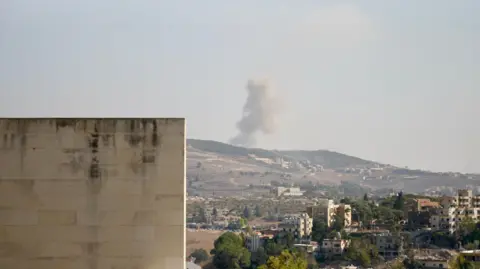
As we tour the hospital, another air strike sends staff rushing to a balcony, to check what has been hit this time. The hospital offers a panoramic view of grey smoke billowing from high ground about 4km away.
Shortly afterwards, a few floors down in the emergency room, the wail of a siren warns of casualties arriving – from that air strike. It had hit Mohammed’s village, Arab Salim.
A woman is rushed in on a stretcher, with blood streaming down her face. She is followed by her husband, who hits a wall in frustration before slumping over in shock. Doctors disappear behind closed doors to examine her.
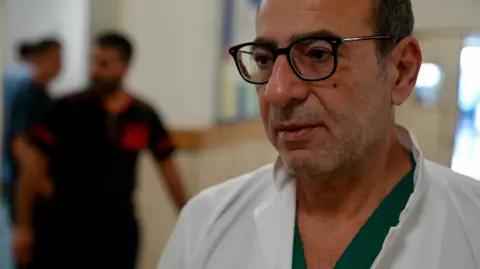
Within minutes the hospital director, Dr Hassan Wazni, tells staff she has a ruptured artery and must be moved to a specialised vascular centre in a hospital further north.
“She needs it immediately,” he says, as cries of pain come from the examining room. “Talk to Saida [a nearby town]. If it’s OK, let’s take her immediately, because she can’t wait.”
 Goktay Koraltan
The hospital receives 20-30 casualties from Israeli air strikes a day. Most are civilians, but no-one is turned away. “We take all patients, and all injured, and all martyrs who come,” he says. “We don’t discriminate between them.”
Dr Wazni has not left the hospital since the war began. Behind his desk in his office, he opens a packet of cigarillos. “I think it’s OK to break some rules in a war,” he says with an apologetic smile.
He is struggling to pay wages and come up with 1,200 litres of fuel per day to run the generators that power the hospital. “We get nothing from the government,” he says. “It doesn’t have it.”
His fuel is espresso, which he offers us repeatedly.
With 170 beds, Nabih Berri is the main public hospital in the city, but now has only a skeleton staff, and 25 patients. The sick and the wounded brought here are transferred quickly to hospitals in safer areas further North. Staff say there have been “many strikes “close to Nabih Berri. During our visit there’s broken glass inside the foyer.
Nabatieh has been under fire for more than a month.
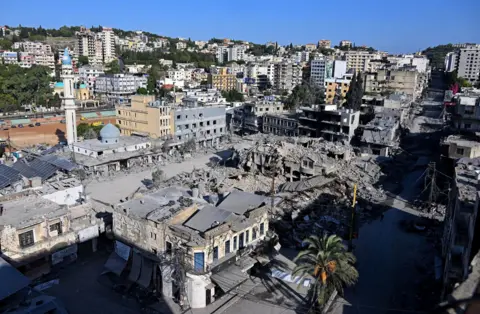
The municipality building was blown up two weeks ago, killing the mayor, Ahmad Kahil, and 16 others. At the time he was having a meeting to co-ordinate aid distribution. When we pass by the ruins, bundles of flat bread remain visible on the floor of a wrecked ambulance.
 Reuters
The massive strike brought down several neighbouring buildings – a city block is missing from the landscape.
Also missing is an Ottoman era market – the heart of Nabatieh – which was destroyed on the same day. Centuries of history were crushed into rubble, heritage turned to dust.
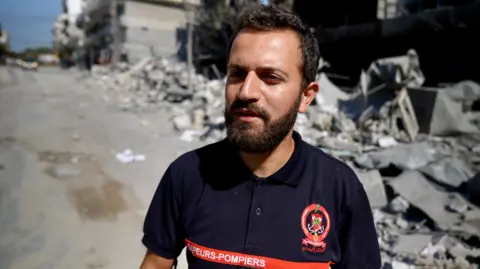
The old market, or souk, was treasured by Hussein Jaber, 30, who is part of the government’s emergency services. He and his men, some of them volunteers, take us there for a brief visit. They drive at speed – the only way to travel in Nabatieh.
“We were born and raised here,” Hussein says, gesturing around at slabs of concrete and twisted metal. “We have been here since we were children. The souk means a great deal to us. It is really sad to see it like this. It holds memories of the past and the beautiful days we spent with the people of this city.”
Like Dr Wazni, Hussein and his colleagues have remained with the people, despite the risks. More than 110 paramedics and first responders have been killed in Israeli attacks in Lebanon in the past year, according to Lebanese government figures – most of them in the past month. Some attacks involve “apparent war crimes”, according to the international campaign group, Human Rights Watch.
 Goktay Koraltan
Hussein lost a colleague and a friend this month, in an air strike 50m from their civil defence station, where they sleep with mattresses up against the windows. The dead man, Naji Fahes, was 50 years old and had two children.
“He was enthusiastic and strong and loved to help others,” Hussein tells me. “Even though he was older than us, he was the one rushing to go on missions, to be with the people and to rescue them.”
He died, as he lived.
When the air strike happened, Naji Fahes was standing outside the station, ready to go on a mission.
As Hussein speaks, we have company. An Israeli drone circles in the skies overhead, then gets lower and louder. The insistent buzzing of the drone competes with his voice. “We hear it 90% of the time,” he says. “We think it’s directly above us now. Most probably it’s watching us.”
As for Hezbollah, its presence in the city is out of sight.
The Israel Defence forces (IDF) told us it is “operating solely against the Hezbollah terrorist organisation, not against the Lebanese population.”
Israel says its fight is “against the Hezbollah terrorist organisation, embedded within civilian population and infrastructure”.
A spokesman said it “takes many measures to mitigate civilian harm including advance warnings”, though there was no warning for the air strike that wounded Mohammed, or the attack that killed the mayor.
In five and a half hours in this once bustling city we saw two people out in the open, on foot. Both rushed away, unwilling to speak. During our visit a drone was broadcasting messages from the Israeli army – instructing people to leave immediately.
It’s estimated that only a few hundred remain here unwilling or unable to move elsewhere. They are mainly the old and the poor, and they will live or die with their city.
And Hussein and his team will be here, to come to their aid. “We are like a safety net for the people,” he says. “We will stay, and we will carry on. We will be next to the civilians. Nothing will stop us.”
Additional reporting by Wietske Burema and Angie Mrad
