
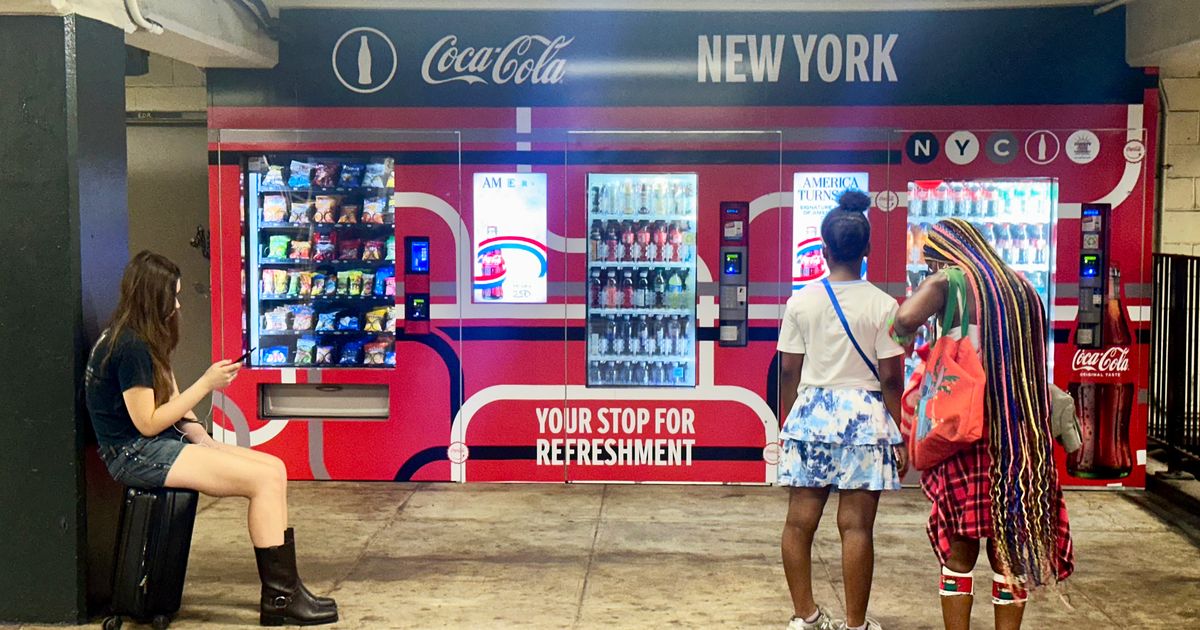

Plenty of riders stopped to gawk at the giant red vending machines installed last week on the mezzanine level of the Second Avenue F station. The machines are hard to miss — much bigger than your average treat dispenser, and lined up together, they look like a glowing storefront, with three displays of drinks and snacks. “They should have one in every station,” said Neil, a Dumbo lawyer buying a chocolate protein drink. “They’re easier and faster. In the subway, you’re in a hurry.”
Most of the subway system’s newsstands and walk-in convenience stores closed during the pandemic, and many never reopened. The new vending machines are designed to occupy these empty locations, and last week the MTA unveiled them in three stations (besides Second Avenue, they are 23rd Street–Broadway and 116th Street–Lexington Avenue). They’ll be installed in an additional 23 stations over the coming months.

The 40 snack options include beef jerky, gummy worms, and honey buns.
Photo: Anne Kadet
MTA real-estate chief David Florio said the agency would have preferred to rent the spaces to stores tended by a live person: “It adds to the security of the station.” But there just wasn’t enough business at these particular locations to support one. “If we can’t get the ideal store, there’s vending,” he said. “In fact, historically, vending was all over the system.”
Starting in the 1880s, in fact, subway platforms were crowded with thousands of vending machines dispensing tutti-frutti chewing gum, peanuts, and chocolate, says Polly Desjarlais, content and research manager at the New York Transit Museum, who recently delivered an hour-long lecture on the topic. The 1940s and 1950s saw the advent of subway soda and coffee vending machines. There was even a machine dispensing soft-serve ice cream at the Jay Street station in Brooklyn. The machines were removed in the 1970s due to maintenance difficulties and vandalism, Desjarlais said. She’s happy to see the machines return: “It brings life and commerce and energy back into the system.”

Multiple-unit vending machine, 34th Street Station, ca. 1950s, Archival Collection, New York Transit Museum
Photo: Courtesy of the New York Transit Museum

Children using Hershey’s candy dispenser, ca. 1943, GT-82, Subway Photo Essay Collection, New York Transit Museum
Photo: Courtesy of the New York Transit Museum
The new vending machines were custom-designed for the subway with heavy-duty steel bodies and big LED screens for advertising. While vending machines elsewhere now dispense everything from oysters to high-end jewelry, the subway selection thus far could not be more standard — they’re stocked with your usual assortment of chips, candy, cookies, soda, and water. Strawberry Pop-Tarts are about as crazy as it gets.
Over a two-hour stretch on a recent afternoon, roughly ten riders of the hundreds streaming by the Second Avenue station machines stopped to make a purchase. Key, a Bushwick pattern designer, was pleased they carried his favorite sweet tea, not usually found in a vending machine. East Village health-care worker Lakeia said she wished the machines carried healthier options: “It should be more in the juices, not no sodas.” Lower East Side handyman Raymond, meanwhile, was put off by the prices. Not only are they a bit of a mystery (you have to key in your selection to reveal the price), they are, in most cases, much higher than you’d see at a newsstand or bodega. A 20-ounce Coke runs $3.50, for example; a 2.17-ounce packet of Skittles costs $3.25. Raymond shook his head at the idea of paying $3.25 for a two-ounce packet of Planters peanuts. “These peanuts go for 99 cents,” he said. “I buy them all the time at the store.” Florio, the MTA real-estate chief, says his agency doesn’t get involved with pricing. “If it’s expensive, people will go to the bodega,” he says. “We let the market regulate.”

Raymond would like to see lower prices.
Photo: Anne Kadet
So who’s making those decisions? CC Vending, the local company paying the MTA $102,500 a year for the next five years (plus a 14 percent cut of the revenue after the first $1 million in sales) to operate in all 26 stations. Founder Michael Cascione Sr. says he launched the family business — which now employs 140 — when he installed his first vending machine in a Washington Heights laundromat back in 1989. It currently operates more than 5,000 vending machines in area gas stations, schools, and employee break rooms. “And now I do subways!”
He agrees the prices are higher than you’d pay at the bodega, but customers are paying for the convenience and supporting higher-wage jobs for his employees, he says. As for the missing price tags? CC Vending is doing its part to “go green” by not printing price labels, he says. “If you multiply that by thousands of machines, that’s a lot of labels we can eliminate!”
The initial product selection, meanwhile, is based on data collected by his 5,000 machines on what sells best in the NYC area. Water and “orange Doritos” are the top sellers. And while the selection could evolve over time to include anything from coffee to tech products, Cascione has his immediate sights set on introducing his favorite snack, Snickers — which also happens to be the region’s top-selling candy bar. It’s currently too hot in the stations right now to stock anything that melts. But come fall? Expect a lot more chocolate!
